Knee Manipulation (MUA) — Complete Exercise Program
Looking for a shorter starting point? The Knee Manipulation (MUA) starter guide covers the first 8 exercises on a printable sheet.
A phase-by-phase exercise program used in recovery for knee manipulation (mua). Each movement includes what it's working on and how it's typically performed. Your own surgeon's or therapist's guidance always comes first.
The first 72 hours
Days 0–3
Seated Assisted Knee Bend
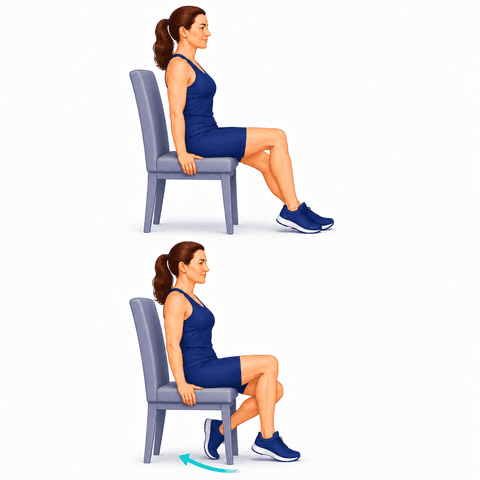
Gently improves how far the knee can bend — often the most important early flexion exercise.
What it helps: Gently improves how far the knee bends — early flexion that makes stairs, chairs, and cars far easier.
- Sit in a chair with both feet on the floor.
- Place your non-operative leg in front of the operative leg.
- Use the non-operative leg to gently help bend the operative knee further.
- Hold briefly, then relax.
Tips:
- Go only as far as is comfortable.
Commonly done as 5-10 repetitions, every 1-2 hours while awake.
Assisted Knee Extension Stretch
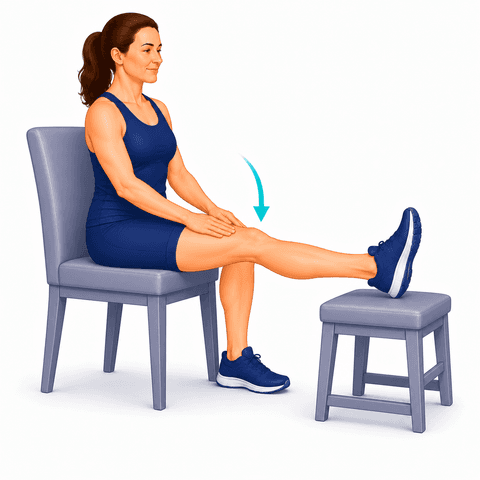
Helps the knee straighten fully.
What it helps: Gently coaxes the knee toward fully straight — important for a normal, efficient stride.
- Support your heel on a rolled towel.
- Let the knee relax downward toward straight.
Commonly done as directed.
Heel Slides
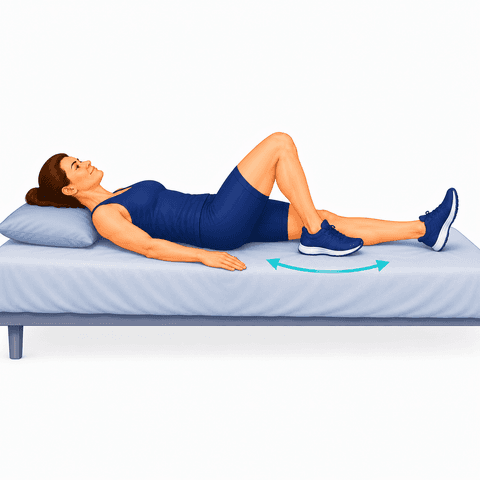
Encourages early, gentle knee motion.
What it helps: Coaxes gentle bending back into the knee — restoring the motion you need for stairs, sitting, and getting in and out of a car.
- Lie on your back with your legs straight.
- Slowly slide your heel toward you, bending the knee.
- Slide it back down.
Tips:
- Only go as far as is comfortable.
Commonly done as 2-3 sets of 10, a few times a day.
Stationary Bike
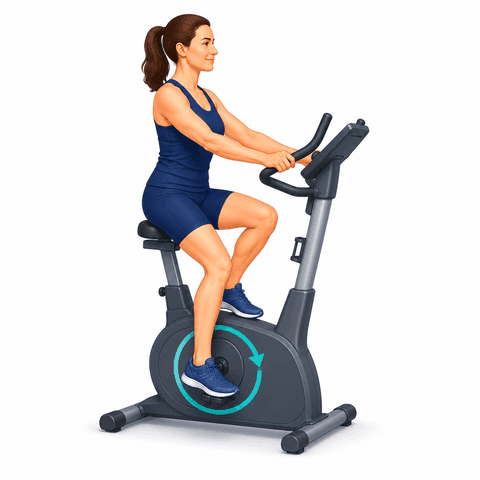
Builds motion and endurance with low impact.
What it helps: Keeps the joints moving and nourished while you build endurance — all with no pounding. One of the gentlest ways to stay active when a joint is sore.
- Set the seat so pedaling is comfortable.
- Pedal at an easy pace.
- Increase your time gradually.
Commonly done as directed.
Quad Sets
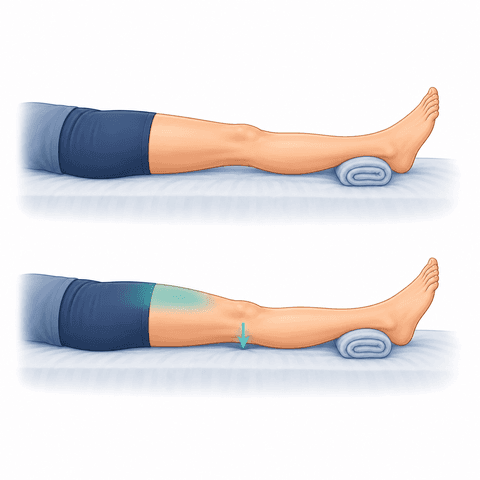
Re-activates the thigh muscle and supports knee control.
What it helps: Wakes up the quadriceps — the big thigh muscles that support and control your knee. Getting them firing is the foundation of a strong, steady leg.
- Sit or lie with your leg straight.
- Tighten the muscle on top of your thigh, pressing the back of your knee down.
- Hold briefly, then relax.
Commonly done as 2-3 sets of 10, a few times a day.
Heel Prop Quad Set
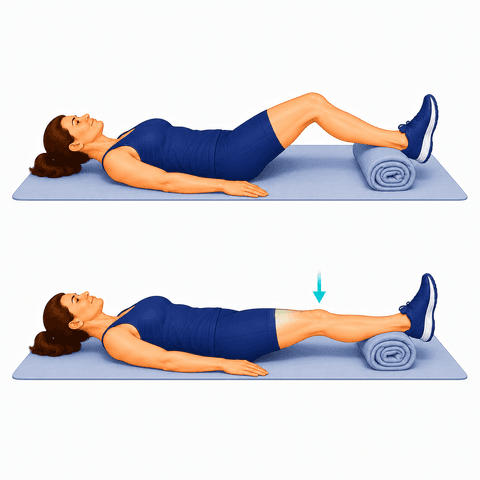
Helps the knee straighten fully — your main extension exercise.
What it helps: Helps the knee settle out fully straight. Full extension is what lets you walk smoothly and stand without strain.
- Place your heel on a stool, pillow, or rolled towel.
- Allow the knee to hang freely.
- Tighten your thigh muscles and push the back of the knee downward.
- Hold for 5-10 seconds.
Tips:
- Ice or a light weight may be added if instructed.
Commonly done as 10 repetitions, several times a day.
Straight Leg Raises
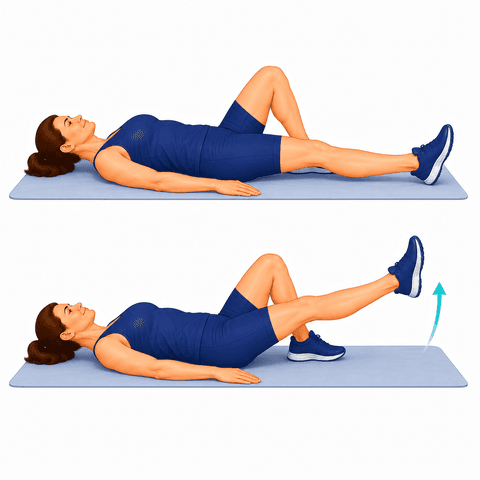
Strengthens the thigh while protecting the joint.
What it helps: Builds quad and hip strength while the knee stays straight, so the muscle works hard without stressing the joint.
- Lie down with one leg bent and the other straight.
- Tighten your thigh and lift the straight leg a few inches.
- Lower slowly.
Tips:
- Keep the knee straight as you lift.
Commonly done as 2-3 sets of 10, once or twice a day.
Ankle Pumps
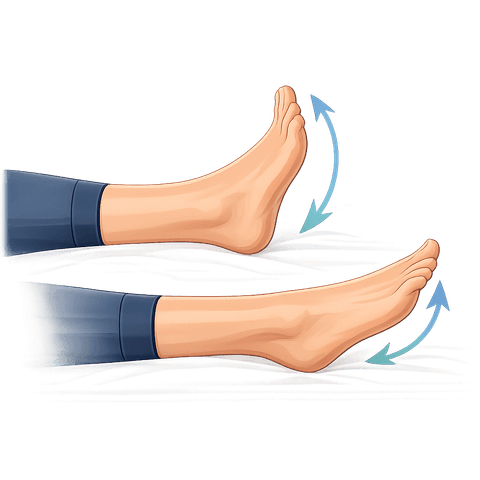
Improves circulation and helps reduce swelling.
What it helps: Keeps blood moving to reduce swelling and the risk of clots while you're less active — small, frequent, and important early on.
- Flex your foot up, pointing your toes toward the ceiling.
- Point your toes down, away from your body.
Tips:
- Move slowly and with control.
Commonly done as 20 repetitions, several times a day.
Walking Program
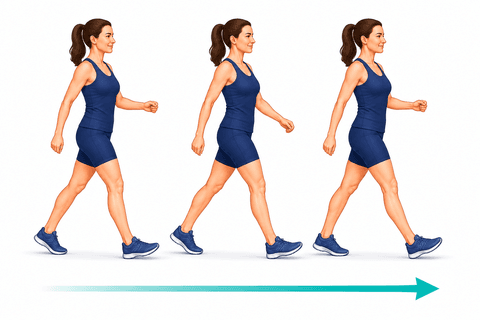
Short, frequent walks build endurance and confidence.
What it helps: Comfortable, frequent walking keeps the joints loose, builds your stamina, and rebuilds confidence on your feet. Little and often beats long and tiring.
- Take short walks at a comfortable pace.
- Increase your distance gradually as you feel able.
Tips:
- Use your assistive device as directed.
Commonly done throughout the day.
The first two weeks
Days 3–14
Seated Assisted Knee Bend
Gently improves how far the knee can bend — often the most important early flexion exercise.
What it helps: Gently improves how far the knee bends — early flexion that makes stairs, chairs, and cars far easier.
- Sit in a chair with both feet on the floor.
- Place your non-operative leg in front of the operative leg.
- Use the non-operative leg to gently help bend the operative knee further.
- Hold briefly, then relax.
Tips:
- Go only as far as is comfortable.
Commonly done as 5-10 repetitions, every 1-2 hours while awake.
Assisted Knee Extension Stretch
Helps the knee straighten fully.
What it helps: Gently coaxes the knee toward fully straight — important for a normal, efficient stride.
- Support your heel on a rolled towel.
- Let the knee relax downward toward straight.
Commonly done as directed.
Heel Slides
Encourages early, gentle knee motion.
What it helps: Coaxes gentle bending back into the knee — restoring the motion you need for stairs, sitting, and getting in and out of a car.
- Lie on your back with your legs straight.
- Slowly slide your heel toward you, bending the knee.
- Slide it back down.
Tips:
- Only go as far as is comfortable.
Commonly done as 2-3 sets of 10, a few times a day.
Stationary Bike
Builds motion and endurance with low impact.
What it helps: Keeps the joints moving and nourished while you build endurance — all with no pounding. One of the gentlest ways to stay active when a joint is sore.
- Set the seat so pedaling is comfortable.
- Pedal at an easy pace.
- Increase your time gradually.
Commonly done as directed.
Quad Sets
Re-activates the thigh muscle and supports knee control.
What it helps: Wakes up the quadriceps — the big thigh muscles that support and control your knee. Getting them firing is the foundation of a strong, steady leg.
- Sit or lie with your leg straight.
- Tighten the muscle on top of your thigh, pressing the back of your knee down.
- Hold briefly, then relax.
Commonly done as 2-3 sets of 10, a few times a day.
Terminal Knee Extensions
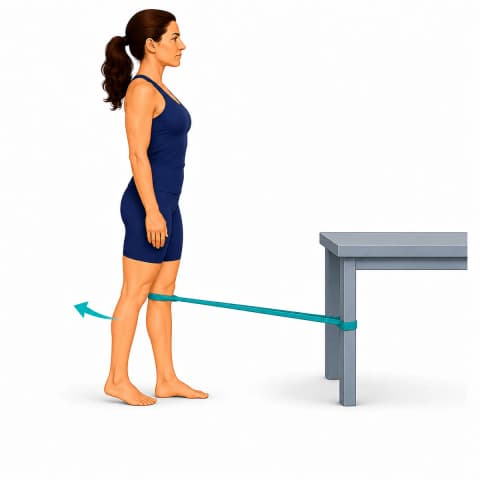
Strengthens the muscles that straighten the knee, standing against a band.
What it helps: Trains the quad to lock the knee out fully straight — the strength you rely on every time you stand and step.
- Anchor a resistance band to something solid at about ankle height — a table leg or a door anchor.
- Loop the free end around the back of your knee, then face the anchor and step back until the band is taut.
- Stand with that knee slightly bent, weight through the foot.
- Tighten your thigh and push the knee straight against the band's pull.
- Let the knee bend slowly back to the start.
Tips:
- The band pulls the knee forwards; your job is to resist it. Nothing goes around your foot.
- Hold a counter if standing on that leg feels unsteady.
Commonly done as 2-3 sets of 10-15, once or twice a day.
Heel Prop Quad Set
Helps the knee straighten fully — your main extension exercise.
What it helps: Helps the knee settle out fully straight. Full extension is what lets you walk smoothly and stand without strain.
- Place your heel on a stool, pillow, or rolled towel.
- Allow the knee to hang freely.
- Tighten your thigh muscles and push the back of the knee downward.
- Hold for 5-10 seconds.
Tips:
- Ice or a light weight may be added if instructed.
Commonly done as 10 repetitions, several times a day.
Straight Leg Raises
Strengthens the thigh while protecting the joint.
What it helps: Builds quad and hip strength while the knee stays straight, so the muscle works hard without stressing the joint.
- Lie down with one leg bent and the other straight.
- Tighten your thigh and lift the straight leg a few inches.
- Lower slowly.
Tips:
- Keep the knee straight as you lift.
Commonly done as 2-3 sets of 10, once or twice a day.
Walking Program
Short, frequent walks build endurance and confidence.
What it helps: Comfortable, frequent walking keeps the joints loose, builds your stamina, and rebuilds confidence on your feet. Little and often beats long and tiring.
- Take short walks at a comfortable pace.
- Increase your distance gradually as you feel able.
Tips:
- Use your assistive device as directed.
Commonly done throughout the day.
Holding the gains
Weeks 2–6
Seated Assisted Knee Bend
Gently improves how far the knee can bend — often the most important early flexion exercise.
What it helps: Gently improves how far the knee bends — early flexion that makes stairs, chairs, and cars far easier.
- Sit in a chair with both feet on the floor.
- Place your non-operative leg in front of the operative leg.
- Use the non-operative leg to gently help bend the operative knee further.
- Hold briefly, then relax.
Tips:
- Go only as far as is comfortable.
Commonly done as 5-10 repetitions, every 1-2 hours while awake.
Assisted Knee Extension Stretch
Helps the knee straighten fully.
What it helps: Gently coaxes the knee toward fully straight — important for a normal, efficient stride.
- Support your heel on a rolled towel.
- Let the knee relax downward toward straight.
Commonly done as directed.
Stationary Bike
Builds motion and endurance with low impact.
What it helps: Keeps the joints moving and nourished while you build endurance — all with no pounding. One of the gentlest ways to stay active when a joint is sore.
- Set the seat so pedaling is comfortable.
- Pedal at an easy pace.
- Increase your time gradually.
Commonly done as directed.
Terminal Knee Extensions
Strengthens the muscles that straighten the knee, standing against a band.
What it helps: Trains the quad to lock the knee out fully straight — the strength you rely on every time you stand and step.
- Anchor a resistance band to something solid at about ankle height — a table leg or a door anchor.
- Loop the free end around the back of your knee, then face the anchor and step back until the band is taut.
- Stand with that knee slightly bent, weight through the foot.
- Tighten your thigh and push the knee straight against the band's pull.
- Let the knee bend slowly back to the start.
Tips:
- The band pulls the knee forwards; your job is to resist it. Nothing goes around your foot.
- Hold a counter if standing on that leg feels unsteady.
Commonly done as 2-3 sets of 10-15, once or twice a day.
Standing Hamstring Curls
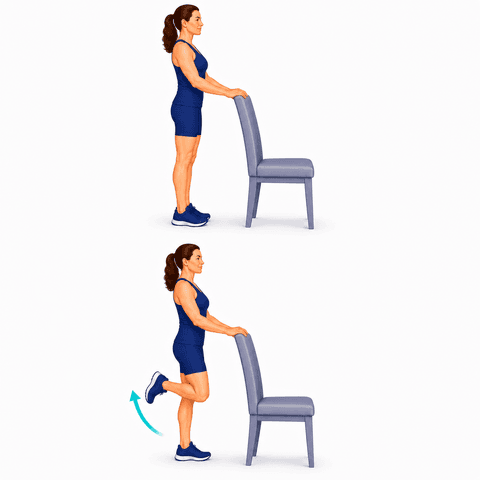
Strengthens the muscles at the back of the thigh.
What it helps: Strengthens the hamstrings at the back of the thigh that balance the quad and help steady the knee.
- Stand holding a counter.
- Bend your knee, bringing your heel toward your buttock.
- Lower slowly.
Commonly done as 2-3 sets of 10-15, once or twice a day.
Mini Squats
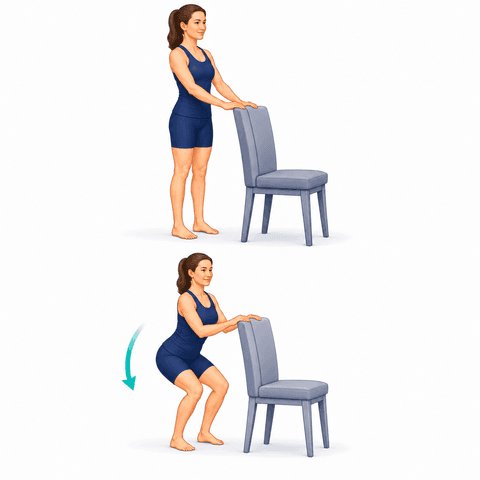
Builds leg strength through a comfortable range.
What it helps: Builds hip and leg strength through a comfortable range, so everyday moves — sitting, standing, bending — take less out of your joints.
- Stand holding a counter.
- Bend your knees a small amount, keeping them behind your toes.
- Return to standing.
Tips:
- Keep the movement small — this is not a deep squat.
- If bending under your own weight is not available yet, standing up from a higher chair asks the same muscles with less load.
Commonly done as 2-3 sets of 10, once or twice a day.
Step-Ups
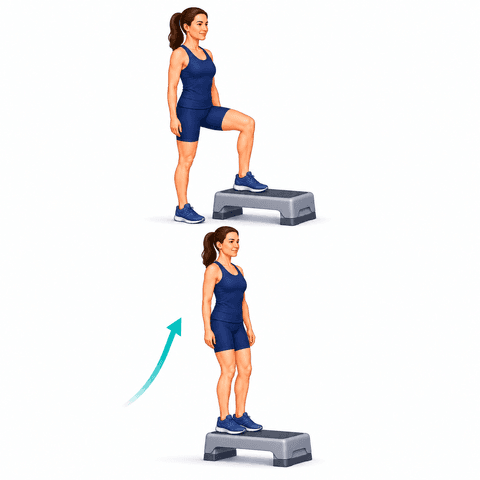
Builds strength for stairs and daily activity.
What it helps: Builds the leg and hip strength — and the control — for stairs, curbs, and everyday activity.
- Step up onto a low step with your operative leg.
- Step back down with control.
Tips:
- Hold a rail for balance.
- Going up stairs one foot at a time, holding the rail, is this exercise at this stage. If that is how you manage stairs at home, you are already doing it.
Commonly done as 2-3 sets of 10, once or twice a day.
Walking Program
Short, frequent walks build endurance and confidence.
What it helps: Comfortable, frequent walking keeps the joints loose, builds your stamina, and rebuilds confidence on your feet. Little and often beats long and tiring.
- Take short walks at a comfortable pace.
- Increase your distance gradually as you feel able.
Tips:
- Use your assistive device as directed.
Commonly done throughout the day.
Balance Exercises
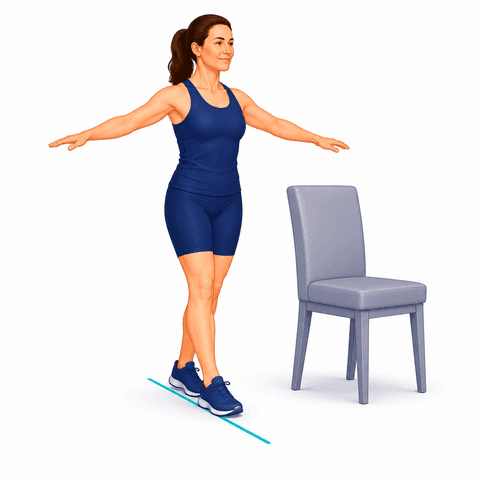
General balance work to steady your gait.
What it helps: Steadies your gait and sharpens your balance, helping you move with confidence.
- Practice standing balance near support.
- Progress as you feel steady.
Commonly done daily.
Strength & Function
Weeks 6–12
Walking Program
Short, frequent walks build endurance and confidence.
What it helps: Comfortable, frequent walking keeps the joints loose, builds your stamina, and rebuilds confidence on your feet. Little and often beats long and tiring.
- Take short walks at a comfortable pace.
- Increase your distance gradually as you feel able.
Tips:
- Use your assistive device as directed.
Commonly done throughout the day.
Stationary Bike
Builds motion and endurance with low impact.
What it helps: Keeps the joints moving and nourished while you build endurance — all with no pounding. One of the gentlest ways to stay active when a joint is sore.
- Set the seat so pedaling is comfortable.
- Pedal at an easy pace.
- Increase your time gradually.
Commonly done as directed.
Cycling
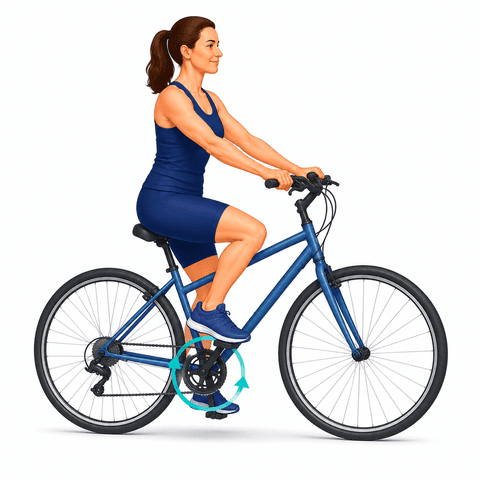
Low-impact endurance and motion.
What it helps: Low-impact endurance that keeps the joints moving smoothly while you build fitness — easy on the body, good for the long run.
- Set the saddle so your knee stays slightly bent at the bottom of the pedal stroke.
- Begin with light resistance on flat ground, pedalling smooth, full circles.
- Build the time you ride before you build the resistance or the hills.
Tips:
- Many people start on a stationary bike and move outdoors, as drawn here, once balance and confidence are back. The pedalling is the same either way.
- A saddle set too low is the usual reason a hip or knee feels cramped while riding.
- Your surgeon can say when getting onto a road bike is reasonable for you.
Commonly done as able.
Leg Press
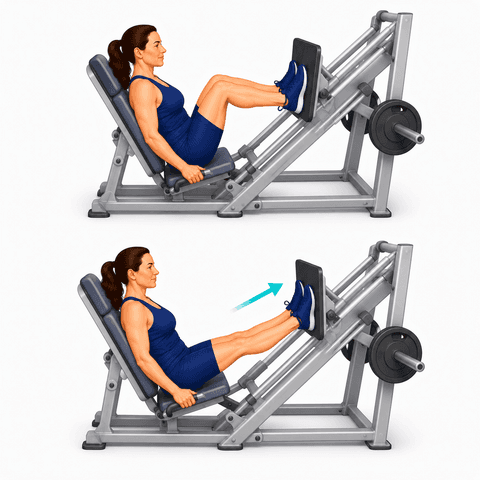
Builds leg strength with adjustable resistance.
What it helps: Builds solid leg and hip strength with resistance you can dial precisely to your comfort.
- Start with light resistance.
- Press through your whole foot.
- Return slowly.
Commonly done as 2-3 sets of 10-15, a few times a week.
Step-Ups & Step-Downs
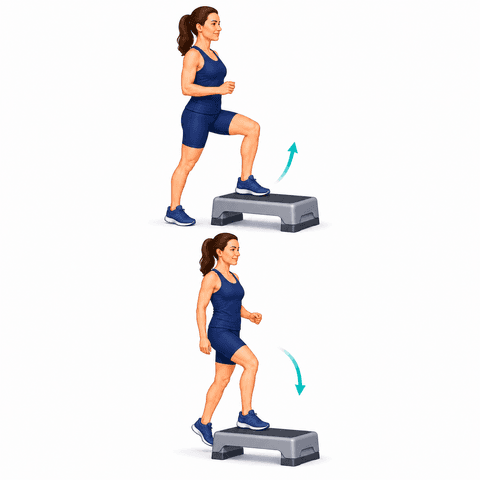
Advances stair strength and control.
What it helps: Advances your stair strength and the control to come down as confidently as you go up.
- Step up onto a step, then step down slowly.
- Control the lowering phase.
Tips:
- Hold a rail for balance.
Commonly done as 2-3 sets of 10, once or twice a day.
Stair Training
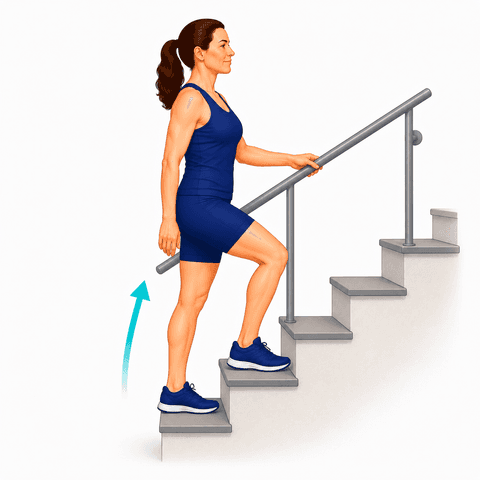
Practices safe, confident stair use.
What it helps: Practices safe, confident stair use — strength and control for one of the most demanding everyday tasks.
- Practice going up and down stairs with a rail.
- Lead as directed by your therapist.
Commonly done as directed.
Core Strengthening
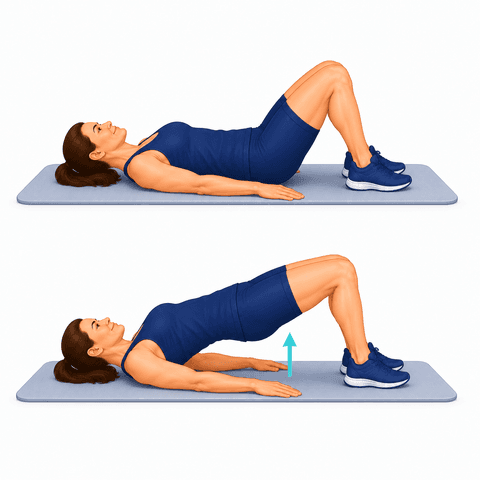
Supports posture and overall stability.
What it helps: Builds the core that holds your trunk steady, supporting your posture, your back, and everything you do on your feet.
- Lie on your back with your knees bent, feet flat and arms resting at your sides.
- Gently tighten your stomach muscles, as though bracing.
- Lift your hips until your body makes a straight line from shoulders to knees.
- Hold for a few seconds, then lower slowly.
Tips:
- Push through your heels and let your shoulders stay resting on the floor.
- Breathe normally through the hold rather than holding your breath.
- The bridge shown here is one of several ways to work the core - your therapist may give you others.
Commonly done a few times a week.
Progressive Strengthening
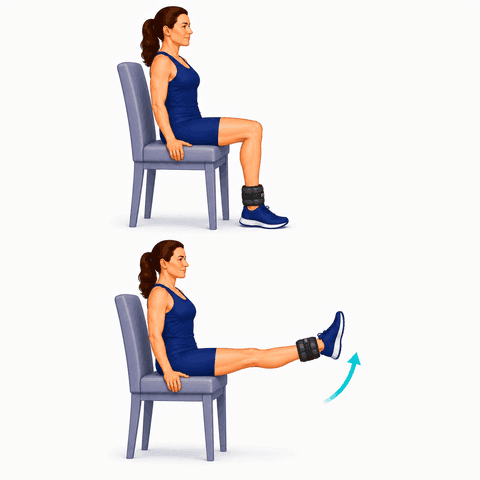
Gradually increases strength as you recover.
What it helps: Gradually raises the challenge as you get stronger, so your body keeps adapting and improving rather than plateauing.
- Begin with no added weight and get the movement smooth and comfortable first.
- When a set starts to feel easy, add a light load - the ankle cuff shown here, a dumbbell or a band.
- Sit tall, straighten the knee against the weight, hold briefly, then lower slowly.
- Step the load up in small amounts rather than in jumps.
Tips:
- Progress one thing at a time - more weight or more repetitions, not both in the same week.
- If your form slips before the set ends, the load is too heavy.
- The ankle-weight knee extension is the example drawn. The same rule of small steps applies to whichever exercises your program includes.
Commonly done as directed.
Balance Training
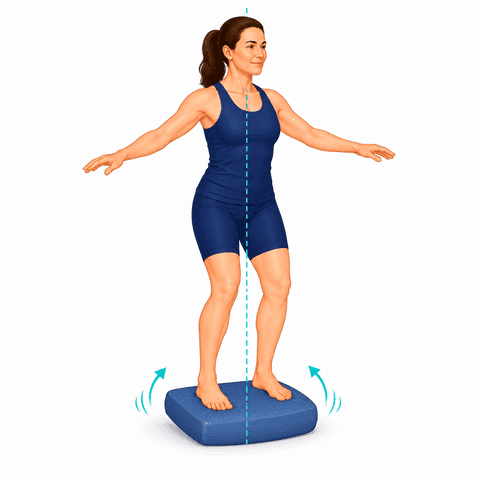
Ongoing balance work for steady movement.
What it helps: Sharpens your steadiness and reactions so you move with confidence and lower your risk of a fall — protecting the progress you've made.
- Stand with your feet hip-width apart on a soft surface such as a balance pad, with something solid within reach.
- Let your arms come out to the sides and settle over your midline - weight even, hips level.
- Hold steady for up to a minute, then step off and rest.
- As it gets easier, bring your feet closer together or close your eyes briefly.
Tips:
- A firm cushion or a folded towel works if you do not have a pad.
- Stand near a counter or a wall so there is always something to reach for.
- Some wobble is the exercise working, not a sign you are doing it wrong.
Commonly done a few times a week.
Long-Term Recovery
Months 3–6
Walking Program
Short, frequent walks build endurance and confidence.
What it helps: Comfortable, frequent walking keeps the joints loose, builds your stamina, and rebuilds confidence on your feet. Little and often beats long and tiring.
- Take short walks at a comfortable pace.
- Increase your distance gradually as you feel able.
Tips:
- Use your assistive device as directed.
Commonly done throughout the day.
Cycling
Low-impact endurance and motion.
What it helps: Low-impact endurance that keeps the joints moving smoothly while you build fitness — easy on the body, good for the long run.
- Set the saddle so your knee stays slightly bent at the bottom of the pedal stroke.
- Begin with light resistance on flat ground, pedalling smooth, full circles.
- Build the time you ride before you build the resistance or the hills.
Tips:
- Many people start on a stationary bike and move outdoors, as drawn here, once balance and confidence are back. The pedalling is the same either way.
- A saddle set too low is the usual reason a hip or knee feels cramped while riding.
- Your surgeon can say when getting onto a road bike is reasonable for you.
Commonly done as able.
Swimming
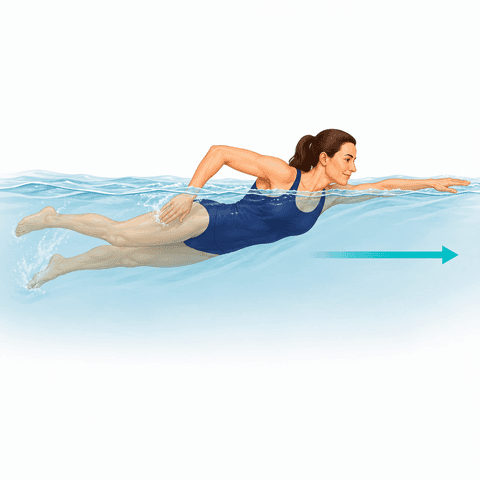
Low-impact, full-body conditioning.
What it helps: Full-body conditioning with the water carrying your weight, so your muscles work hard with almost no load on the joints.
- Wait until any wound is fully healed and you have been cleared to swim.
- Start with a few easy lengths, resting between them.
- Build the distance gradually across sessions rather than within one.
Tips:
- The picture shows front crawl. Which stroke suits you depends on which joint was operated on, and your care team can say which to begin with.
- The water carries most of your weight, so a session can feel easier than it was - judge it by how you feel the next day.
- Walking in chest-deep water is a gentler place to start than swimming lengths.
Commonly done as able.
Strength Training
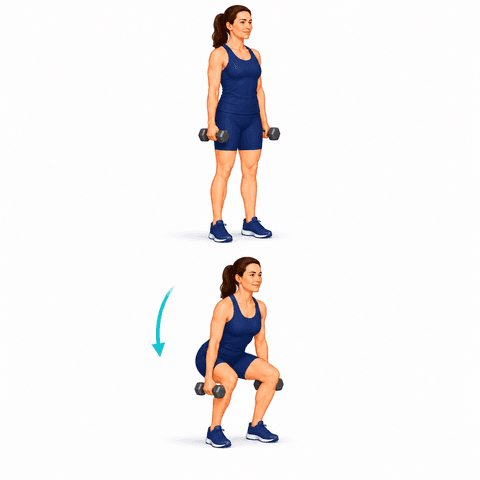
Maintains and builds long-term strength.
What it helps: Builds and maintains long-term strength to keep you active, resilient, and independent.
- Work the major muscle groups two or three times a week, leaving a day between sessions.
- Use a weight you can lift with good form for the whole set - the last repetition should feel hard, not impossible.
- Lower slowly. The controlled way down is where much of the benefit sits.
- Add a little weight only once the current one feels comfortable.
Tips:
- The dumbbell squat shown is one example. Which exercises suit you depends on the joint you are recovering from, and your program will say.
- Breathe out on the effort rather than holding your breath.
- Muscle soreness a day or two later is expected. Pain in the joint itself while you lift is a sign to lighten the weight.
Commonly done a few times a week.
Flexibility Exercises
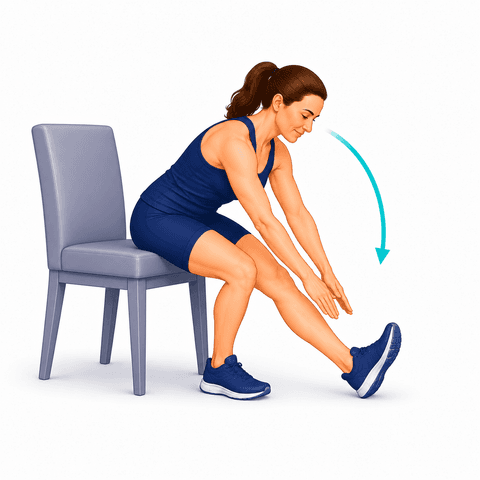
Maintains a comfortable range of motion.
What it helps: Keeps your joints and muscles moving through a comfortable range, so you stay supple and move with ease.
- Sit tall on a chair and slide one leg forward, heel on the floor and toes up.
- Hinge forward from the hips and reach gently toward that foot until you feel a stretch behind the thigh.
- Hold for around 30 seconds, breathing normally, then ease back.
- Repeat on the other side.
Tips:
- A stretch should feel like a long pull, never a pinch - and never bounce into it.
- Muscles stretch more easily when they are warm, so after a walk is a good time.
- The seated hamstring stretch drawn here is one example; your program may include stretches for other areas too.
Commonly done most days.
Balance Training
Ongoing balance work for steady movement.
What it helps: Sharpens your steadiness and reactions so you move with confidence and lower your risk of a fall — protecting the progress you've made.
- Stand with your feet hip-width apart on a soft surface such as a balance pad, with something solid within reach.
- Let your arms come out to the sides and settle over your midline - weight even, hips level.
- Hold steady for up to a minute, then step off and rest.
- As it gets easier, bring your feet closer together or close your eyes briefly.
Tips:
- A firm cushion or a folded towel works if you do not have a pad.
- Stand near a counter or a wall so there is always something to reach for.
- Some wobble is the exercise working, not a sign you are doing it wrong.
Commonly done a few times a week.
Core Strengthening
Supports posture and overall stability.
What it helps: Builds the core that holds your trunk steady, supporting your posture, your back, and everything you do on your feet.
- Lie on your back with your knees bent, feet flat and arms resting at your sides.
- Gently tighten your stomach muscles, as though bracing.
- Lift your hips until your body makes a straight line from shoulders to knees.
- Hold for a few seconds, then lower slowly.
Tips:
- Push through your heels and let your shoulders stay resting on the floor.
- Breathe normally through the hold rather than holding your breath.
- The bridge shown here is one of several ways to work the core - your therapist may give you others.
Commonly done a few times a week.
Progressive Strengthening
Gradually increases strength as you recover.
What it helps: Gradually raises the challenge as you get stronger, so your body keeps adapting and improving rather than plateauing.
- Begin with no added weight and get the movement smooth and comfortable first.
- When a set starts to feel easy, add a light load - the ankle cuff shown here, a dumbbell or a band.
- Sit tall, straighten the knee against the weight, hold briefly, then lower slowly.
- Step the load up in small amounts rather than in jumps.
Tips:
- Progress one thing at a time - more weight or more repetitions, not both in the same week.
- If your form slips before the set ends, the load is too heavy.
- The ankle-weight knee extension is the example drawn. The same rule of small steps applies to whichever exercises your program includes.
Commonly done as directed.
Low-Impact Recreational Activities
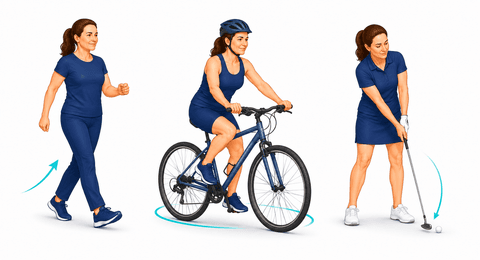
Enjoyable activities that protect your joint.
What it helps: Getting back to the activities you enjoy in ways that are kind to your joints — the whole point of building this strength.
- Choose activities that keep you moving without jarring the joint - walking, cycling and golf are three common ones.
- Start with a short session and add time before you add intensity.
- Spread them across the week rather than doing everything in one day.
- Keep the effort at a level where you could still hold a conversation.
Tips:
- The picture shows three examples, not a list to work through - the best activity is the one you will keep doing.
- A little stiffness the next day is usual; a flare that lingers means the session was too long, not that the activity was wrong.
- Your surgeon or therapist can say when each activity is a reasonable one to add.
Commonly done as you like.
What to expect in recovery
The full recovery guide for this procedure: Knee Manipulation (MUA) recovery.
Recovery reading
Browse all exercise guides · Condition guides · Recovery education library
Are you a clinician? See how orthopedic practices use JointBooklet.
These are general exercise guides, not a personal prescription. The repetitions and frequency shown are what's commonly used — your own surgeon or therapist may advise something different, and their guidance comes first.