Cycling
Low-impact endurance and motion.
What it helps
Low-impact endurance that keeps the joints moving smoothly while you build fitness — easy on the body, good for the long run.
How to do it
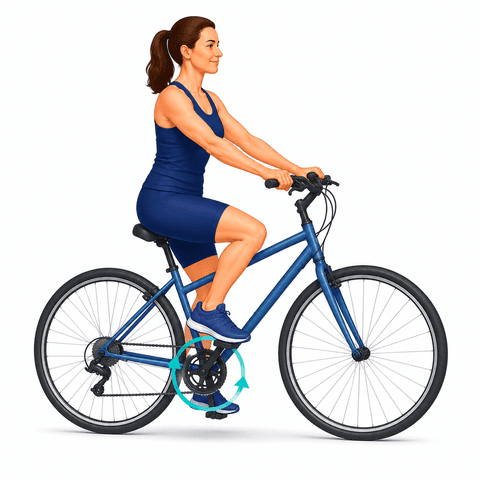
- Set the saddle so your knee stays slightly bent at the bottom of the pedal stroke.
- Begin with light resistance on flat ground, pedalling smooth, full circles.
- Build the time you ride before you build the resistance or the hills.
Tips
- Many people start on a stationary bike and move outdoors, as drawn here, once balance and confidence are back. The pedalling is the same either way.
- A saddle set too low is the usual reason a hip or knee feels cramped while riding.
- Your surgeon can say when getting onto a road bike is reasonable for you.
Commonly done as able.
Where this appears in recovery
Cycling is part of 235 recovery programs, most often at the return to activity (months 3–6), return to sport (months 9–18) and advanced recovery (months 3–6) stages, among others. Each program shows how it fits alongside the other movements:
- Clavicle Fracture ORIF exercise guide
- ACL Revision Reconstruction exercise guide
- Tarsal Tunnel Release exercise guide
- Tarsal Tunnel Release exercise guide
- Distal Fibula Fracture ORIF exercise guide
- Distal Fibula Fracture ORIF exercise guide
- Spinal Cord Stimulator Implant exercise guide
- Spinal Cord Stimulator Implant exercise guide
- Knee Arthroscopy (Diagnostic / Debridement) exercise guide
- Kyphoplasty exercise guide
- Kyphoplasty exercise guide
- Knee Arthroscopy with Partial Meniscectomy exercise guide
- …and 223 more
All exercise guides · Condition guides · Recovery education
These are general exercise guides, not a personal prescription. The repetitions and frequency shown are what's commonly used — your own surgeon or therapist may advise something different, and their guidance comes first.