JointBooklet · jointbooklet.com
ACL Revision Reconstruction Starter Exercise Guide
A short starting program — 8 exercises drawn from the full 50-exercise program. These are the movements most people begin with.
Before you begin. This is general guidance, not a personal prescription. If your surgeon or therapist has given you a different program or different limits, follow theirs.
1. Heel Prop Quad Set
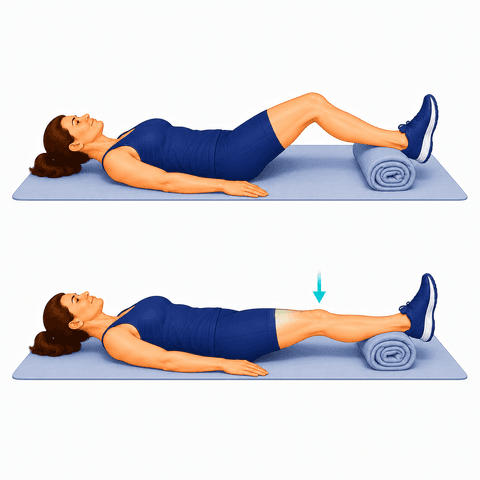
What it helps: Helps the knee settle out fully straight. Full extension is what lets you walk smoothly and stand without strain.
How often: 10 repetitions, several times a day.
- Place your heel on a stool, pillow, or rolled towel.
- Allow the knee to hang freely.
- Tighten your thigh muscles and push the back of the knee downward.
- Hold for 5-10 seconds.
Tip: Ice or a light weight may be added if instructed.
2. Prone Hangs
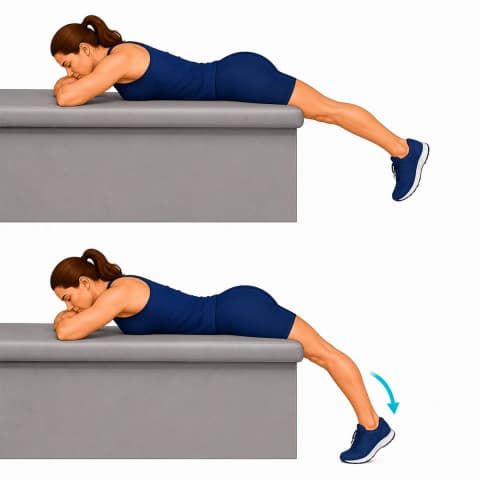
What it helps: Restores full straightening of the knee. Regaining this early matters more than regaining bend: a knee that does not fully straighten changes how you walk and is much harder to correct later.
How often: 2–3 sets of hold 5–10 minutes, daily.
- Lie face down on a bed or couch with your thigh supported and the knee and lower leg hanging off the edge.
- Let the leg hang freely and relax the thigh completely. Gravity does the work.
- Allow the knee to settle toward straight. A pulling sensation behind the knee is expected.
- Hold the position while staying relaxed, then bend the knee gently a few times before getting up.
Tip: Relaxing is the exercise. Holding the muscles tight stops the knee from settling and wastes the stretch.
3. Quad Sets
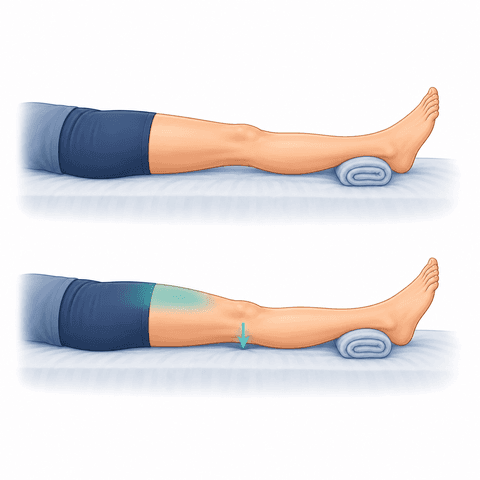
What it helps: Wakes up the quadriceps — the big thigh muscles that support and control your knee. Getting them firing is the foundation of a strong, steady leg.
How often: 2-3 sets of 10, a few times a day.
- Sit or lie with your leg straight.
- Tighten the muscle on top of your thigh, pressing the back of your knee down.
- Hold briefly, then relax.
4. Patellar Mobilization
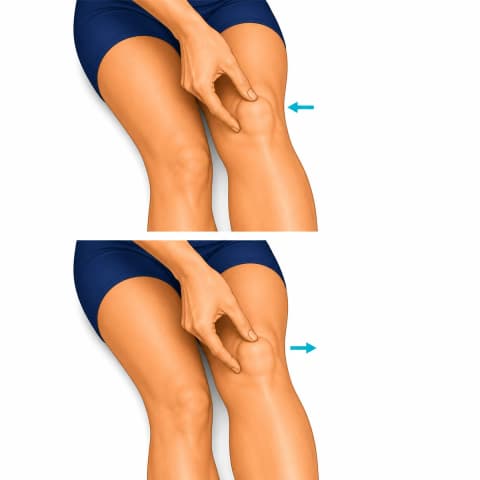
What it helps: Stops the kneecap becoming tethered by scar tissue after surgery. A kneecap that does not glide blocks both full straightening and full bending, so this quietly protects the range of motion you are working for.
How often: 2 sets of 10 in each direction, daily.
- Sit with your leg out straight and the thigh muscles completely relaxed.
- Place your thumb and fingers on the edges of your kneecap.
- Glide it gently toward the inside of the knee, hold briefly, then toward the outside.
- Then glide it gently upward toward the thigh, and downward toward the shin.
- Move slowly and only as far as it goes easily.
Tip: The thigh must be relaxed. A tightened quadriceps locks the kneecap and nothing will move.
5. Heel Slides
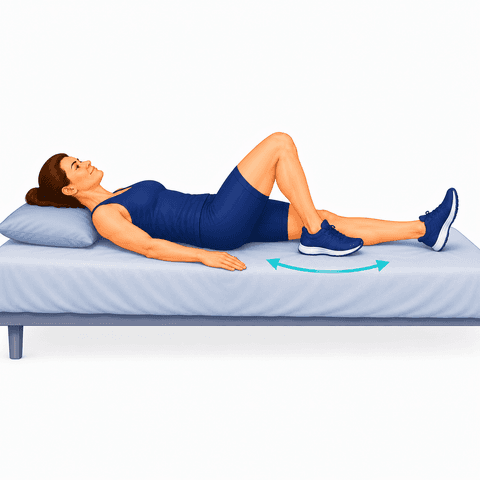
What it helps: Coaxes gentle bending back into the knee — restoring the motion you need for stairs, sitting, and getting in and out of a car.
How often: 2-3 sets of 10, a few times a day.
- Lie on your back with your legs straight.
- Slowly slide your heel toward you, bending the knee.
- Slide it back down.
Tip: Only go as far as is comfortable.
6. Walking with Crutches or Walker (Non-Weight-Bearing)
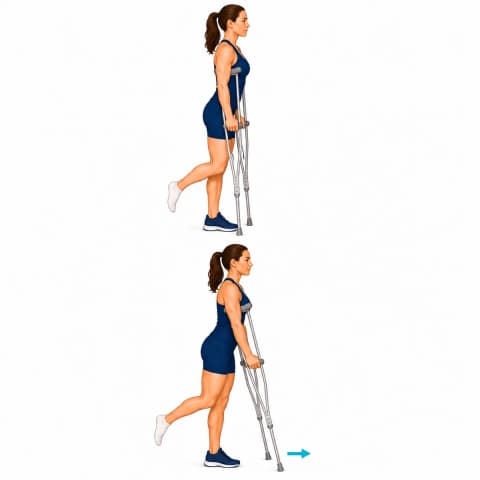
What it helps: Safe walking with crutches or a walker that keeps weight off the healing leg, protecting the bone while you stay mobile.
How often: needed.
- Keep all weight off the surgical foot, using your crutches or walker.
- Take short, level trips as needed.
- Keep the foot elevated when resting.
Tip: Follow your surgeon's weight-bearing instructions exactly in the early weeks.
7. Straight Leg Raises
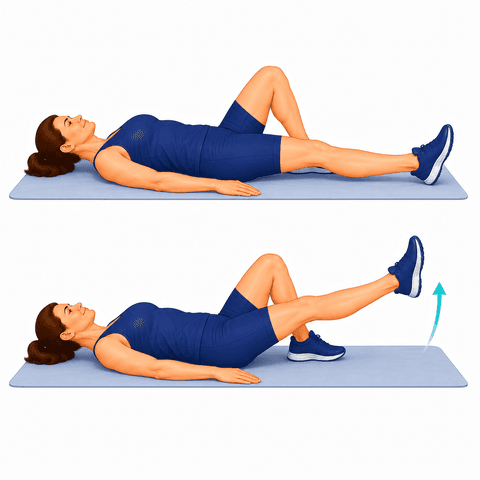
What it helps: Builds quad and hip strength while the knee stays straight, so the muscle works hard without stressing the joint.
How often: 2-3 sets of 10, once or twice a day.
- Lie down with one leg bent and the other straight.
- Tighten your thigh and lift the straight leg a few inches.
- Lower slowly.
Tip: Keep the knee straight as you lift.
8. Glute Squeezes
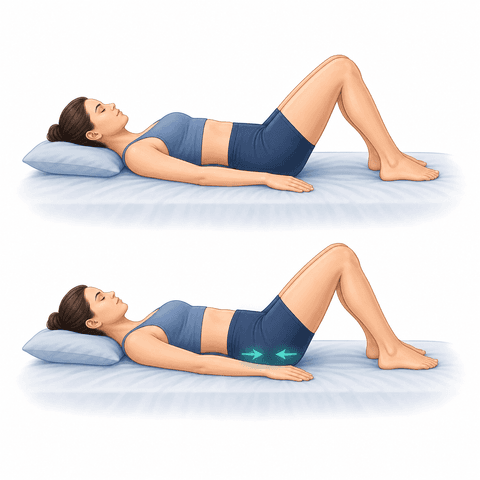
What it helps: Wakes up the glutes — the big muscles that steady and support your hip. Getting them firing again is the first step toward a hip that feels stronger and carries you with less strain on the joint.
How often: 2-3 sets of 10, a few times a day.
- Lie or sit comfortably.
- Squeeze your buttock muscles together.
- Hold a few seconds, then relax.
See the complete 50-exercise program, phase by phase.
What to expect in recovery
The full recovery guide for this procedure: ACL Revision Reconstruction recovery.
Recovery reading
Browse all exercise guides · Condition guides · Recovery education library
Are you a clinician? See how orthopedic practices use JointBooklet.
Are you a clinician? See how orthopedic practices use JointBooklet.
These are general exercise guides, not a personal prescription. The repetitions and frequency shown are what's commonly used — your own surgeon or therapist may advise something different, and their guidance comes first.