Prone Hangs
Lets gravity straighten the knee fully — the most important early goal after knee ligament surgery.
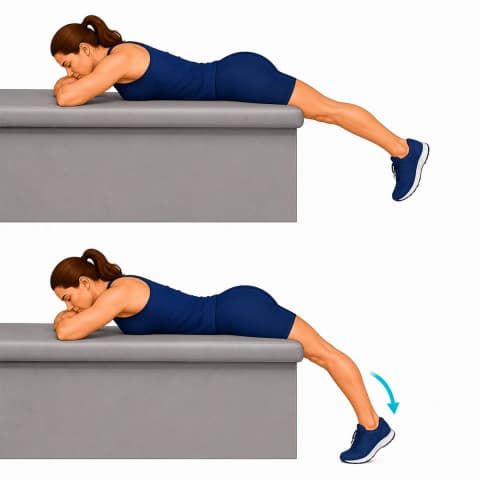
What it helps
Restores full straightening of the knee. Regaining this early matters more than regaining bend: a knee that does not fully straighten changes how you walk and is much harder to correct later.
How to do it
- Lie face down on a bed or couch with your thigh supported and the knee and lower leg hanging off the edge.
- Let the leg hang freely and relax the thigh completely. Gravity does the work.
- Allow the knee to settle toward straight. A pulling sensation behind the knee is expected.
- Hold the position while staying relaxed, then bend the knee gently a few times before getting up.
Tips
- Relaxing is the exercise. Holding the muscles tight stops the knee from settling and wastes the stretch.
- A small ankle weight can be added once this feels comfortable, if your therapist suggests it.
- This is meant to be a slow, low-effort stretch held for time — not something to push or bounce into.
Commonly done as 2–3 sets of hold 5–10 minutes, daily.
Where this appears in recovery
Prone Hangs is part of 13 recovery programs, most often at the immediate recovery (weeks 0–2), motion & gait (weeks 2–8) and protected healing (weeks 0–2) stages, among others. Each program shows how it fits alongside the other movements:
- ACL Revision Reconstruction exercise guide
- ACL Revision Reconstruction exercise guide
- PCL Reconstruction exercise guide
- PCL Reconstruction exercise guide
- Microfracture (Knee Cartilage) exercise guide
- ACL Reconstruction exercise guide
- ACL Reconstruction exercise guide
- MACI Cartilage Implantation exercise guide
- Osteochondral Autograft (OATS) exercise guide
- Meniscal Repair exercise guide
- MCL Reconstruction exercise guide
- Meniscal Allograft Transplantation exercise guide
- …and 1 more
All exercise guides · Condition guides · Recovery education
These are general exercise guides, not a personal prescription. The repetitions and frequency shown are what's commonly used — your own surgeon or therapist may advise something different, and their guidance comes first.