Swimming
Low-impact, full-body conditioning.
What it helps
Full-body conditioning with the water carrying your weight, so your muscles work hard with almost no load on the joints.
How to do it
- Wait until any wound is fully healed and you have been cleared to swim.
- Start with a few easy lengths, resting between them.
- Build the distance gradually across sessions rather than within one.
Tips
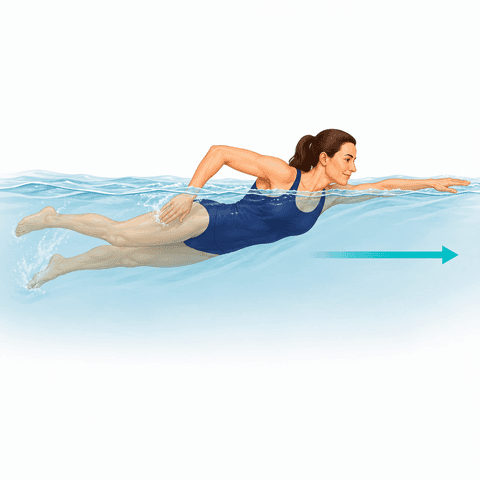
- The picture shows front crawl. Which stroke suits you depends on which joint was operated on, and your care team can say which to begin with.
- The water carries most of your weight, so a session can feel easier than it was - judge it by how you feel the next day.
- Walking in chest-deep water is a gentler place to start than swimming lengths.
Commonly done as able.
Where this appears in recovery
Swimming is part of 215 recovery programs, most often at the return to activity (months 3–6), long-term recovery (months 6–12) and return to contact sport (months 9–15) stages, among others. Each program shows how it fits alongside the other movements:
- Clavicle Fracture ORIF exercise guide
- Clavicle Fracture ORIF exercise guide
- Latarjet Procedure exercise guide
- ACL Revision Reconstruction exercise guide
- Tarsal Tunnel Release exercise guide
- Tarsal Tunnel Release exercise guide
- Distal Fibula Fracture ORIF exercise guide
- Distal Fibula Fracture ORIF exercise guide
- Spinal Cord Stimulator Implant exercise guide
- Spinal Cord Stimulator Implant exercise guide
- Knee Arthroscopy (Diagnostic / Debridement) exercise guide
- Kyphoplasty exercise guide
- …and 203 more
All exercise guides · Condition guides · Recovery education
These are general exercise guides, not a personal prescription. The repetitions and frequency shown are what's commonly used — your own surgeon or therapist may advise something different, and their guidance comes first.