Progressive Strengthening
Gradually increases strength as you recover.
What it helps
Gradually raises the challenge as you get stronger, so your body keeps adapting and improving rather than plateauing.
How to do it
- Begin with no added weight and get the movement smooth and comfortable first.
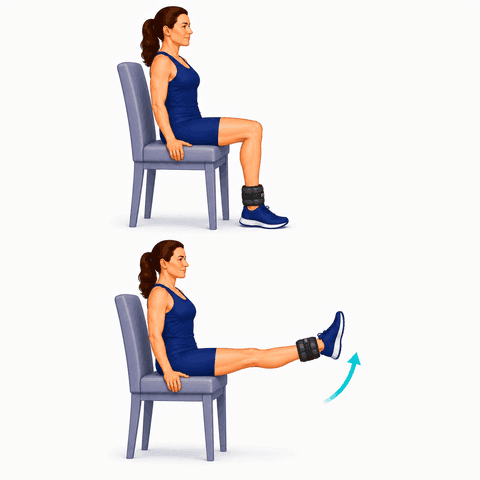
- When a set starts to feel easy, add a light load - the ankle cuff shown here, a dumbbell or a band.
- Sit tall, straighten the knee against the weight, hold briefly, then lower slowly.
- Step the load up in small amounts rather than in jumps.
Tips
- Progress one thing at a time - more weight or more repetitions, not both in the same week.
- If your form slips before the set ends, the load is too heavy.
- The ankle-weight knee extension is the example drawn. The same rule of small steps applies to whichever exercises your program includes.
Commonly done as directed.
Where this appears in recovery
Progressive Strengthening is part of 126 recovery programs, most often at the return to activity (months 3–6), advanced strengthening (months 6–9) and return to running (months 5–9) stages, among others. Each program shows how it fits alongside the other movements:
- Clavicle Fracture ORIF exercise guide
- Latarjet Procedure exercise guide
- ACL Revision Reconstruction exercise guide
- Kyphoplasty exercise guide
- Knee Arthroscopy with Partial Meniscectomy exercise guide
- Soft Tissue Mass Excision (Deep) exercise guide
- PCL Reconstruction exercise guide
- Distal Radius Fracture ORIF exercise guide
- Distal Clavicle Excision exercise guide
- Superior Capsular Reconstruction exercise guide
- Arthroscopic Rotator Cuff Repair exercise guide
- Bone Graft Harvest (Iliac Crest) exercise guide
- …and 114 more
All exercise guides · Condition guides · Recovery education
These are general exercise guides, not a personal prescription. The repetitions and frequency shown are what's commonly used — your own surgeon or therapist may advise something different, and their guidance comes first.