Core Strengthening
Supports posture and overall stability.
What it helps
Builds the core that holds your trunk steady, supporting your posture, your back, and everything you do on your feet.
How to do it
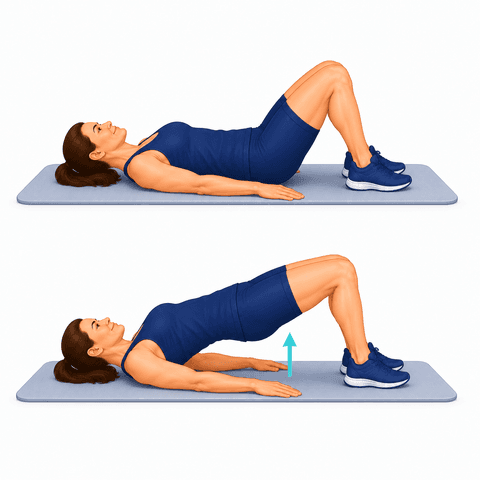
- Lie on your back with your knees bent, feet flat and arms resting at your sides.
- Gently tighten your stomach muscles, as though bracing.
- Lift your hips until your body makes a straight line from shoulders to knees.
- Hold for a few seconds, then lower slowly.
Tips
- Push through your heels and let your shoulders stay resting on the floor.
- Breathe normally through the hold rather than holding your breath.
- The bridge shown here is one of several ways to work the core - your therapist may give you others.
Commonly done a few times a week.
Where this appears in recovery
Core Strengthening is part of 173 recovery programs, most often at the strength building (weeks 6–12), strength building (months 3–6) and return to running (months 5–9) stages, among others. Each program shows how it fits alongside the other movements:
- Clavicle Fracture ORIF exercise guide
- Latarjet Procedure exercise guide
- ACL Revision Reconstruction exercise guide
- Tarsal Tunnel Release exercise guide
- Distal Fibula Fracture ORIF exercise guide
- Spinal Cord Stimulator Implant exercise guide
- Spinal Cord Stimulator Implant exercise guide
- Knee Arthroscopy (Diagnostic / Debridement) exercise guide
- Kyphoplasty exercise guide
- Kyphoplasty exercise guide
- Knee Arthroscopy with Partial Meniscectomy exercise guide
- Knee Arthroscopy with Partial Meniscectomy exercise guide
- …and 161 more
All exercise guides · Condition guides · Recovery education
These are general exercise guides, not a personal prescription. The repetitions and frequency shown are what's commonly used — your own surgeon or therapist may advise something different, and their guidance comes first.