Flexibility Exercises
Maintains a comfortable range of motion.
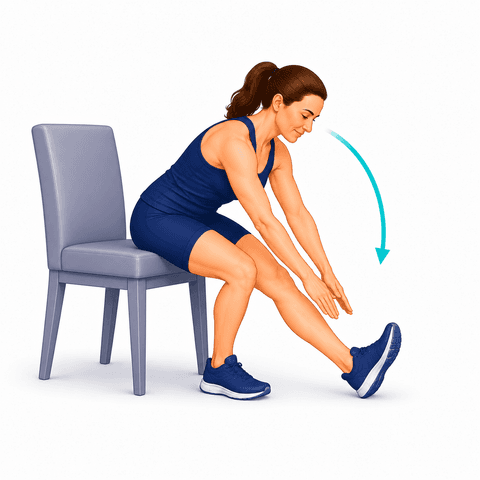
What it helps
Keeps your joints and muscles moving through a comfortable range, so you stay supple and move with ease.
How to do it
- Sit tall on a chair and slide one leg forward, heel on the floor and toes up.
- Hinge forward from the hips and reach gently toward that foot until you feel a stretch behind the thigh.
- Hold for around 30 seconds, breathing normally, then ease back.
- Repeat on the other side.
Tips
- A stretch should feel like a long pull, never a pinch - and never bounce into it.
- Muscles stretch more easily when they are warm, so after a walk is a good time.
- The seated hamstring stretch drawn here is one example; your program may include stretches for other areas too.
Commonly done most days.
Where this appears in recovery
Flexibility Exercises is part of 128 recovery programs, most often at the long-term recovery (months 6–12), return to contact sport (months 9–15) and long-term knee health (months 3–12) stages, among others. Each program shows how it fits alongside the other movements:
- Clavicle Fracture ORIF exercise guide
- Latarjet Procedure exercise guide
- Tarsal Tunnel Release exercise guide
- Distal Fibula Fracture ORIF exercise guide
- Spinal Cord Stimulator Implant exercise guide
- Knee Arthroscopy (Diagnostic / Debridement) exercise guide
- Kyphoplasty exercise guide
- Achilles Tendon Lengthening exercise guide
- Lapidus Bunionectomy exercise guide
- Soft Tissue Mass Excision (Deep) exercise guide
- Distal Radius Fracture ORIF exercise guide
- Cervical Laminoplasty exercise guide
- …and 116 more
All exercise guides · Condition guides · Recovery education
These are general exercise guides, not a personal prescription. The repetitions and frequency shown are what's commonly used — your own surgeon or therapist may advise something different, and their guidance comes first.