Strength Training
Maintains and builds long-term strength.
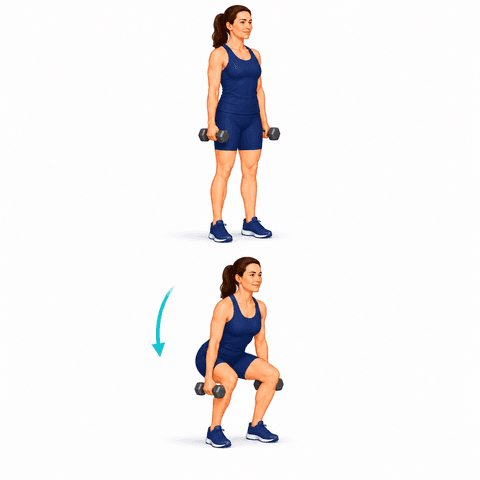
What it helps
Builds and maintains long-term strength to keep you active, resilient, and independent.
How to do it
- Work the major muscle groups two or three times a week, leaving a day between sessions.
- Use a weight you can lift with good form for the whole set - the last repetition should feel hard, not impossible.
- Lower slowly. The controlled way down is where much of the benefit sits.
- Add a little weight only once the current one feels comfortable.
Tips
- The dumbbell squat shown is one example. Which exercises suit you depends on the joint you are recovering from, and your program will say.
- Breathe out on the effort rather than holding your breath.
- Muscle soreness a day or two later is expected. Pain in the joint itself while you lift is a sign to lighten the weight.
Commonly done a few times a week.
Where this appears in recovery
Strength Training is part of 125 recovery programs, most often at the long-term recovery (months 6–12), return to contact sport (months 9–15) and return to sport (months 9–18) stages, among others. Each program shows how it fits alongside the other movements:
- Clavicle Fracture ORIF exercise guide
- Latarjet Procedure exercise guide
- ACL Revision Reconstruction exercise guide
- Tarsal Tunnel Release exercise guide
- Distal Fibula Fracture ORIF exercise guide
- Spinal Cord Stimulator Implant exercise guide
- Knee Arthroscopy (Diagnostic / Debridement) exercise guide
- Knee Arthroscopy with Partial Meniscectomy exercise guide
- Achilles Tendon Lengthening exercise guide
- Lapidus Bunionectomy exercise guide
- Soft Tissue Mass Excision (Deep) exercise guide
- PCL Reconstruction exercise guide
- …and 113 more
All exercise guides · Condition guides · Recovery education
These are general exercise guides, not a personal prescription. The repetitions and frequency shown are what's commonly used — your own surgeon or therapist may advise something different, and their guidance comes first.