Balance Training
Ongoing balance work for steady movement.
What it helps
Sharpens your steadiness and reactions so you move with confidence and lower your risk of a fall — protecting the progress you've made.
How to do it
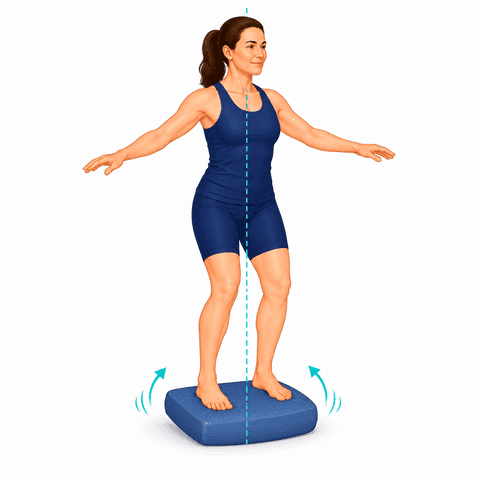
- Stand with your feet hip-width apart on a soft surface such as a balance pad, with something solid within reach.
- Let your arms come out to the sides and settle over your midline - weight even, hips level.
- Hold steady for up to a minute, then step off and rest.
- As it gets easier, bring your feet closer together or close your eyes briefly.
Tips
- A firm cushion or a folded towel works if you do not have a pad.
- Stand near a counter or a wall so there is always something to reach for.
- Some wobble is the exercise working, not a sign you are doing it wrong.
Commonly done a few times a week.
Where this appears in recovery
Balance Training is part of 145 recovery programs, most often at the strength & function (weeks 6–12), immediate recovery (weeks 0–2) and early recovery (weeks 2–6) stages, among others. Each program shows how it fits alongside the other movements:
- Tarsal Tunnel Release exercise guide
- Distal Fibula Fracture ORIF exercise guide
- Spinal Cord Stimulator Implant exercise guide
- Spinal Cord Stimulator Implant exercise guide
- Spinal Cord Stimulator Implant exercise guide
- Spinal Cord Stimulator Implant exercise guide
- Spinal Cord Stimulator Implant exercise guide
- Kyphoplasty exercise guide
- Kyphoplasty exercise guide
- Kyphoplasty exercise guide
- Kyphoplasty exercise guide
- Kyphoplasty exercise guide
- …and 133 more
All exercise guides · Condition guides · Recovery education
These are general exercise guides, not a personal prescription. The repetitions and frequency shown are what's commonly used — your own surgeon or therapist may advise something different, and their guidance comes first.