Tennis Elbow Release (Lateral Epicondyle) — Complete Exercise Program
Looking for a shorter starting point? The Tennis Elbow Release (Lateral Epicondyle) starter guide covers the first 8 exercises on a printable sheet.
A phase-by-phase exercise program used in recovery for tennis elbow release (lateral epicondyle). Each movement includes what it's working on and how it's typically performed. Your own surgeon's or therapist's guidance always comes first.
Wound & Gentle Motion
Weeks 0–2
Hand & Wrist Elevation and Swelling Control
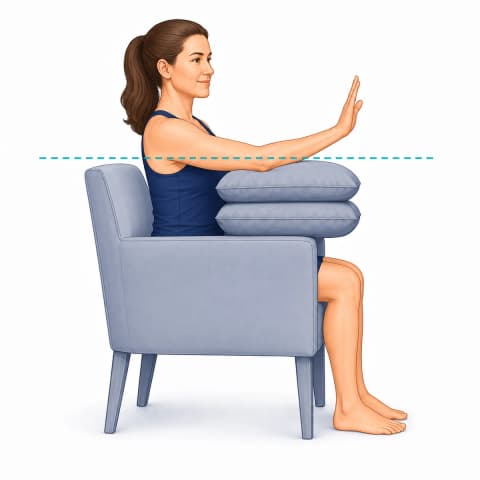
Keeping the hand above heart level and pumping the fingers — the most important thing you do in the first fortnight.
What it helps: Controls the swelling that is the main cause of stiffness after hand and wrist surgery. A swollen hand cannot make a full fist, and fingers left stiff in the first weeks are much harder to free later than the wrist itself is.
- Rest the hand higher than your heart. Sitting, prop the whole forearm on a stack of cushions so the hand sits above chest level.
- Standing, rest it on the opposite shoulder; lying down, support the whole forearm on pillows.
- With the hand up, slowly make a loose fist and open it fully, spreading the fingers.
- Repeat the slow fist-and-open several times, then let the hand rest in the raised position.
- Come back to it regularly through the day rather than doing one long session.
Tips:
- Above the heart is the part that matters. A hand resting on your lap or in a sling at waist height is not elevated, and this is the commonest reason swelling does not settle.
- The fist-and-open is a pump: muscles squeezing push fluid back up the arm. Elevation alone works, but elevation with movement works far better.
- A hand that is puffy and stiff first thing in the morning usually means it spent the night down; support it on pillows in bed.
Commonly done as every hour while awake sets of 10 slow fists, daily.
Elbow Range of Motion
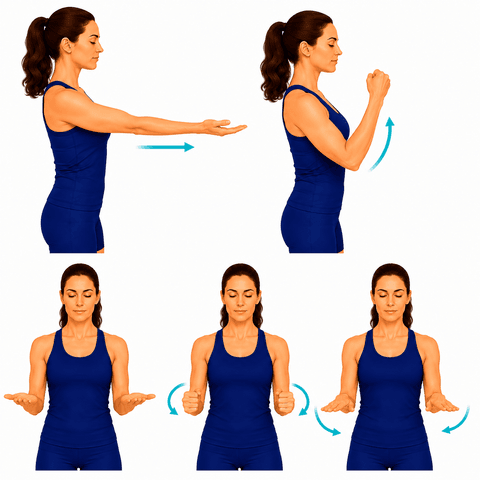
Gentle bending, straightening, and forearm turning to keep the elbow moving freely.
What it helps: Keeps the elbow and forearm moving through their full range — preserving the bend, straighten, and rotation you use for everyday tasks.
- Bend the elbow to bring your hand toward your shoulder, then slowly straighten it all the way.
- With the elbow tucked at your side and bent 90°, turn your palm up, then down.
- Move smoothly through comfortable range; don't force the ends.
Tips:
- Keep the upper arm still — the movement is at the elbow and forearm.
- Sore is okay; sharp is a sign to ease back.
Commonly done as 2–3 sets of 10 each, daily.
Finger Range of Motion
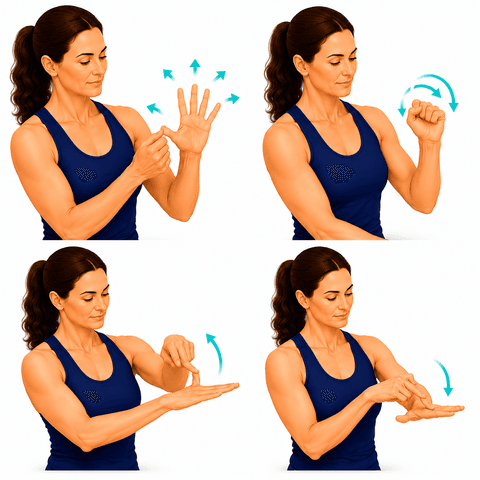
Gentle bending and straightening to keep the finger joints moving.
What it helps: Keeps the finger joints moving through their full range — preserving the bend and straighten you need to grip, pinch, and use your hands for everything.
- Open the hand wide, fingers straight.
- Make a full fist, then open again.
- Bend each finger one at a time toward the palm, then straighten.
Tips:
- Smooth, comfortable motion through the whole range.
- Do it often through the day, especially when the hand feels stiff.
Commonly done as 2–3 sets of 10, daily (several times).
Grip Strengthening
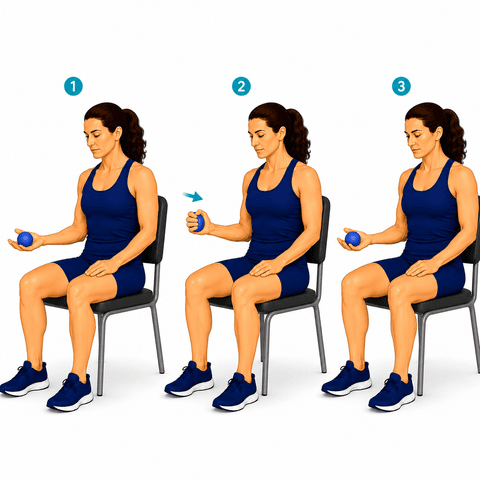
Builds hand and forearm grip strength with a ball or putty.
What it helps: Builds the grip and forearm strength behind almost every hand task — and supports the tendons at the elbow that grip relies on.
- Hold a soft ball or therapy putty in your hand.
- Squeeze firmly and hold a few seconds, then relax fully.
- Work through comfortable effort; stop short of sharp pain.
Tips:
- Full squeeze, full relax — both matter.
- Grip work loads the elbow tendons, so build it gradually if you have tennis or golfer's elbow.
Commonly done as 2–3 sets of 10–15, most days.
Wrist Range of Motion
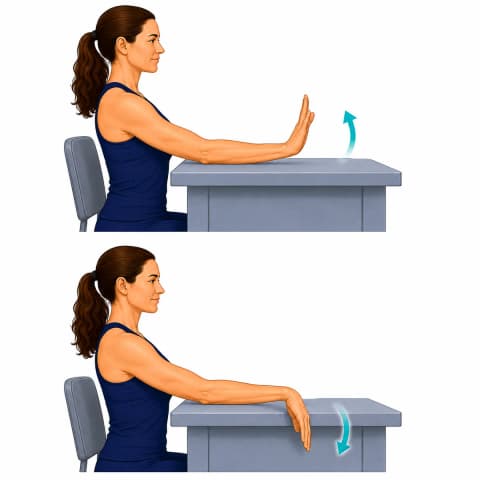
Gentle bending and side-to-side motion to keep the wrist moving freely.
What it helps: Keeps the wrist moving through its full range — preserving the bend, straighten, and side-to-side motion you use for everyday hand tasks.
- Rest your forearm on a table with your hand just past the edge, hand open and relaxed.
- Bend the wrist up so the back of the hand rises, then down so the fingers drop, through a comfortable range.
- Then move the hand side to side — toward the thumb, then toward the little finger.
- Finally make slow circles.
Tips:
- Smooth, comfortable motion — don't force the ends.
- Keep the forearm supported so only the wrist moves.
- No weight for this one. It is about movement, not strength — that is what separates it from wrist curls.
Commonly done as 2–3 sets of 10 each, daily.
Gentle Neck Isometrics
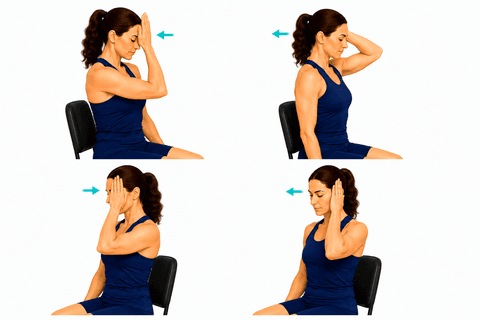
A steady, held press against your own hand — strengthens the neck with no movement.
What it helps: Strengthens the deep muscles that support and steady your neck without moving it — a safe, comfortable way to build the support that eases neck pain.
- Sit tall with a gentle chin-tuck. Place your palm on your forehead.
- Press your head lightly into your hand and your hand back into your head — a steady, comfortable push with NO movement of the neck.
- Hold, relax, and repeat. Do the same with the hand on the back of the head, then each side.
Tips:
- Light pressure — about 20–30% effort. This is not a strength test.
- No actual neck movement: the head stays still while the muscles work.
- Keep the gentle chin-tuck throughout.
Commonly done as 5 each direction sets of Hold 5–10 seconds, daily.
Walking Program
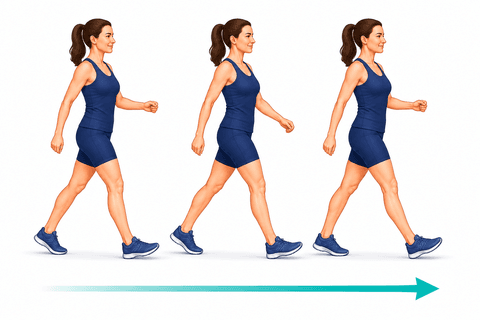
Short, frequent walks build endurance and confidence.
What it helps: Comfortable, frequent walking keeps the joints loose, builds your stamina, and rebuilds confidence on your feet. Little and often beats long and tiring.
- Take short walks at a comfortable pace.
- Increase your distance gradually as you feel able.
Tips:
- Use your assistive device as directed.
Commonly done throughout the day.
Restoring Motion
Weeks 2–6
Elbow Range of Motion
Gentle bending, straightening, and forearm turning to keep the elbow moving freely.
What it helps: Keeps the elbow and forearm moving through their full range — preserving the bend, straighten, and rotation you use for everyday tasks.
- Bend the elbow to bring your hand toward your shoulder, then slowly straighten it all the way.
- With the elbow tucked at your side and bent 90°, turn your palm up, then down.
- Move smoothly through comfortable range; don't force the ends.
Tips:
- Keep the upper arm still — the movement is at the elbow and forearm.
- Sore is okay; sharp is a sign to ease back.
Commonly done as 2–3 sets of 10 each, daily.
Forearm Stretch (Flexors & Extensors)
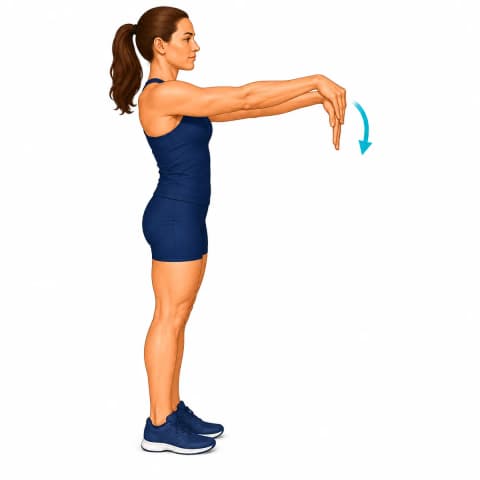
Stretches the muscles of the forearm that attach at the elbow.
What it helps: Loosens the forearm muscles that attach at the elbow — easing the tension that pulls on irritated tendons and limits comfortable wrist and grip use.
- Straighten the arm in front of you, palm down. With the other hand, gently bend the wrist down until you feel a stretch along the top of the forearm (extensors).
- Then turn the palm up and gently bend the wrist down to stretch the underside (flexors).
- Hold each gently; keep the elbow straight.
Tips:
- A gentle, steady pull — never sharp.
- Keeping the elbow straight makes the stretch reach the muscles that attach there.
Commonly done as 3 sets of Hold 20–30 sec each, daily.
Scar Massage & Desensitisation
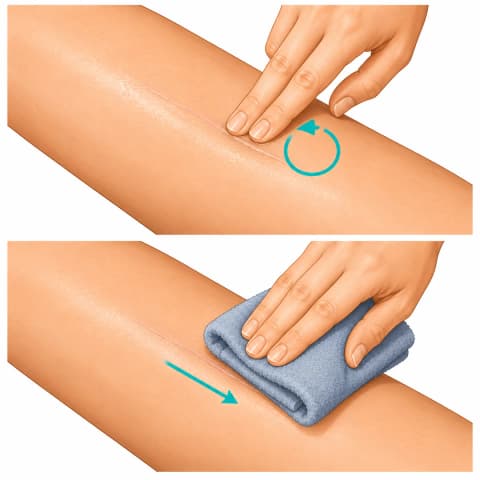
Firm massage over a healed scar, and getting the skin used to being touched again.
What it helps: Keeps the scar soft and mobile rather than tethered to the tissue underneath, and settles the hypersensitivity that makes a healed scar uncomfortable to knock or lean on. It is also what most helps the deep soreness in the heels of the palm after a carpal tunnel release.
- Wait until the wound is fully closed and any stitches are out — usually around two to three weeks. Check with your care team if unsure.
- Put a little unscented moisturiser or plain cream on the scar.
- Press firmly with a fingertip and move in small circles along and across the scar, firm enough to move the skin over the tissue beneath rather than sliding over the surface.
- Then rub different textures over the area — a towel, a soft cloth, clothing — for a minute or two, building from soft to coarser as it becomes tolerable.
Tips:
- Firm enough to move the skin is the point. Light stroking feels pleasant and does very little.
- It will feel odd and slightly unpleasant at first, and tenderness settling over weeks is the sign it is working.
- A few short sessions daily beats one long one. Most people do it while watching television.
Commonly done as 2–3 sets of 3–5 minutes, daily.
Forearm Rotation
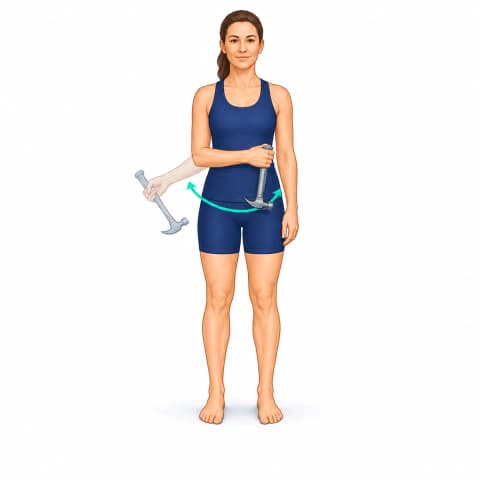
Strengthens the muscles that turn the palm up and down.
What it helps: Strengthens the muscles that rotate the forearm — the motion behind turning a key, a doorknob, or a screwdriver.
- Tuck your elbow in at your side, bent to 90 degrees, and hold a hammer by the end of its handle.
- Slowly rotate your forearm to turn the palm up, then down, through a comfortable range.
- The hammer head swings from one side to the other as you turn — that arc is the whole movement.
- Keep the elbow pinned to your side throughout.
Tips:
- Holding the hammer toward the head end adds gentle resistance — slide your grip to adjust.
- Keep the elbow still; only the forearm rotates.
- No hammer? A light hand weight works the same way.
Commonly done as 2–3 sets of 10–12 each way, most days.
Wrist Range of Motion
Gentle bending and side-to-side motion to keep the wrist moving freely.
What it helps: Keeps the wrist moving through its full range — preserving the bend, straighten, and side-to-side motion you use for everyday hand tasks.
- Rest your forearm on a table with your hand just past the edge, hand open and relaxed.
- Bend the wrist up so the back of the hand rises, then down so the fingers drop, through a comfortable range.
- Then move the hand side to side — toward the thumb, then toward the little finger.
- Finally make slow circles.
Tips:
- Smooth, comfortable motion — don't force the ends.
- Keep the forearm supported so only the wrist moves.
- No weight for this one. It is about movement, not strength — that is what separates it from wrist curls.
Commonly done as 2–3 sets of 10 each, daily.
Grip Strengthening
Builds hand and forearm grip strength with a ball or putty.
What it helps: Builds the grip and forearm strength behind almost every hand task — and supports the tendons at the elbow that grip relies on.
- Hold a soft ball or therapy putty in your hand.
- Squeeze firmly and hold a few seconds, then relax fully.
- Work through comfortable effort; stop short of sharp pain.
Tips:
- Full squeeze, full relax — both matter.
- Grip work loads the elbow tendons, so build it gradually if you have tennis or golfer's elbow.
Commonly done as 2–3 sets of 10–15, most days.
Walking Program
Short, frequent walks build endurance and confidence.
What it helps: Comfortable, frequent walking keeps the joints loose, builds your stamina, and rebuilds confidence on your feet. Little and often beats long and tiring.
- Take short walks at a comfortable pace.
- Increase your distance gradually as you feel able.
Tips:
- Use your assistive device as directed.
Commonly done throughout the day.
Loading the Tendon
Weeks 6–16
Eccentric Wrist Extension
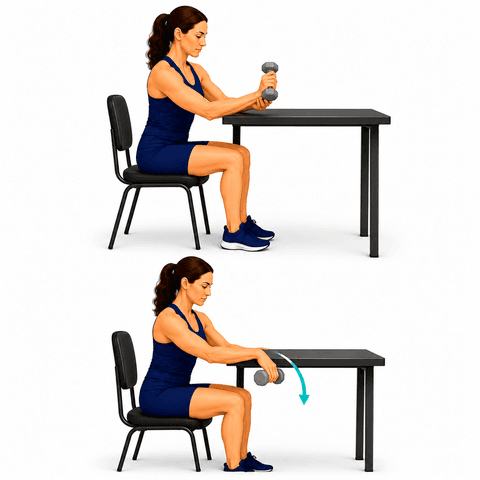
Slow lowering of the wrist that rebuilds the tendons on the outside of the elbow (tennis elbow).
What it helps: Rebuilds the wrist-extensor tendons on the outside of the elbow through slow, controlled loading — the proven way to make tennis-elbow tendons stronger and more resilient.
- Rest the forearm on a table, palm down, hand off the edge, holding a light weight.
- Use your other hand to help lift the wrist up.
- Let go with the helping hand and lower the weight down slowly over 3–4 seconds. Help it back up and repeat.
Tips:
- The work is in the slow lowering, not the lift.
- Start with a very light weight (even a soup can); add load only as it stays comfortable.
- Some mild ache during/after is normal with tendon work.
Commonly done as 3 sets of 10–15, daily (or every other day).
Wrist Curls
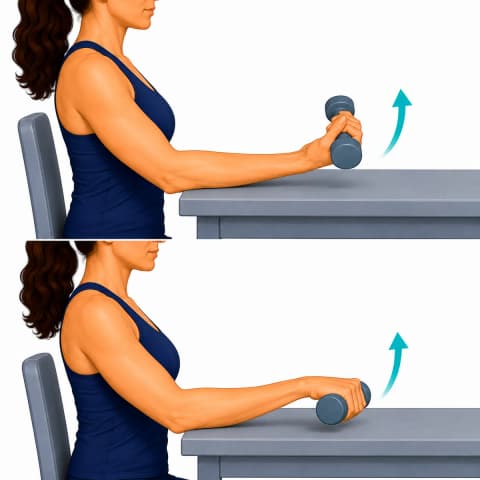
Strengthens the forearm muscles in both directions.
What it helps: Builds balanced forearm strength in both directions — the everyday strength behind a comfortable, capable wrist and grip.
- Rest your forearm on a table with your hand just past the edge, holding a light weight.
- Palm up: curl your wrist upward, then lower it slowly.
- Turn your forearm over so the palm faces down, then lift the back of your hand upward and lower it slowly.
- Move smoothly through a comfortable range.
Tips:
- Light weight, controlled motion.
- Your forearm stays resting on the table — only the wrist moves.
- Build the forearm in both directions for balance.
Commonly done as 2–3 sets of 12–15 each, most days.
Grip Strengthening
Builds hand and forearm grip strength with a ball or putty.
What it helps: Builds the grip and forearm strength behind almost every hand task — and supports the tendons at the elbow that grip relies on.
- Hold a soft ball or therapy putty in your hand.
- Squeeze firmly and hold a few seconds, then relax fully.
- Work through comfortable effort; stop short of sharp pain.
Tips:
- Full squeeze, full relax — both matter.
- Grip work loads the elbow tendons, so build it gradually if you have tennis or golfer's elbow.
Commonly done as 2–3 sets of 10–15, most days.
Forearm Stretch (Flexors & Extensors)
Stretches the muscles of the forearm that attach at the elbow.
What it helps: Loosens the forearm muscles that attach at the elbow — easing the tension that pulls on irritated tendons and limits comfortable wrist and grip use.
- Straighten the arm in front of you, palm down. With the other hand, gently bend the wrist down until you feel a stretch along the top of the forearm (extensors).
- Then turn the palm up and gently bend the wrist down to stretch the underside (flexors).
- Hold each gently; keep the elbow straight.
Tips:
- A gentle, steady pull — never sharp.
- Keeping the elbow straight makes the stretch reach the muscles that attach there.
Commonly done as 3 sets of Hold 20–30 sec each, daily.
Forearm Rotation
Strengthens the muscles that turn the palm up and down.
What it helps: Strengthens the muscles that rotate the forearm — the motion behind turning a key, a doorknob, or a screwdriver.
- Tuck your elbow in at your side, bent to 90 degrees, and hold a hammer by the end of its handle.
- Slowly rotate your forearm to turn the palm up, then down, through a comfortable range.
- The hammer head swings from one side to the other as you turn — that arc is the whole movement.
- Keep the elbow pinned to your side throughout.
Tips:
- Holding the hammer toward the head end adds gentle resistance — slide your grip to adjust.
- Keep the elbow still; only the forearm rotates.
- No hammer? A light hand weight works the same way.
Commonly done as 2–3 sets of 10–12 each way, most days.
Hand Putty Exercises
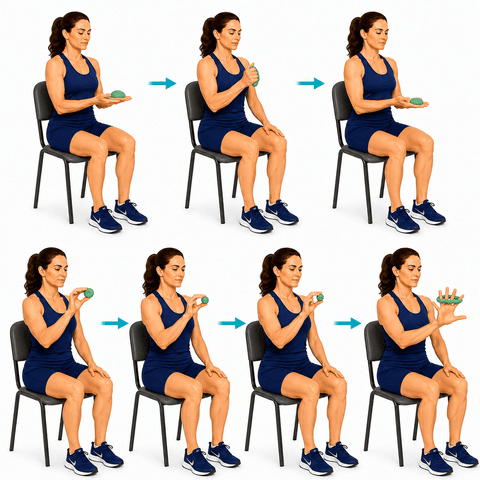
All-around hand strengthening with therapy putty — grip, pinch, and spread.
What it helps: Builds all-around hand and finger strength — grip, pinch, and the muscles that spread the fingers — the foundation of strong, capable hands for daily tasks.
- Squeeze the putty in a full fist, then release.
- Pinch the putty between the thumb and each fingertip in turn.
- Press the putty flat and dig individual fingers in; spread the fingers against a loop of putty.
Tips:
- Comfortable effort; full squeeze and full release.
- Putty comes in firmnesses — start soft and progress as you get stronger.
Commonly done as 2 sets of 10 each, most days.
Stationary Bike
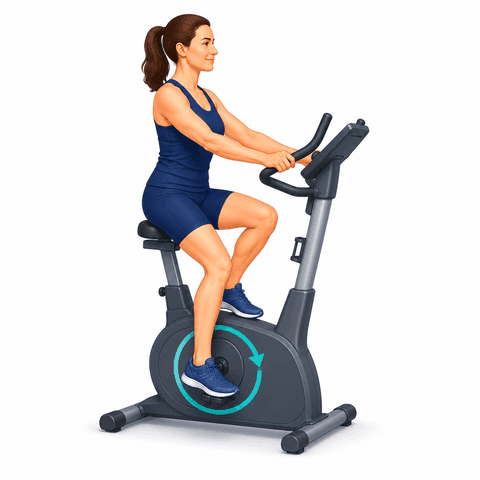
Builds motion and endurance with low impact.
What it helps: Keeps the joints moving and nourished while you build endurance — all with no pounding. One of the gentlest ways to stay active when a joint is sore.
- Set the seat so pedaling is comfortable.
- Pedal at an easy pace.
- Increase your time gradually.
Commonly done as directed.
Long-Term Recovery
Months 4–12
Eccentric Wrist Extension
Slow lowering of the wrist that rebuilds the tendons on the outside of the elbow (tennis elbow).
What it helps: Rebuilds the wrist-extensor tendons on the outside of the elbow through slow, controlled loading — the proven way to make tennis-elbow tendons stronger and more resilient.
- Rest the forearm on a table, palm down, hand off the edge, holding a light weight.
- Use your other hand to help lift the wrist up.
- Let go with the helping hand and lower the weight down slowly over 3–4 seconds. Help it back up and repeat.
Tips:
- The work is in the slow lowering, not the lift.
- Start with a very light weight (even a soup can); add load only as it stays comfortable.
- Some mild ache during/after is normal with tendon work.
Commonly done as 3 sets of 10–15, daily (or every other day).
Grip Strengthening
Builds hand and forearm grip strength with a ball or putty.
What it helps: Builds the grip and forearm strength behind almost every hand task — and supports the tendons at the elbow that grip relies on.
- Hold a soft ball or therapy putty in your hand.
- Squeeze firmly and hold a few seconds, then relax fully.
- Work through comfortable effort; stop short of sharp pain.
Tips:
- Full squeeze, full relax — both matter.
- Grip work loads the elbow tendons, so build it gradually if you have tennis or golfer's elbow.
Commonly done as 2–3 sets of 10–15, most days.
Progressive Strengthening
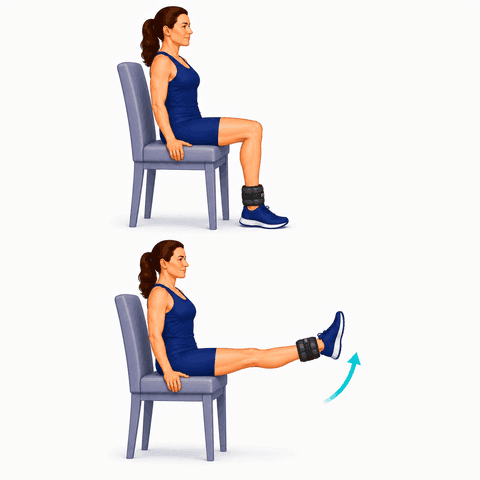
Gradually increases strength as you recover.
What it helps: Gradually raises the challenge as you get stronger, so your body keeps adapting and improving rather than plateauing.
- Begin with no added weight and get the movement smooth and comfortable first.
- When a set starts to feel easy, add a light load - the ankle cuff shown here, a dumbbell or a band.
- Sit tall, straighten the knee against the weight, hold briefly, then lower slowly.
- Step the load up in small amounts rather than in jumps.
Tips:
- Progress one thing at a time - more weight or more repetitions, not both in the same week.
- If your form slips before the set ends, the load is too heavy.
- The ankle-weight knee extension is the example drawn. The same rule of small steps applies to whichever exercises your program includes.
Commonly done as directed.
Functional Strength Training
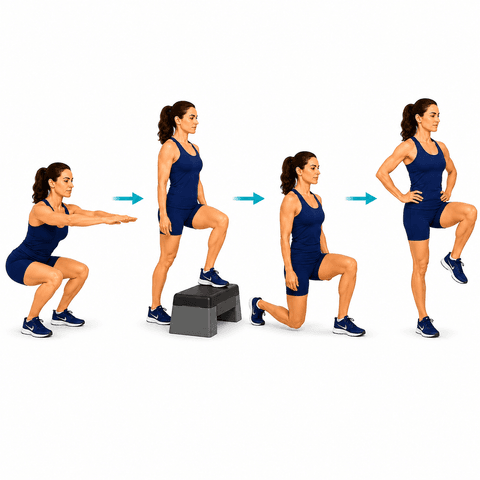
Task-based strengthening that rebuilds the movements of daily life and activity.
What it helps: Trains the real movements of daily life — lifting, carrying, squatting — with good mechanics, so everyday tasks feel easier.
- Work through functional movements — squats, step-ups, lunges, and balance — as cleared.
- Add resistance gradually.
Tips:
- Quality of movement first, then load.
Commonly done several times a week.
Low-Impact Recreational Activities
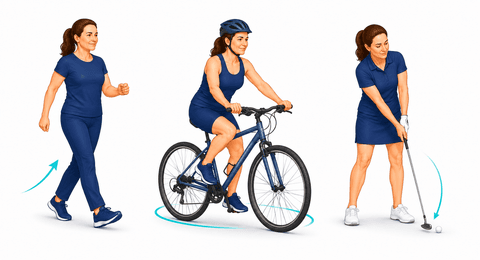
Enjoyable activities that protect your joint.
What it helps: Getting back to the activities you enjoy in ways that are kind to your joints — the whole point of building this strength.
- Choose activities that keep you moving without jarring the joint - walking, cycling and golf are three common ones.
- Start with a short session and add time before you add intensity.
- Spread them across the week rather than doing everything in one day.
- Keep the effort at a level where you could still hold a conversation.
Tips:
- The picture shows three examples, not a list to work through - the best activity is the one you will keep doing.
- A little stiffness the next day is usual; a flare that lingers means the session was too long, not that the activity was wrong.
- Your surgeon or therapist can say when each activity is a reasonable one to add.
Commonly done as you like.
What to expect in recovery
The full recovery guide for this procedure: Tennis Elbow Release recovery.
Recovery reading
Browse all exercise guides · Condition guides · Recovery education library
Are you a clinician? See how orthopedic practices use JointBooklet.
These are general exercise guides, not a personal prescription. The repetitions and frequency shown are what's commonly used — your own surgeon or therapist may advise something different, and their guidance comes first.