Scar Massage & Desensitisation
Firm massage over a healed scar, and getting the skin used to being touched again.
What it helps
Keeps the scar soft and mobile rather than tethered to the tissue underneath, and settles the hypersensitivity that makes a healed scar uncomfortable to knock or lean on. It is also what most helps the deep soreness in the heels of the palm after a carpal tunnel release.
How to do it
- Wait until the wound is fully closed and any stitches are out — usually around two to three weeks. Check with your care team if unsure.
- Put a little unscented moisturiser or plain cream on the scar.
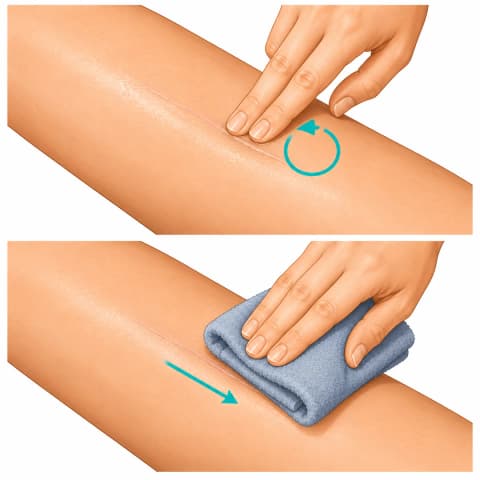
- Press firmly with a fingertip and move in small circles along and across the scar, firm enough to move the skin over the tissue beneath rather than sliding over the surface.
- Then rub different textures over the area — a towel, a soft cloth, clothing — for a minute or two, building from soft to coarser as it becomes tolerable.
Tips
- Firm enough to move the skin is the point. Light stroking feels pleasant and does very little.
- It will feel odd and slightly unpleasant at first, and tenderness settling over weeks is the sign it is working.
- A few short sessions daily beats one long one. Most people do it while watching television.
Commonly done as 2–3 sets of 3–5 minutes, daily.
Where this appears in recovery
Scar Massage & Desensitisation is part of 50 recovery programs, most often at the restoring motion (weeks 2–6), strength & scar (weeks 6–12) and regaining motion (weeks 3–8) stages, among others. Each program shows how it fits alongside the other movements:
- Dupuytren Fasciectomy exercise guide
- Dupuytren Fasciectomy exercise guide
- PIP Joint Arthroplasty exercise guide
- PIP Joint Arthroplasty exercise guide
- Proximal Row Carpectomy exercise guide
- Proximal Row Carpectomy exercise guide
- Partial Wrist Fusion (Four-Corner Fusion) exercise guide
- Partial Wrist Fusion (Four-Corner Fusion) exercise guide
- de Quervain Release exercise guide
- de Quervain Release exercise guide
- Ganglion Cyst Excision (Wrist) exercise guide
- Ganglion Cyst Excision (Wrist) exercise guide
- …and 38 more
All exercise guides · Condition guides · Recovery education
These are general exercise guides, not a personal prescription. The repetitions and frequency shown are what's commonly used — your own surgeon or therapist may advise something different, and their guidance comes first.