Eccentric Wrist Extension
Slow lowering of the wrist that rebuilds the tendons on the outside of the elbow (tennis elbow).
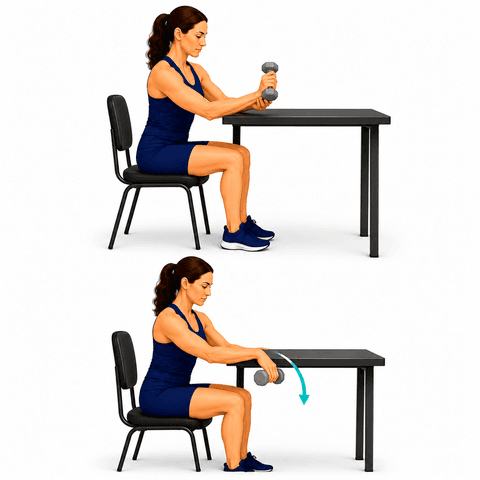
What it helps
Rebuilds the wrist-extensor tendons on the outside of the elbow through slow, controlled loading — the proven way to make tennis-elbow tendons stronger and more resilient.
How to do it
- Rest the forearm on a table, palm down, hand off the edge, holding a light weight.
- Use your other hand to help lift the wrist up.
- Let go with the helping hand and lower the weight down slowly over 3–4 seconds. Help it back up and repeat.
Tips
- The work is in the slow lowering, not the lift.
- Start with a very light weight (even a soup can); add load only as it stays comfortable.
- Some mild ache during/after is normal with tendon work.
Commonly done as 3 sets of 10–15, daily (or every other day).
Where this appears in recovery
Eccentric Wrist Extension is part of 16 recovery programs, most often at the advanced strengthening (months 3–6), strength building (months 2–4) and strength building (months 2–5) stages, among others. Each program shows how it fits alongside the other movements:
- Distal Radius Fracture ORIF exercise guide
- Distal Biceps Tendon Repair exercise guide
- Proximal Row Carpectomy exercise guide
- Partial Wrist Fusion (Four-Corner Fusion) exercise guide
- de Quervain Release exercise guide
- Ganglion Cyst Excision (Wrist) exercise guide
- Distal Humerus ORIF exercise guide
- Forearm Fracture ORIF (Radius / Ulna Shaft) exercise guide
- Scaphoid Fracture ORIF exercise guide
- TFCC Repair (Arthroscopic) exercise guide
- Tennis Elbow Release (Lateral Epicondyle) exercise guide
- Tennis Elbow Release (Lateral Epicondyle) exercise guide
- …and 4 more
All exercise guides · Condition guides · Recovery education
These are general exercise guides, not a personal prescription. The repetitions and frequency shown are what's commonly used — your own surgeon or therapist may advise something different, and their guidance comes first.