Functional Strength Training
Task-based strengthening that rebuilds the movements of daily life and activity.
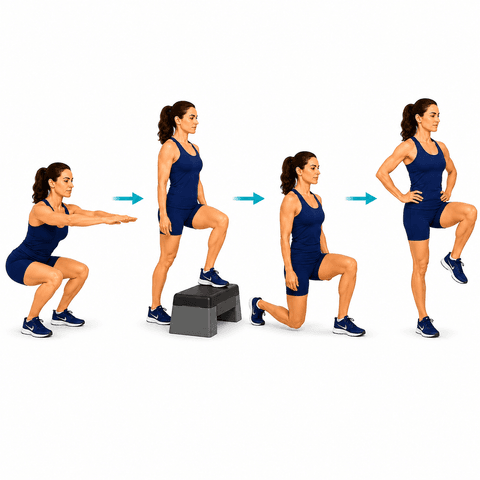
What it helps
Trains the real movements of daily life — lifting, carrying, squatting — with good mechanics, so everyday tasks feel easier.
How to do it
- Work through functional movements — squats, step-ups, lunges, and balance — as cleared.
- Add resistance gradually.
Tips
- Quality of movement first, then load.
Commonly done several times a week.
Where this appears in recovery
Functional Strength Training is part of 164 recovery programs, most often at the return to activity (months 3–6), long-term recovery (months 6–12) and advanced strengthening (months 6–9) stages, among others. Each program shows how it fits alongside the other movements:
- Clavicle Fracture ORIF exercise guide
- Clavicle Fracture ORIF exercise guide
- Latarjet Procedure exercise guide
- Latarjet Procedure exercise guide
- ACL Revision Reconstruction exercise guide
- Tarsal Tunnel Release exercise guide
- Distal Fibula Fracture ORIF exercise guide
- Spinal Cord Stimulator Implant exercise guide
- Kyphoplasty exercise guide
- Knee Arthroscopy with Partial Meniscectomy exercise guide
- Achilles Tendon Lengthening exercise guide
- Lapidus Bunionectomy exercise guide
- …and 152 more
All exercise guides · Condition guides · Recovery education
These are general exercise guides, not a personal prescription. The repetitions and frequency shown are what's commonly used — your own surgeon or therapist may advise something different, and their guidance comes first.