Wrist Range of Motion
Gentle bending and side-to-side motion to keep the wrist moving freely.
What it helps
Keeps the wrist moving through its full range — preserving the bend, straighten, and side-to-side motion you use for everyday hand tasks.
How to do it
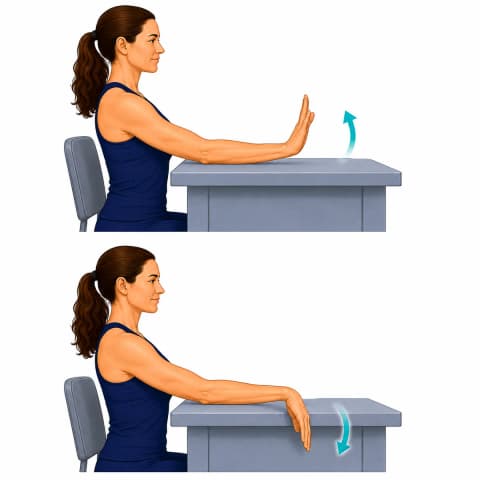
- Rest your forearm on a table with your hand just past the edge, hand open and relaxed.
- Bend the wrist up so the back of the hand rises, then down so the fingers drop, through a comfortable range.
- Then move the hand side to side — toward the thumb, then toward the little finger.
- Finally make slow circles.
Tips
- Smooth, comfortable motion — don't force the ends.
- Keep the forearm supported so only the wrist moves.
- No weight for this one. It is about movement, not strength — that is what separates it from wrist curls.
Commonly done as 2–3 sets of 10 each, daily.
Where this appears in recovery
Wrist Range of Motion is part of 56 recovery programs, most often at the wrist motion (weeks 2–6), strength building (weeks 6–12) and wound healing & extension (weeks 0–2) stages, among others. Each program shows how it fits alongside the other movements:
- Distal Radius Fracture ORIF exercise guide
- Distal Radius Fracture ORIF exercise guide
- Dupuytren Fasciectomy exercise guide
- Dupuytren Fasciectomy exercise guide
- PIP Joint Arthroplasty exercise guide
- Needle Aponeurotomy (Dupuytren) exercise guide
- Proximal Row Carpectomy exercise guide
- Proximal Row Carpectomy exercise guide
- Partial Wrist Fusion (Four-Corner Fusion) exercise guide
- Partial Wrist Fusion (Four-Corner Fusion) exercise guide
- de Quervain Release exercise guide
- de Quervain Release exercise guide
- …and 44 more
All exercise guides · Condition guides · Recovery education
These are general exercise guides, not a personal prescription. The repetitions and frequency shown are what's commonly used — your own surgeon or therapist may advise something different, and their guidance comes first.