JointBooklet · jointbooklet.com
Needle Aponeurotomy (Dupuytren) Starter Exercise Guide
A short starting program — 8 exercises drawn from the full 24-exercise program. These are the movements most people begin with.
Before you begin. This is general guidance, not a personal prescription. If your surgeon or therapist has given you a different program or different limits, follow theirs.
1. Finger & Hand Stretch
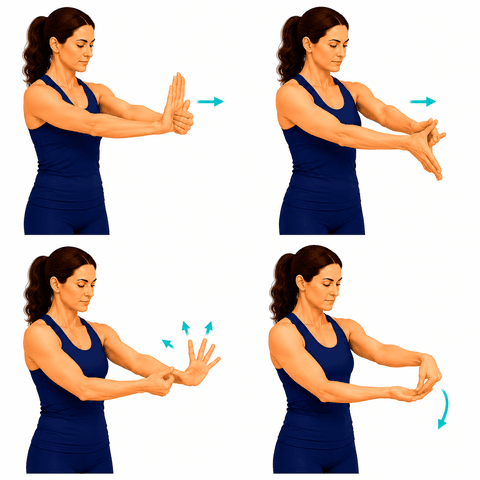
What it helps: Eases stiffness in the finger joints and palm — keeping the hand supple and the fingers moving freely for grip and pinch.
How often: 2–3 sets of Hold 10–15 sec, daily.
- Gently straighten the fingers back with the other hand until you feel a mild stretch in the palm and fingers.
- Spread the fingers wide and hold.
- Gently bend each finger and hold a moment.
Tip: Gentle, mild stretches — never force a stiff or sore joint.
2. Finger Range of Motion
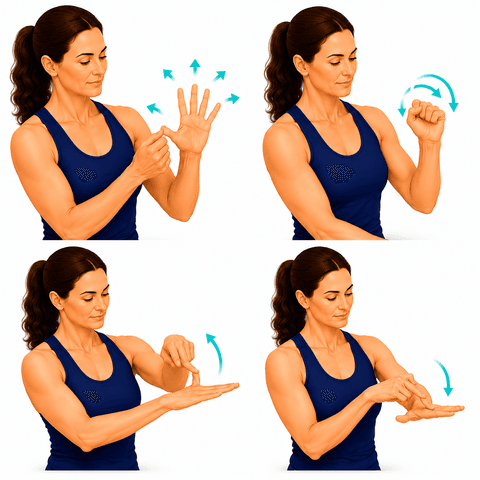
What it helps: Keeps the finger joints moving through their full range — preserving the bend and straighten you need to grip, pinch, and use your hands for everything.
How often: 2–3 sets of 10, daily (several times).
- Open the hand wide, fingers straight.
- Make a full fist, then open again.
- Bend each finger one at a time toward the palm, then straighten.
Tip: Smooth, comfortable motion through the whole range.
3. Hand & Wrist Elevation and Swelling Control
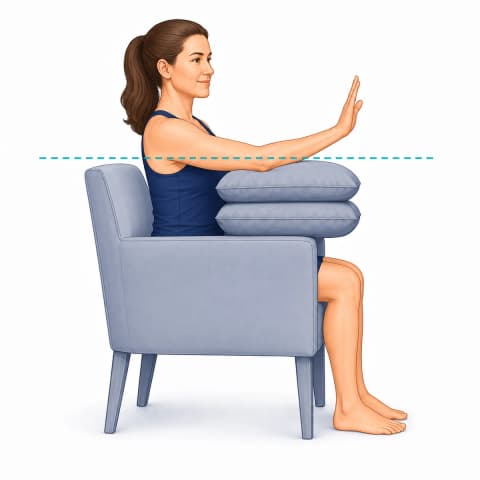
What it helps: Controls the swelling that is the main cause of stiffness after hand and wrist surgery. A swollen hand cannot make a full fist, and fingers left stiff in the first weeks are much harder to free later than the wrist itself is.
How often: every hour while awake sets of 10 slow fists, daily.
- Rest the hand higher than your heart. Sitting, prop the whole forearm on a stack of cushions so the hand sits above chest level.
- Standing, rest it on the opposite shoulder; lying down, support the whole forearm on pillows.
- With the hand up, slowly make a loose fist and open it fully, spreading the fingers.
- Repeat the slow fist-and-open several times, then let the hand rest in the raised position.
- Come back to it regularly through the day rather than doing one long session.
Tip: Above the heart is the part that matters. A hand resting on your lap or in a sling at waist height is not elevated, and this is the commonest reason swelling does not settle.
4. Thumb Range of Motion

What it helps: Keeps the thumb's wide range — reaching, pinching, and opposing to the fingers — which is behind nearly every grip and pinch task the hand does.
How often: 2–3 sets of 8–10 each, daily.
- Move the thumb out away from the palm, then back.
- Touch the thumb tip to each fingertip in turn (opposition).
- Make gentle circles with the thumb. Keep it comfortable.
Tip: Smooth, pain-free motion.
5. Wrist Range of Motion
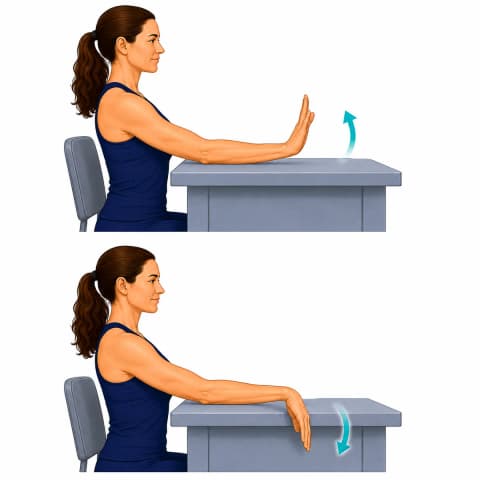
What it helps: Keeps the wrist moving through its full range — preserving the bend, straighten, and side-to-side motion you use for everyday hand tasks.
How often: 2–3 sets of 10 each, daily.
- Rest your forearm on a table with your hand just past the edge, hand open and relaxed.
- Bend the wrist up so the back of the hand rises, then down so the fingers drop, through a comfortable range.
- Then move the hand side to side — toward the thumb, then toward the little finger.
- Finally make slow circles.
Tip: Smooth, comfortable motion — don't force the ends.
6. Walking Program
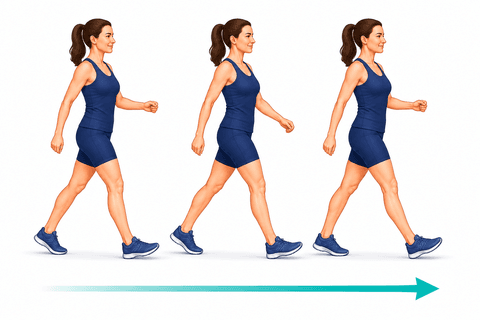
What it helps: Comfortable, frequent walking keeps the joints loose, builds your stamina, and rebuilds confidence on your feet. Little and often beats long and tiring.
How often: throughout the day.
- Take short walks at a comfortable pace.
- Increase your distance gradually as you feel able.
Tip: Use your assistive device as directed.
7. Tendon Gliding (Finger Glides)
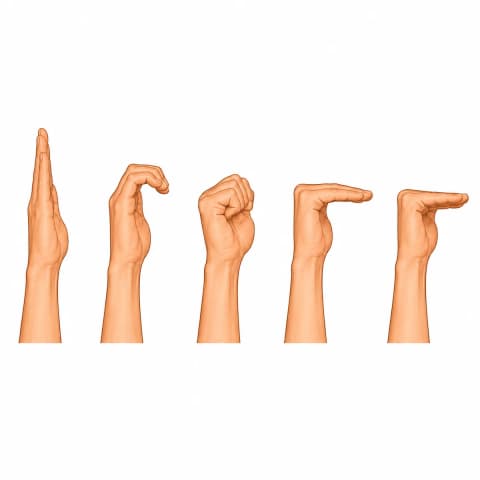
What it helps: Keeps the finger tendons sliding freely through their sheaths and the carpal tunnel — preventing stiffness and catching, and keeping the hand smooth and supple.
How often: 2–3 sets of 5–10 of each, daily.
- Start with fingers straight.
- Bend just the top two knuckles into a "hook," then straighten.
- Make a full fist, then straighten.
- Bend the big knuckles only into a "tabletop," then straighten.
- Make a "straight fist" (fingers curled but knuckles flat). Move slowly through each.
Tip: Move smoothly through the whole sequence.
8. Blocking Exercises (Isolated Joint Motion)
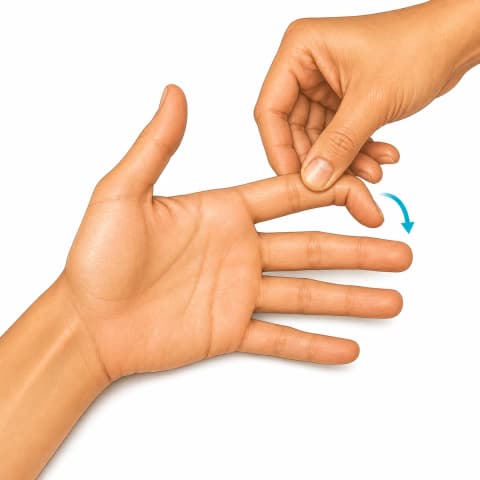
What it helps: Forces a tendon to glide rather than letting the finger move as a single unit, which is how stiffness at one joint gets missed. It is the most reliable way to recover movement at a specific joint after a tendon repair or a finger injury.
How often: 2–3 sets of 10 per joint, daily.
- Rest the injured hand palm-up on a table.
- With the other hand, hold the finger firmly just below the joint you want to move, keeping the joints closer to the palm completely still.
- Now bend and straighten only the free joint beyond where you are holding, slowly and through as much range as it will go.
- Move the holding hand to the next joint along and repeat.
Tip: The point is isolation. If the whole finger is curling as a unit, move your holding hand closer to the joint you are working.
See the complete 24-exercise program, phase by phase.
What to expect in recovery
The full recovery guide for this procedure: Needle Aponeurotomy (Dupuytren) recovery.
Recovery reading
Browse all exercise guides · Condition guides · Recovery education library
Are you a clinician? See how orthopedic practices use JointBooklet.
Are you a clinician? See how orthopedic practices use JointBooklet.
These are general exercise guides, not a personal prescription. The repetitions and frequency shown are what's commonly used — your own surgeon or therapist may advise something different, and their guidance comes first.