Blocking Exercises (Isolated Joint Motion)
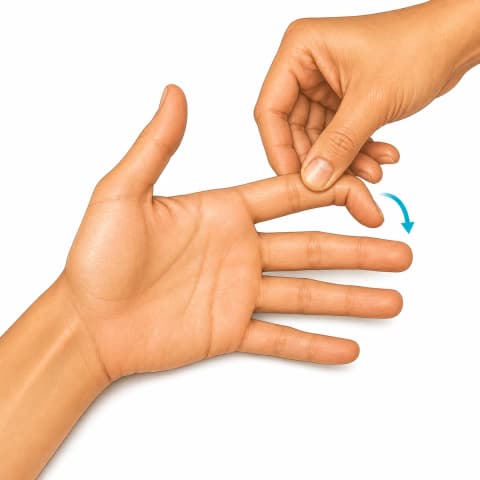
Holding one finger joint still so the movement is forced through the next one.
What it helps
Forces a tendon to glide rather than letting the finger move as a single unit, which is how stiffness at one joint gets missed. It is the most reliable way to recover movement at a specific joint after a tendon repair or a finger injury.
How to do it
- Rest the injured hand palm-up on a table.
- With the other hand, hold the finger firmly just below the joint you want to move, keeping the joints closer to the palm completely still.
- Now bend and straighten only the free joint beyond where you are holding, slowly and through as much range as it will go.
- Move the holding hand to the next joint along and repeat.
Tips
- The point is isolation. If the whole finger is curling as a unit, move your holding hand closer to the joint you are working.
- Slow and deliberate beats fast. Each repetition is asking the tendon to slide a specific distance.
- These often reveal that one joint is much stiffer than the rest, which is exactly what they are for.
Commonly done as 2–3 sets of 10 per joint, daily.
Where this appears in recovery
Blocking Exercises (Isolated Joint Motion) is part of 27 recovery programs, most often at the restoring motion (weeks 2–6), strength & scar (weeks 6–12) and protected motion (weeks 0–3) stages, among others. Each program shows how it fits alongside the other movements:
- Dupuytren Fasciectomy exercise guide
- Dupuytren Fasciectomy exercise guide
- PIP Joint Arthroplasty exercise guide
- PIP Joint Arthroplasty exercise guide
- PIP Joint Arthroplasty exercise guide
- Needle Aponeurotomy (Dupuytren) exercise guide
- Metacarpal Fracture ORIF exercise guide
- Metacarpal Fracture ORIF exercise guide
- Metacarpal Fracture ORIF exercise guide
- DIP Fusion (Arthrodesis) exercise guide
- DIP Fusion (Arthrodesis) exercise guide
- Phalanx Fracture ORIF exercise guide
- …and 15 more
All exercise guides · Condition guides · Recovery education
These are general exercise guides, not a personal prescription. The repetitions and frequency shown are what's commonly used — your own surgeon or therapist may advise something different, and their guidance comes first.