JointBooklet · jointbooklet.com
Phalanx Fracture ORIF Starter Exercise Guide
A short starting program — 8 exercises drawn from the full 26-exercise program. These are the movements most people begin with.
Before you begin. This is general guidance, not a personal prescription. If your surgeon or therapist has given you a different program or different limits, follow theirs.
1. Hand & Wrist Elevation and Swelling Control
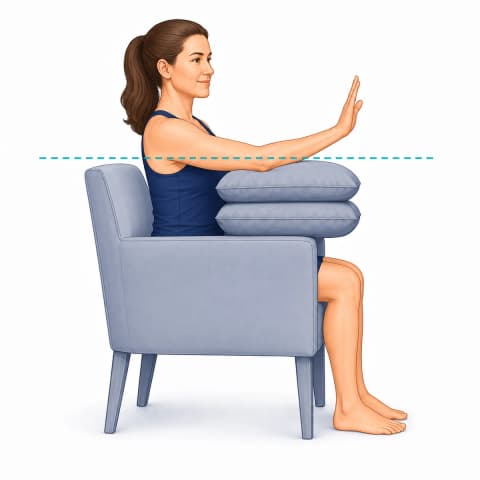
What it helps: Controls the swelling that is the main cause of stiffness after hand and wrist surgery. A swollen hand cannot make a full fist, and fingers left stiff in the first weeks are much harder to free later than the wrist itself is.
How often: every hour while awake sets of 10 slow fists, daily.
- Rest the hand higher than your heart. Sitting, prop the whole forearm on a stack of cushions so the hand sits above chest level.
- Standing, rest it on the opposite shoulder; lying down, support the whole forearm on pillows.
- With the hand up, slowly make a loose fist and open it fully, spreading the fingers.
- Repeat the slow fist-and-open several times, then let the hand rest in the raised position.
- Come back to it regularly through the day rather than doing one long session.
Tip: Above the heart is the part that matters. A hand resting on your lap or in a sling at waist height is not elevated, and this is the commonest reason swelling does not settle.
2. Blocking Exercises (Isolated Joint Motion)
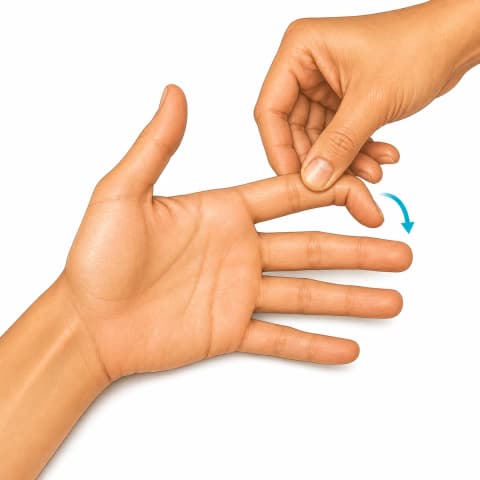
What it helps: Forces a tendon to glide rather than letting the finger move as a single unit, which is how stiffness at one joint gets missed. It is the most reliable way to recover movement at a specific joint after a tendon repair or a finger injury.
How often: 2–3 sets of 10 per joint, daily.
- Rest the injured hand palm-up on a table.
- With the other hand, hold the finger firmly just below the joint you want to move, keeping the joints closer to the palm completely still.
- Now bend and straighten only the free joint beyond where you are holding, slowly and through as much range as it will go.
- Move the holding hand to the next joint along and repeat.
Tip: The point is isolation. If the whole finger is curling as a unit, move your holding hand closer to the joint you are working.
3. Tendon Gliding (Finger Glides)
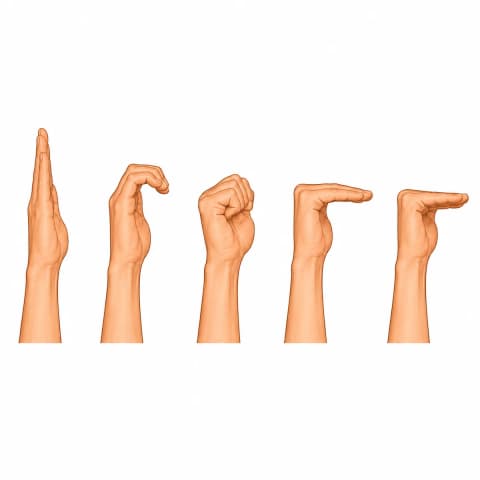
What it helps: Keeps the finger tendons sliding freely through their sheaths and the carpal tunnel — preventing stiffness and catching, and keeping the hand smooth and supple.
How often: 2–3 sets of 5–10 of each, daily.
- Start with fingers straight.
- Bend just the top two knuckles into a "hook," then straighten.
- Make a full fist, then straighten.
- Bend the big knuckles only into a "tabletop," then straighten.
- Make a "straight fist" (fingers curled but knuckles flat). Move slowly through each.
Tip: Move smoothly through the whole sequence.
4. Finger Range of Motion
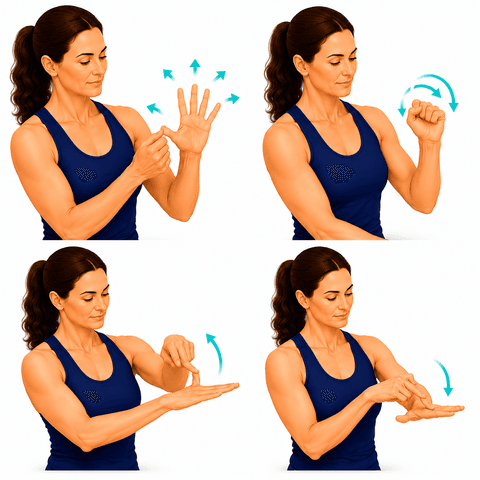
What it helps: Keeps the finger joints moving through their full range — preserving the bend and straighten you need to grip, pinch, and use your hands for everything.
How often: 2–3 sets of 10, daily (several times).
- Open the hand wide, fingers straight.
- Make a full fist, then open again.
- Bend each finger one at a time toward the palm, then straighten.
Tip: Smooth, comfortable motion through the whole range.
5. Finger Abduction & Adduction
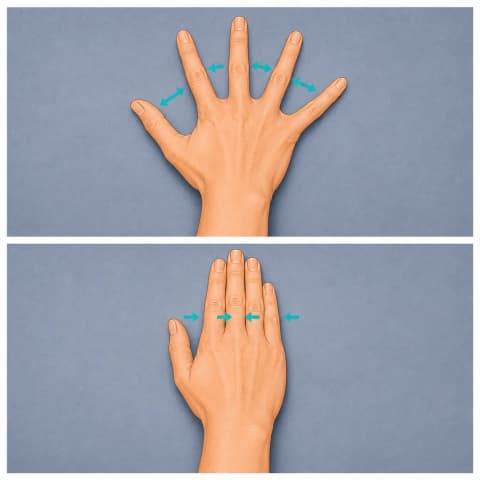
What it helps: Targets the small muscles between the fingers, which are supplied by the ulnar nerve and are the first to waste when it is compressed. They are what allow fine, coordinated hand use — holding cards, turning a key, gripping without the fingers splaying — and they recover only if they are specifically trained.
How often: 2–3 sets of 10 each way, daily.
- Rest your hand flat on a table, palm down, fingers straight.
- Spread the fingers as wide apart as you can, then bring them back together tightly.
- Next, place a folded piece of paper between two fingers and squeeze to hold it while you gently try to pull it away with the other hand.
- Work through each gap between the fingers in turn.
Tip: The movement is small and the muscles are small — this is about control and endurance rather than force.
6. Thumb Range of Motion

What it helps: Keeps the thumb's wide range — reaching, pinching, and opposing to the fingers — which is behind nearly every grip and pinch task the hand does.
How often: 2–3 sets of 8–10 each, daily.
- Move the thumb out away from the palm, then back.
- Touch the thumb tip to each fingertip in turn (opposition).
- Make gentle circles with the thumb. Keep it comfortable.
Tip: Smooth, pain-free motion.
7. Wrist Range of Motion
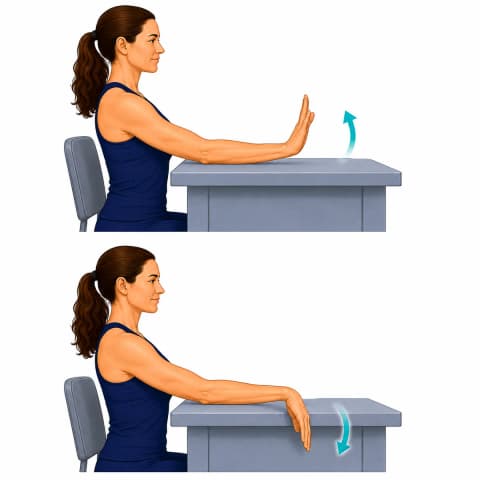
What it helps: Keeps the wrist moving through its full range — preserving the bend, straighten, and side-to-side motion you use for everyday hand tasks.
How often: 2–3 sets of 10 each, daily.
- Rest your forearm on a table with your hand just past the edge, hand open and relaxed.
- Bend the wrist up so the back of the hand rises, then down so the fingers drop, through a comfortable range.
- Then move the hand side to side — toward the thumb, then toward the little finger.
- Finally make slow circles.
Tip: Smooth, comfortable motion — don't force the ends.
8. Gentle Neck Isometrics
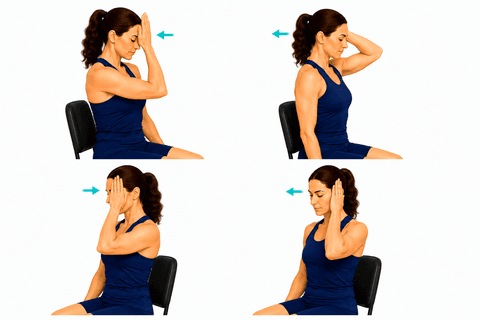
What it helps: Strengthens the deep muscles that support and steady your neck without moving it — a safe, comfortable way to build the support that eases neck pain.
How often: 5 each direction sets of Hold 5–10 seconds, daily.
- Sit tall with a gentle chin-tuck. Place your palm on your forehead.
- Press your head lightly into your hand and your hand back into your head — a steady, comfortable push with NO movement of the neck.
- Hold, relax, and repeat. Do the same with the hand on the back of the head, then each side.
Tip: Light pressure — about 20–30% effort. This is not a strength test.
See the complete 26-exercise program, phase by phase.
Recovering from a broken bone
How bone healing works and how long it usually takes — fracture and trauma recovery.
What to expect in recovery
The full recovery guide for this procedure: Finger Fracture Repair recovery.
Recovery reading
Browse all exercise guides · Condition guides · Recovery education library
Are you a clinician? See how orthopedic practices use JointBooklet.
Are you a clinician? See how orthopedic practices use JointBooklet.
These are general exercise guides, not a personal prescription. The repetitions and frequency shown are what's commonly used — your own surgeon or therapist may advise something different, and their guidance comes first.