Finger Abduction & Adduction
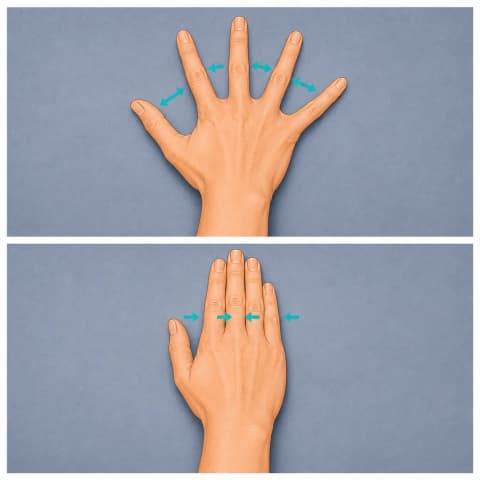
Spreading and squeezing the fingers — training the small hand muscles the ulnar nerve supplies.
What it helps
Targets the small muscles between the fingers, which are supplied by the ulnar nerve and are the first to waste when it is compressed. They are what allow fine, coordinated hand use — holding cards, turning a key, gripping without the fingers splaying — and they recover only if they are specifically trained.
How to do it
- Rest your hand flat on a table, palm down, fingers straight.
- Spread the fingers as wide apart as you can, then bring them back together tightly.
- Next, place a folded piece of paper between two fingers and squeeze to hold it while you gently try to pull it away with the other hand.
- Work through each gap between the fingers in turn.
Tips
- The movement is small and the muscles are small — this is about control and endurance rather than force.
- Doing it with the hand flat on a table stops the bigger forearm muscles taking over.
- If the muscles are weak these will feel almost impossible at first. That is the point of doing them.
Commonly done as 2–3 sets of 10 each way, daily.
Where this appears in recovery
Finger Abduction & Adduction is part of 23 recovery programs, most often at the restoring motion (weeks 2–6), strength building (months 2–4) and restoring motion (weeks 1–4) stages, among others. Each program shows how it fits alongside the other movements:
- Dupuytren Fasciectomy exercise guide
- PIP Joint Arthroplasty exercise guide
- Needle Aponeurotomy (Dupuytren) exercise guide
- Cubital Tunnel Release exercise guide
- Cubital Tunnel Release exercise guide
- Cubital Tunnel Release exercise guide
- Metacarpal Fracture ORIF exercise guide
- Metacarpal Fracture ORIF exercise guide
- Phalanx Fracture ORIF exercise guide
- Phalanx Fracture ORIF exercise guide
- Phalanx Fracture ORIF exercise guide
- PIP Fusion (Arthrodesis) exercise guide
- …and 11 more
All exercise guides · Condition guides · Recovery education
These are general exercise guides, not a personal prescription. The repetitions and frequency shown are what's commonly used — your own surgeon or therapist may advise something different, and their guidance comes first.