Forearm Rotation
Strengthens the muscles that turn the palm up and down.
What it helps
Strengthens the muscles that rotate the forearm — the motion behind turning a key, a doorknob, or a screwdriver.
How to do it
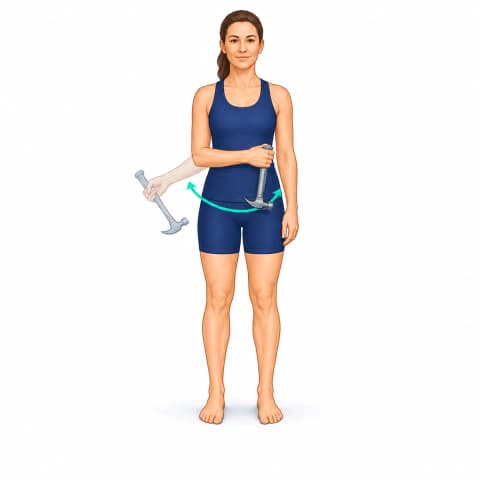
- Tuck your elbow in at your side, bent to 90 degrees, and hold a hammer by the end of its handle.
- Slowly rotate your forearm to turn the palm up, then down, through a comfortable range.
- The hammer head swings from one side to the other as you turn — that arc is the whole movement.
- Keep the elbow pinned to your side throughout.
Tips
- Holding the hammer toward the head end adds gentle resistance — slide your grip to adjust.
- Keep the elbow still; only the forearm rotates.
- No hammer? A light hand weight works the same way.
Commonly done as 2–3 sets of 10–12 each way, most days.
Where this appears in recovery
Forearm Rotation is part of 57 recovery programs, most often at the wrist motion (weeks 2–6), strength building (weeks 6–12) and regaining motion (weeks 4–8) stages, among others. Each program shows how it fits alongside the other movements:
- Distal Radius Fracture ORIF exercise guide
- Distal Radius Fracture ORIF exercise guide
- Distal Biceps Tendon Repair exercise guide
- Distal Biceps Tendon Repair exercise guide
- Distal Biceps Tendon Repair exercise guide
- Proximal Row Carpectomy exercise guide
- Proximal Row Carpectomy exercise guide
- Partial Wrist Fusion (Four-Corner Fusion) exercise guide
- Partial Wrist Fusion (Four-Corner Fusion) exercise guide
- de Quervain Release exercise guide
- Ganglion Cyst Excision (Wrist) exercise guide
- Ganglion Cyst Excision (Wrist) exercise guide
- …and 45 more
All exercise guides · Condition guides · Recovery education
These are general exercise guides, not a personal prescription. The repetitions and frequency shown are what's commonly used — your own surgeon or therapist may advise something different, and their guidance comes first.