Tennis Elbow Exercise Guide
A phase-by-phase exercise program used in recovery for tennis elbow. Each movement includes what it's working on and how it's typically performed. Your own surgeon's or therapist's guidance always comes first.
Phase 1
Forearm Stretch (Flexors & Extensors)
Stretches the muscles of the forearm that attach at the elbow.
What it helps: Loosens the forearm muscles that attach at the elbow — easing the tension that pulls on irritated tendons and limits comfortable wrist and grip use.
- Straighten the arm in front of you, palm down. With the other hand, gently bend the wrist down until you feel a stretch along the top of the forearm (extensors).
- Then turn the palm up and gently bend the wrist down to stretch the underside (flexors).
- Hold each gently; keep the elbow straight.
Tips:
- A gentle, steady pull — never sharp.
- Keeping the elbow straight makes the stretch reach the muscles that attach there.
Commonly done as 3 sets of Hold 20–30 sec each, daily.
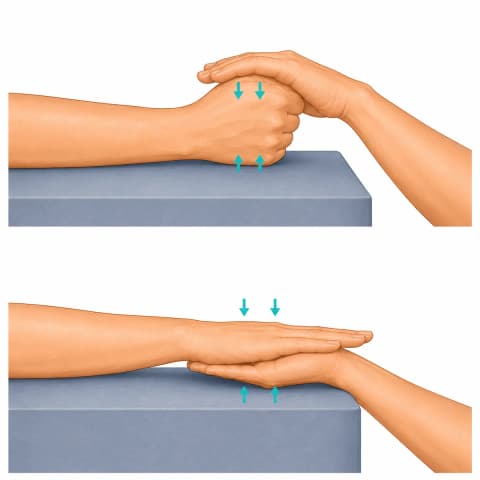
Wrist Isometrics
Gentle no-movement holds that calm tendon pain while keeping the muscles active.
What it helps: Loads the forearm tendons gently without movement — a comfortable way to keep them strong and often to ease tendon pain before they're ready for moving resistance.
- Rest the forearm on a table, hand off the edge. For extensors: make a light fist, push the back of the hand up against your other hand — no movement — and hold.
- For flexors: push the palm down against your other hand and hold.
- Use comfortable pressure; the wrist stays still.
Tips:
- No movement happens — you're holding against resistance.
- Start light; isometrics often ease tendon pain, so find a comfortable level.
Commonly done as 1 sets of Hold 20–45 sec ×3–5, daily.
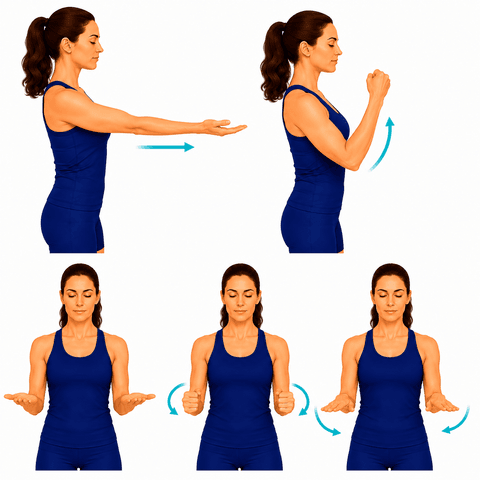
Elbow Range of Motion

Gentle bending, straightening, and forearm turning to keep the elbow moving freely.
What it helps: Keeps the elbow and forearm moving through their full range — preserving the bend, straighten, and rotation you use for everyday tasks.
- Bend the elbow to bring your hand toward your shoulder, then slowly straighten it all the way.
- With the elbow tucked at your side and bent 90°, turn your palm up, then down.
- Move smoothly through comfortable range; don't force the ends.
Tips:
- Keep the upper arm still — the movement is at the elbow and forearm.
- Sore is okay; sharp is a sign to ease back.
Commonly done as 2–3 sets of 10 each, daily.
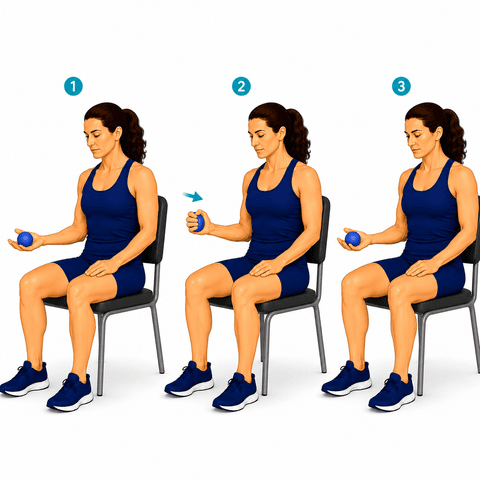
Grip Strengthening

Builds hand and forearm grip strength with a ball or putty.
What it helps: Builds the grip and forearm strength behind almost every hand task — and supports the tendons at the elbow that grip relies on.
- Hold a soft ball or therapy putty in your hand.
- Squeeze firmly and hold a few seconds, then relax fully.
- Work through comfortable effort; stop short of sharp pain.
Tips:
- Full squeeze, full relax — both matter.
- Grip work loads the elbow tendons, so build it gradually if you have tennis or golfer's elbow.
Commonly done as 2–3 sets of 10–15, most days.
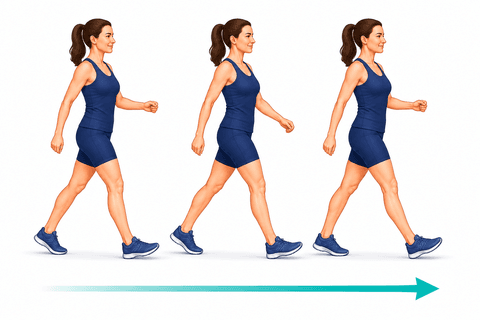
Walking Program

Short, frequent walks build endurance and confidence.
What it helps: Comfortable, frequent walking keeps the joints loose, builds your stamina, and rebuilds confidence on your feet. Little and often beats long and tiring.
- Take short walks at a comfortable pace.
- Increase your distance gradually as you feel able.
Tips:
- Use your assistive device as directed.
Commonly done throughout the day.
Phase 2
Wrist Isometrics
Gentle no-movement holds that calm tendon pain while keeping the muscles active.
What it helps: Loads the forearm tendons gently without movement — a comfortable way to keep them strong and often to ease tendon pain before they're ready for moving resistance.
- Rest the forearm on a table, hand off the edge. For extensors: make a light fist, push the back of the hand up against your other hand — no movement — and hold.
- For flexors: push the palm down against your other hand and hold.
- Use comfortable pressure; the wrist stays still.
Tips:
- No movement happens — you're holding against resistance.
- Start light; isometrics often ease tendon pain, so find a comfortable level.
Commonly done as 1 sets of Hold 20–45 sec ×3–5, daily.
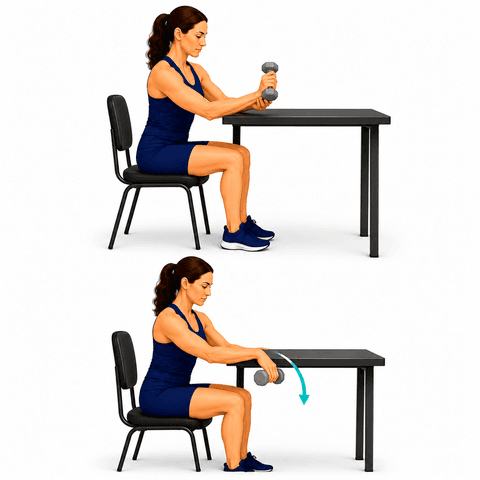
Eccentric Wrist Extension

Slow lowering of the wrist that rebuilds the tendons on the outside of the elbow (tennis elbow).
What it helps: Rebuilds the wrist-extensor tendons on the outside of the elbow through slow, controlled loading — the proven way to make tennis-elbow tendons stronger and more resilient.
- Rest the forearm on a table, palm down, hand off the edge, holding a light weight.
- Use your other hand to help lift the wrist up.
- Let go with the helping hand and lower the weight down slowly over 3–4 seconds. Help it back up and repeat.
Tips:
- The work is in the slow lowering, not the lift.
- Start with a very light weight (even a soup can); add load only as it stays comfortable.
- Some mild ache during/after is normal with tendon work.
Commonly done as 3 sets of 10–15, daily (or every other day).
Forearm Stretch (Flexors & Extensors)
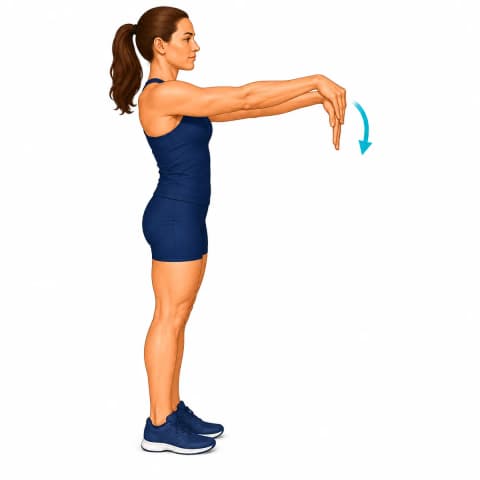
Stretches the muscles of the forearm that attach at the elbow.
What it helps: Loosens the forearm muscles that attach at the elbow — easing the tension that pulls on irritated tendons and limits comfortable wrist and grip use.
- Straighten the arm in front of you, palm down. With the other hand, gently bend the wrist down until you feel a stretch along the top of the forearm (extensors).
- Then turn the palm up and gently bend the wrist down to stretch the underside (flexors).
- Hold each gently; keep the elbow straight.
Tips:
- A gentle, steady pull — never sharp.
- Keeping the elbow straight makes the stretch reach the muscles that attach there.
Commonly done as 3 sets of Hold 20–30 sec each, daily.
Grip Strengthening

Builds hand and forearm grip strength with a ball or putty.
What it helps: Builds the grip and forearm strength behind almost every hand task — and supports the tendons at the elbow that grip relies on.
- Hold a soft ball or therapy putty in your hand.
- Squeeze firmly and hold a few seconds, then relax fully.
- Work through comfortable effort; stop short of sharp pain.
Tips:
- Full squeeze, full relax — both matter.
- Grip work loads the elbow tendons, so build it gradually if you have tennis or golfer's elbow.
Commonly done as 2–3 sets of 10–15, most days.
Walking Program

Short, frequent walks build endurance and confidence.
What it helps: Comfortable, frequent walking keeps the joints loose, builds your stamina, and rebuilds confidence on your feet. Little and often beats long and tiring.
- Take short walks at a comfortable pace.
- Increase your distance gradually as you feel able.
Tips:
- Use your assistive device as directed.
Commonly done throughout the day.
Phase 3
Eccentric Wrist Extension

Slow lowering of the wrist that rebuilds the tendons on the outside of the elbow (tennis elbow).
What it helps: Rebuilds the wrist-extensor tendons on the outside of the elbow through slow, controlled loading — the proven way to make tennis-elbow tendons stronger and more resilient.
- Rest the forearm on a table, palm down, hand off the edge, holding a light weight.
- Use your other hand to help lift the wrist up.
- Let go with the helping hand and lower the weight down slowly over 3–4 seconds. Help it back up and repeat.
Tips:
- The work is in the slow lowering, not the lift.
- Start with a very light weight (even a soup can); add load only as it stays comfortable.
- Some mild ache during/after is normal with tendon work.
Commonly done as 3 sets of 10–15, daily (or every other day).
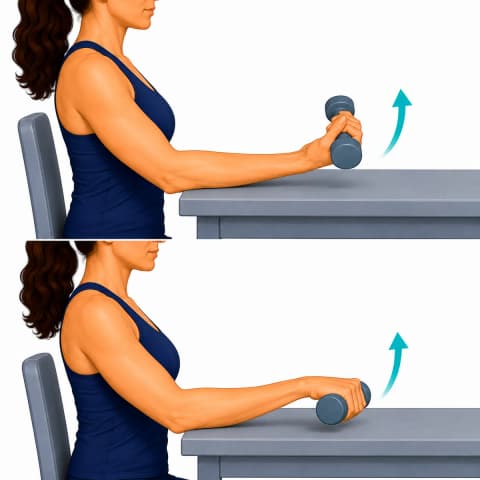
Wrist Curls
Strengthens the forearm muscles in both directions.
What it helps: Builds balanced forearm strength in both directions — the everyday strength behind a comfortable, capable wrist and grip.
- Rest the forearm on a table, hand off the edge, holding a light weight.
- Palm up: curl the wrist up, then lower with control (flexion). Palm down: lift the back of the hand up, then lower (extension).
- Move smoothly through comfortable range.
Tips:
- Light weight, controlled motion.
- Build the forearm in both directions for balance.
Commonly done as 2–3 sets of 12–15 each, most days.
Grip Strengthening

Builds hand and forearm grip strength with a ball or putty.
What it helps: Builds the grip and forearm strength behind almost every hand task — and supports the tendons at the elbow that grip relies on.
- Hold a soft ball or therapy putty in your hand.
- Squeeze firmly and hold a few seconds, then relax fully.
- Work through comfortable effort; stop short of sharp pain.
Tips:
- Full squeeze, full relax — both matter.
- Grip work loads the elbow tendons, so build it gradually if you have tennis or golfer's elbow.
Commonly done as 2–3 sets of 10–15, most days.
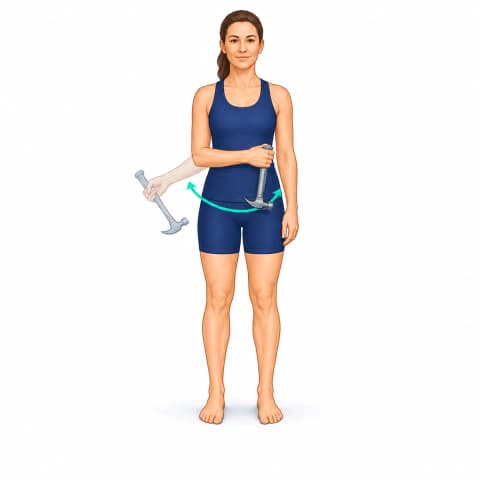
Forearm Rotation
Strengthens the muscles that turn the palm up and down.
What it helps: Strengthens the muscles that rotate the forearm — the motion behind turning a key, a doorknob, or a screwdriver.
- Tuck the elbow at your side, bent 90°, holding a light weight or a hammer by the handle.
- Slowly rotate the forearm to turn the palm up, then down, through comfortable range.
- Keep the elbow pinned to your side.
Tips:
- Holding a hammer toward the head end adds gentle resistance — slide your grip to adjust.
- Keep the elbow still; only the forearm rotates.
Commonly done as 2–3 sets of 10–12 each way, most days.
Forearm Stretch (Flexors & Extensors)
Stretches the muscles of the forearm that attach at the elbow.
What it helps: Loosens the forearm muscles that attach at the elbow — easing the tension that pulls on irritated tendons and limits comfortable wrist and grip use.
- Straighten the arm in front of you, palm down. With the other hand, gently bend the wrist down until you feel a stretch along the top of the forearm (extensors).
- Then turn the palm up and gently bend the wrist down to stretch the underside (flexors).
- Hold each gently; keep the elbow straight.
Tips:
- A gentle, steady pull — never sharp.
- Keeping the elbow straight makes the stretch reach the muscles that attach there.
Commonly done as 3 sets of Hold 20–30 sec each, daily.
Phase 4
Eccentric Wrist Extension

Slow lowering of the wrist that rebuilds the tendons on the outside of the elbow (tennis elbow).
What it helps: Rebuilds the wrist-extensor tendons on the outside of the elbow through slow, controlled loading — the proven way to make tennis-elbow tendons stronger and more resilient.
- Rest the forearm on a table, palm down, hand off the edge, holding a light weight.
- Use your other hand to help lift the wrist up.
- Let go with the helping hand and lower the weight down slowly over 3–4 seconds. Help it back up and repeat.
Tips:
- The work is in the slow lowering, not the lift.
- Start with a very light weight (even a soup can); add load only as it stays comfortable.
- Some mild ache during/after is normal with tendon work.
Commonly done as 3 sets of 10–15, daily (or every other day).
Wrist Curls
Strengthens the forearm muscles in both directions.
What it helps: Builds balanced forearm strength in both directions — the everyday strength behind a comfortable, capable wrist and grip.
- Rest the forearm on a table, hand off the edge, holding a light weight.
- Palm up: curl the wrist up, then lower with control (flexion). Palm down: lift the back of the hand up, then lower (extension).
- Move smoothly through comfortable range.
Tips:
- Light weight, controlled motion.
- Build the forearm in both directions for balance.
Commonly done as 2–3 sets of 12–15 each, most days.
Grip Strengthening

Builds hand and forearm grip strength with a ball or putty.
What it helps: Builds the grip and forearm strength behind almost every hand task — and supports the tendons at the elbow that grip relies on.
- Hold a soft ball or therapy putty in your hand.
- Squeeze firmly and hold a few seconds, then relax fully.
- Work through comfortable effort; stop short of sharp pain.
Tips:
- Full squeeze, full relax — both matter.
- Grip work loads the elbow tendons, so build it gradually if you have tennis or golfer's elbow.
Commonly done as 2–3 sets of 10–15, most days.
Resistance Band Rows
Strengthens the upper back to support posture and the cervical spine.
What it helps: Strengthens the upper back that supports good posture and takes strain off the neck.
- Anchor a resistance band at chest height and hold an end in each hand.
- Pull your elbows back, squeezing your shoulder blades together.
- Return slowly with control.
Tips:
- Keep your neck relaxed and posture tall.
- Lead with the shoulder blades, not the neck.
Commonly done as 2 sets of 10–15, 3–4 times a week.
Low-Impact Recreational Activities

Enjoyable activities that protect your joint.
What it helps: Getting back to the activities you enjoy in ways that are kind to your joints — the whole point of building this strength.
Commonly done as you like.
Phase 5
Wrist Curls
Strengthens the forearm muscles in both directions.
What it helps: Builds balanced forearm strength in both directions — the everyday strength behind a comfortable, capable wrist and grip.
- Rest the forearm on a table, hand off the edge, holding a light weight.
- Palm up: curl the wrist up, then lower with control (flexion). Palm down: lift the back of the hand up, then lower (extension).
- Move smoothly through comfortable range.
Tips:
- Light weight, controlled motion.
- Build the forearm in both directions for balance.
Commonly done as 2–3 sets of 12–15 each, most days.
Grip Strengthening

Builds hand and forearm grip strength with a ball or putty.
What it helps: Builds the grip and forearm strength behind almost every hand task — and supports the tendons at the elbow that grip relies on.
- Hold a soft ball or therapy putty in your hand.
- Squeeze firmly and hold a few seconds, then relax fully.
- Work through comfortable effort; stop short of sharp pain.
Tips:
- Full squeeze, full relax — both matter.
- Grip work loads the elbow tendons, so build it gradually if you have tennis or golfer's elbow.
Commonly done as 2–3 sets of 10–15, most days.
Eccentric Wrist Extension

Slow lowering of the wrist that rebuilds the tendons on the outside of the elbow (tennis elbow).
What it helps: Rebuilds the wrist-extensor tendons on the outside of the elbow through slow, controlled loading — the proven way to make tennis-elbow tendons stronger and more resilient.
- Rest the forearm on a table, palm down, hand off the edge, holding a light weight.
- Use your other hand to help lift the wrist up.
- Let go with the helping hand and lower the weight down slowly over 3–4 seconds. Help it back up and repeat.
Tips:
- The work is in the slow lowering, not the lift.
- Start with a very light weight (even a soup can); add load only as it stays comfortable.
- Some mild ache during/after is normal with tendon work.
Commonly done as 3 sets of 10–15, daily (or every other day).
Walking Program

Short, frequent walks build endurance and confidence.
What it helps: Comfortable, frequent walking keeps the joints loose, builds your stamina, and rebuilds confidence on your feet. Little and often beats long and tiring.
- Take short walks at a comfortable pace.
- Increase your distance gradually as you feel able.
Tips:
- Use your assistive device as directed.
Commonly done throughout the day.
Low-Impact Recreational Activities

Enjoyable activities that protect your joint.
What it helps: Getting back to the activities you enjoy in ways that are kind to your joints — the whole point of building this strength.
Commonly done as you like.
About Tennis Elbow
What the condition is, how it's usually managed, and what to expect — read the Tennis Elbow guide.
Recovery reading
Browse all exercise guides · Condition guides · Recovery education library
These are general exercise guides, not a personal prescription. The repetitions and frequency shown are what's commonly used — your own surgeon or therapist may advise something different, and their guidance comes first.