Lumbar Spinal Stenosis Exercise Guide
A phase-by-phase exercise program used in recovery for lumbar spinal stenosis. Each movement includes what it's working on and how it's typically performed. Your own surgeon's or therapist's guidance always comes first.
Phase 1
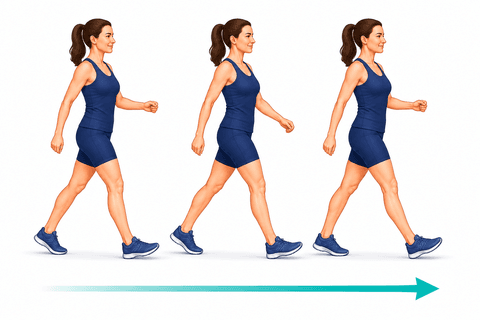
Walking Program

Short, frequent walks build endurance and confidence.
What it helps: Comfortable, frequent walking keeps the joints loose, builds your stamina, and rebuilds confidence on your feet. Little and often beats long and tiring.
- Take short walks at a comfortable pace.
- Increase your distance gradually as you feel able.
Tips:
- Use your assistive device as directed.
Commonly done throughout the day.
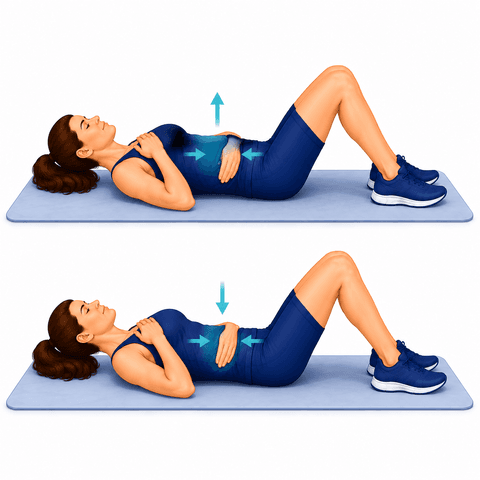
Diaphragmatic Breathing

Calms the nervous system and gently wakes up your deep core without straining the back.
What it helps: Calms the nervous system and gently engages your deep core — a relaxed, supported way to start any session.
- Lie on your back, knees bent, one hand on your chest and one on your belly.
- Breathe in slowly through your nose so your belly rises while your chest stays still.
- Breathe out slowly through pursed lips, letting your belly fall.
Tips:
- Keep it relaxed — never force the breath.
- Useful any time you feel tense or sore.
Commonly done as 5–10 breaths repetitions, several times a day.
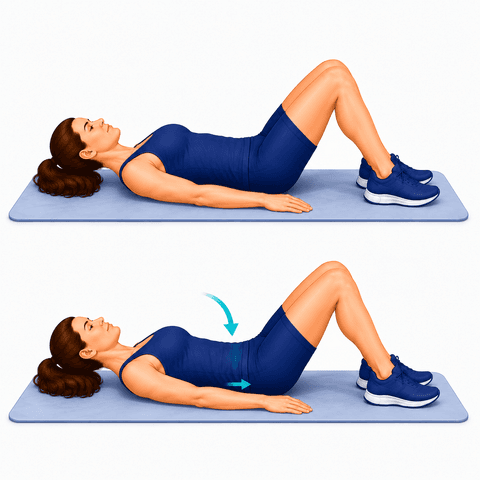
Pelvic Tilts

Gently mobilizes the low back and re-engages the core.
What it helps: Gently keeps the hips and low back moving and re-engages the core, so the whole midsection stays supple and supportive rather than stiff.
- Lie on your back, knees bent, feet flat.
- Slowly flatten your low back into the floor by tilting your pelvis and tightening your stomach.
- Hold briefly, then relax back to neutral.
Tips:
- Move slowly within a comfortable range.
- Pair the motion with your breathing.
Commonly done as 10–15 repetitions, 1–2 times a day.
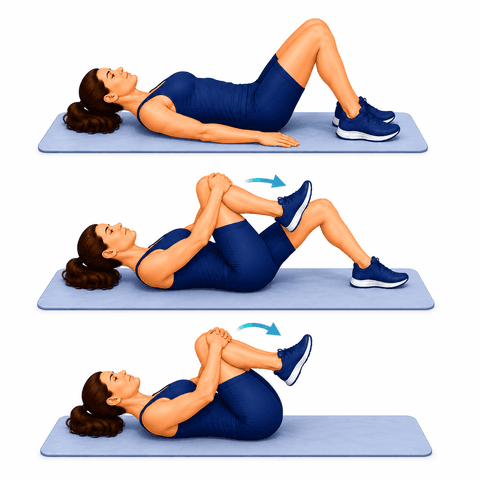
Knee-to-Chest Stretch

A gentle stretch that eases tension across the low back.
What it helps: A gentle stretch that eases tension across the hip and lower back and keeps the hip moving freely.
- Lie on your back with your knees bent and feet flat.
- Bring one knee up and gently draw it toward your chest with your hands.
- Hold easily, then lower and switch sides.
- As it feels comfortable, draw both knees up together.
Tips:
- Keep it gentle — a comfortable stretch, never a strain.
- Let your low back relax into the floor.
Commonly done as hold 10–20s sets of 5 each side, daily.
Gentle Lumbar Mobility

Keeps the low back moving comfortably as it heals.
What it helps: Keeps the low back moving comfortably as it heals, so it stays supple rather than stiffening up.
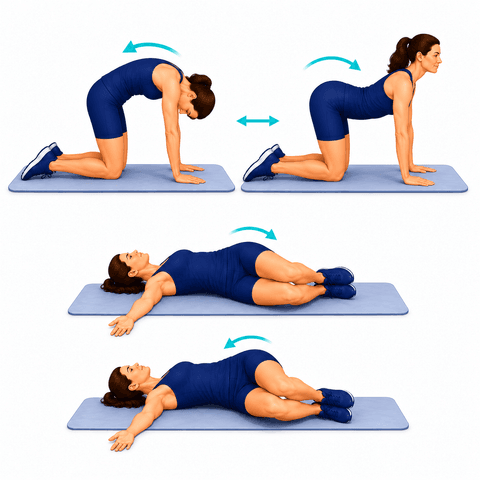
- On hands and knees, slowly round then gently arch your back (cat–camel) within a comfortable range.
- Or, lying down, let bent knees rock slowly a few inches side to side.
- Move smoothly and stay pain-free.
Tips:
- Small, comfortable ranges early on.
- Stop short of any sharp pain.
Commonly done as 10 repetitions, 1–2 times a day.
Abdominal Bracing

Builds gentle deep-core support that protects your spine during daily movement.
What it helps: Switches on the deep core muscles that stabilize and protect your spine through everyday movement — lifting, bending, twisting.
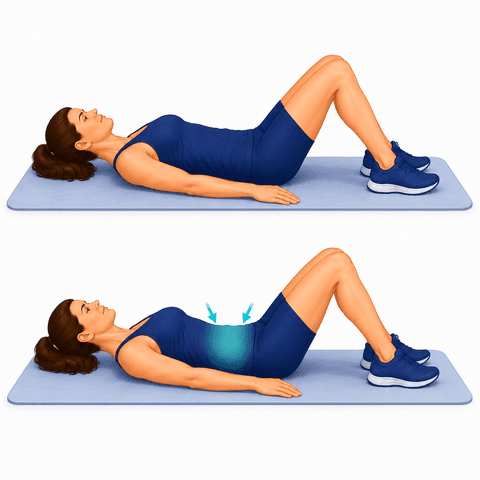
- Lie on your back with knees bent.
- Gently tighten your stomach as if bracing for a light poke — do not suck in or hold your breath.
- Hold the light tension while breathing normally, then relax.
Tips:
- Aim for about 20% effort, not a maximal squeeze.
- Brace before you roll, stand, or reach.
Commonly done as hold 5–10s sets of 10, a few times a day.
Hamstring Stretching

Eases tightness behind the thigh that can pull on the low back.
What it helps: Keeps the back of the thigh flexible so the knee and hip move freely and your stride stays easy.
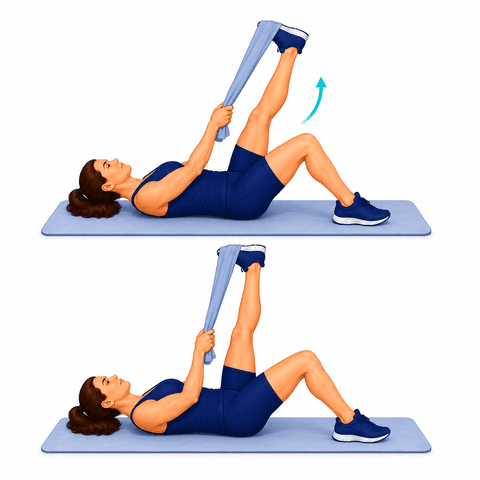
- Lie on your back and loop a towel around one foot.
- Gently straighten the knee toward the ceiling until you feel a light stretch.
- Hold, then relax.
Tips:
- Stretch to mild tension, not pain.
- Breathe and ease into it.
Commonly done as hold 20–30s sets of 2–3 reps, 1–2 times a day.
Hip Flexor Stretch
Loosens the muscles at the front of the hip that can pull the low back into an arch.
What it helps: Tight hip flexors tip your pelvis and pull your low back into an arch. Loosening them lets your back settle into a more open, comfortable position and takes strain off the spine.
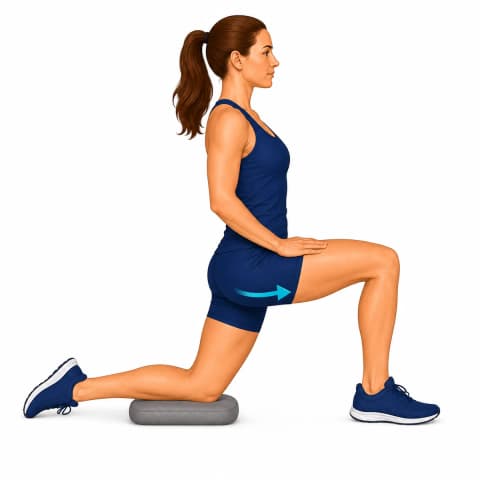
- Kneel on the leg you want to stretch, with the other foot planted in front (a half-kneeling lunge). Use a cushion under the knee.
- Gently tuck your tailbone under (a small posterior pelvic tilt) so your low back flattens slightly.
- Keeping tall and your core gently braced, ease your weight forward until you feel a comfortable stretch across the front of the kneeling hip.
- Hold, breathing easily — never push into back or leg pain. Switch sides.
Tips:
- The stretch should be felt at the front of the hip/thigh, not in the back.
- Keep the gentle tailbone-tuck the whole time — letting the back arch defeats the purpose.
- A standing version (one foot up on a chair, ease the hips forward) works if kneeling is uncomfortable.
Commonly done as 2–3 each side sets of Hold 30 seconds, daily.
Phase 2
Cycling

Low-impact endurance and motion.
What it helps: Low-impact endurance that keeps the joints moving smoothly while you build fitness — easy on the body, good for the long run.
Commonly done as able.
Bridges

Strengthens the glutes and core that support the low back.
What it helps: Builds the glutes and core together, giving your hips and low back a strong, stable base to move from — so the muscles do the work instead of the joints.
- Lie on your back, knees bent, feet flat.
- Brace your core and squeeze your glutes to lift your hips into a straight line.
- Lower slowly with control.
Tips:
- Keep your stomach gently braced — do not arch your back.
- Drive through the glutes, not the low back.
Commonly done as 2 sets of 10–15, daily.
Dead Bug

Teaches your core to keep your spine steady while your arms and legs move.
What it helps: Teaches your core to keep your spine steady while your arms and legs move — the control that protects your back in daily life.
- Lie on your back with your arms reaching toward the ceiling and your knees bent up over your hips.
- Gently flatten your low back into the floor by tightening your core.
- Slowly lower one arm overhead and the opposite leg toward the floor.
- Return, then repeat with the other arm and leg.
Tips:
- Keep your low back pressed gently into the floor the whole time.
- Move slowly and only as far as you can control.
Commonly done as 1–2 sets sets of 5–8 each side, most days.
Modified Bird Dog

An early, gentle core-stability drill — one limb at a time.
What it helps: An early, gentle way to build core stability one limb at a time, training your trunk to stay steady as you move.
- On hands and knees, brace your core to keep your spine still and level.
- Slowly slide one arm forward OR one leg back, keeping your back from sagging or twisting.
- Return and switch sides.
Tips:
- Move only as far as you can keep your spine perfectly still.
- Start with just the arms, or just the legs.
Commonly done as 1–2 sets of 8 each side, daily.
Figure-4 (Piriformis) Stretch

Eases tightness deep in the buttock that can travel into the hip.
What it helps: Eases tightness deep in the buttock that can travel into the hip, keeping the area loose and comfortable.
- Lie on your back with both knees bent.
- Cross one ankle over the opposite thigh to make a "figure 4".
- Reach through and gently pull the lower thigh toward you until you feel a stretch in the buttock.
- Hold, then switch sides.
Tips:
- Keep your head and shoulders relaxed on the floor.
- A gentle, comfortable stretch is all you need.
Commonly done as hold 20–30s sets of 3 each side, daily.
Posture Training

Trains a neutral spine for sitting, standing, and lifting safely.
What it helps: Trains a neutral, balanced spine for sitting, standing, and lifting — good posture takes strain off the back all day long.
- Sit or stand tall, stacking ears over shoulders over hips.
- Gently draw your shoulder blades down and back.
- Hold a tall, relaxed neutral position; reset whenever you slouch.
Tips:
- Set reminders to check your posture during the day.
- A small lumbar roll helps when sitting.
Commonly done throughout the day.
Walking Program

Short, frequent walks build endurance and confidence.
What it helps: Comfortable, frequent walking keeps the joints loose, builds your stamina, and rebuilds confidence on your feet. Little and often beats long and tiring.
- Take short walks at a comfortable pace.
- Increase your distance gradually as you feel able.
Tips:
- Use your assistive device as directed.
Commonly done throughout the day.
Hip Flexor Stretch
Loosens the muscles at the front of the hip that can pull the low back into an arch.
What it helps: Tight hip flexors tip your pelvis and pull your low back into an arch. Loosening them lets your back settle into a more open, comfortable position and takes strain off the spine.
- Kneel on the leg you want to stretch, with the other foot planted in front (a half-kneeling lunge). Use a cushion under the knee.
- Gently tuck your tailbone under (a small posterior pelvic tilt) so your low back flattens slightly.
- Keeping tall and your core gently braced, ease your weight forward until you feel a comfortable stretch across the front of the kneeling hip.
- Hold, breathing easily — never push into back or leg pain. Switch sides.
Tips:
- The stretch should be felt at the front of the hip/thigh, not in the back.
- Keep the gentle tailbone-tuck the whole time — letting the back arch defeats the purpose.
- A standing version (one foot up on a chair, ease the hips forward) works if kneeling is uncomfortable.
Commonly done as 2–3 each side sets of Hold 30 seconds, daily.
Phase 3
Bird Dog

Builds core stability by holding a steady spine while moving opposite arm and leg.
What it helps: Builds core control and balance while your arms and legs move — a steadier trunk means a steadier hip underneath you.
- On hands and knees, brace your core.
- Reach one arm forward and the opposite leg back until level with your body.
- Hold briefly, return with control, then switch sides.
Tips:
- Keep hips and shoulders square — no twisting.
- Quality over speed.
Commonly done as 2 sets of 8–10 each side, daily.
Progressive Planks

Builds whole-core endurance, progressing from easier to harder holds.
What it helps: Builds whole-core endurance from easier to harder holds — a strong core supports your spine and everything you lift and carry.
- Start with a plank on knees and forearms, body in a straight line, core braced.
- Hold for a comfortable time, keeping your back from sagging.
- Progress to a full plank and longer holds as you get stronger.
Tips:
- Never let your low back sag — drop to your knees first.
- Build time gradually.
Commonly done as hold 15–45s sets of 2–3 reps, most days.
Modified Side Plank

Builds the side-core muscles that steady the spine.
What it helps: Builds the side-core muscles that steady your spine and keep your trunk strong from every angle.
- Lie on your side with your forearm under your shoulder and your knees bent.
- Tighten your core and lift your hips so your body makes a straight line from head to knees.
- Hold, then lower and switch sides.
- As you get stronger, straighten your legs for a full side plank.
Tips:
- Keep your neck in line with your spine.
- Do not let your hips sag — keep your core engaged.
Commonly done as hold 10–20s sets of 5 each side, most days.
Core Stabilization

Trains your deep core to hold a steady, protected spine.
What it helps: Strengthens the core that holds your pelvis and spine steady, so your hips move from a strong, controlled base.
- Brace your core gently to keep your spine neutral.
- Add a small challenge — a marching foot, an arm reach, or a dead-bug motion — without letting your back move.
- Return and repeat.
Tips:
- The goal is a still spine, not a hard crunch.
- Stop if your back starts to move or ache.
Commonly done as 2 sets of 8–10, daily.
Bridges

Strengthens the glutes and core that support the low back.
What it helps: Builds the glutes and core together, giving your hips and low back a strong, stable base to move from — so the muscles do the work instead of the joints.
- Lie on your back, knees bent, feet flat.
- Brace your core and squeeze your glutes to lift your hips into a straight line.
- Lower slowly with control.
Tips:
- Keep your stomach gently braced — do not arch your back.
- Drive through the glutes, not the low back.
Commonly done as 2 sets of 10–15, daily.
Cycling

Low-impact endurance and motion.
What it helps: Low-impact endurance that keeps the joints moving smoothly while you build fitness — easy on the body, good for the long run.
Commonly done as able.
Walking Program

Short, frequent walks build endurance and confidence.
What it helps: Comfortable, frequent walking keeps the joints loose, builds your stamina, and rebuilds confidence on your feet. Little and often beats long and tiring.
- Take short walks at a comfortable pace.
- Increase your distance gradually as you feel able.
Tips:
- Use your assistive device as directed.
Commonly done throughout the day.
Phase 4
Functional Strength Training

Task-based strengthening that rebuilds the movements of daily life and activity.
What it helps: Trains the real movements of daily life — lifting, carrying, squatting — with good mechanics, so everyday tasks feel easier.
- Work through functional movements — squats, step-ups, lunges, and balance — as cleared.
- Add resistance gradually.
Tips:
- Quality of movement first, then load.
Commonly done several times a week.
Resistance Band Hip Strengthening

Builds hip and glute strength in every direction with a band.
What it helps: Strengthens the hip in every direction with a band, building the all-around support that keeps the joint stable as you move.
- Loop a band around your legs (above the knees or ankles).
- Perform side steps, hip abductions, or extensions against the band.
- Control the movement out and back.
Tips:
- Keep your core braced and trunk steady.
- Increase band resistance gradually.
Commonly done as 2 sets of 10–15, 3–4 times a week.
Progressive Planks

Builds whole-core endurance, progressing from easier to harder holds.
What it helps: Builds whole-core endurance from easier to harder holds — a strong core supports your spine and everything you lift and carry.
- Start with a plank on knees and forearms, body in a straight line, core braced.
- Hold for a comfortable time, keeping your back from sagging.
- Progress to a full plank and longer holds as you get stronger.
Tips:
- Never let your low back sag — drop to your knees first.
- Build time gradually.
Commonly done as hold 15–45s sets of 2–3 reps, most days.
Progressive Strengthening

Gradually increases strength as you recover.
What it helps: Gradually raises the challenge as you get stronger, so your body keeps adapting and improving rather than plateauing.
Commonly done as directed.
Cycling

Low-impact endurance and motion.
What it helps: Low-impact endurance that keeps the joints moving smoothly while you build fitness — easy on the body, good for the long run.
Commonly done as able.
Low-Impact Recreational Activities

Enjoyable activities that protect your joint.
What it helps: Getting back to the activities you enjoy in ways that are kind to your joints — the whole point of building this strength.
Commonly done as you like.
Phase 5
Walking Program

Short, frequent walks build endurance and confidence.
What it helps: Comfortable, frequent walking keeps the joints loose, builds your stamina, and rebuilds confidence on your feet. Little and often beats long and tiring.
- Take short walks at a comfortable pace.
- Increase your distance gradually as you feel able.
Tips:
- Use your assistive device as directed.
Commonly done throughout the day.
Cycling

Low-impact endurance and motion.
What it helps: Low-impact endurance that keeps the joints moving smoothly while you build fitness — easy on the body, good for the long run.
Commonly done as able.
Swimming

Low-impact, full-body conditioning.
What it helps: Full-body conditioning with the water carrying your weight, so your muscles work hard with almost no load on the joints.
Commonly done as able.
Functional Strength Training

Task-based strengthening that rebuilds the movements of daily life and activity.
What it helps: Trains the real movements of daily life — lifting, carrying, squatting — with good mechanics, so everyday tasks feel easier.
- Work through functional movements — squats, step-ups, lunges, and balance — as cleared.
- Add resistance gradually.
Tips:
- Quality of movement first, then load.
Commonly done several times a week.
Core Stabilization

Trains your deep core to hold a steady, protected spine.
What it helps: Strengthens the core that holds your pelvis and spine steady, so your hips move from a strong, controlled base.
- Brace your core gently to keep your spine neutral.
- Add a small challenge — a marching foot, an arm reach, or a dead-bug motion — without letting your back move.
- Return and repeat.
Tips:
- The goal is a still spine, not a hard crunch.
- Stop if your back starts to move or ache.
Commonly done as 2 sets of 8–10, daily.
Low-Impact Recreational Activities

Enjoyable activities that protect your joint.
What it helps: Getting back to the activities you enjoy in ways that are kind to your joints — the whole point of building this strength.
Commonly done as you like.
About Lumbar Spinal Stenosis
What the condition is, how it's usually managed, and what to expect — read the Lumbar Spinal Stenosis guide.
Recovery reading
Browse all exercise guides · Condition guides · Recovery education library
These are general exercise guides, not a personal prescription. The repetitions and frequency shown are what's commonly used — your own surgeon or therapist may advise something different, and their guidance comes first.