Hip Flexor Stretch
Loosens the muscles at the front of the hip that can pull the low back into an arch.
What it helps
Tight hip flexors tip your pelvis and pull your low back into an arch. Loosening them lets your back settle into a more open, comfortable position and takes strain off the spine.
How to do it
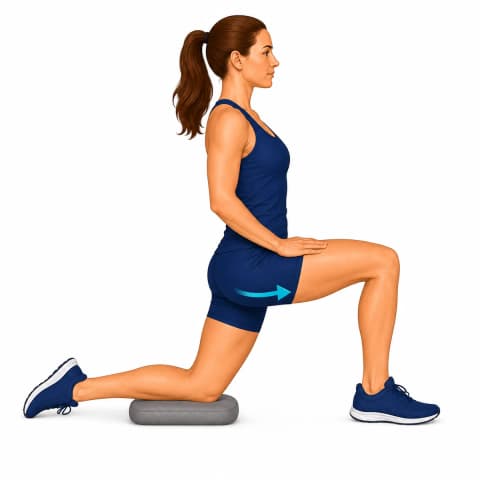
- Kneel on the leg you want to stretch, with the other foot planted in front (a half-kneeling lunge). Use a cushion under the knee.
- Gently tuck your tailbone under (a small posterior pelvic tilt) so your low back flattens slightly.
- Keeping tall and your core gently braced, ease your weight forward until you feel a comfortable stretch across the front of the kneeling hip.
- Hold, breathing easily — never push into back or leg pain. Switch sides.
Tips
- The stretch should be felt at the front of the hip/thigh, not in the back.
- Keep the gentle tailbone-tuck the whole time — letting the back arch defeats the purpose.
- A standing version (one foot up on a chair, ease the hips forward) works if kneeling is uncomfortable.
Commonly done as 2–3 each side sets of Hold 30 seconds, daily.
Where this appears in recovery
Hip Flexor Stretch is part of 8 recovery programs, most often at the return to normal (weeks 2–6), building comfort (weeks 2–6) and restoring motion (weeks 2–6) stages, among others. Each program shows how it fits alongside the other movements:
- Soft Tissue Mass Excision (Deep) exercise guide
- Bone Graft Harvest (Iliac Crest) exercise guide
- Hip Arthroscopy with FAI Decompression exercise guide
- Hip Arthroscopy with Labral Repair exercise guide
- Lumbar Spinal Stenosis exercise guide
- Lumbar Spinal Stenosis exercise guide
- Spondylolisthesis exercise guide
- Spondylolisthesis exercise guide
All exercise guides · Condition guides · Recovery education
These are general exercise guides, not a personal prescription. The repetitions and frequency shown are what's commonly used — your own surgeon or therapist may advise something different, and their guidance comes first.