Diaphragmatic Breathing
Calms the nervous system and gently wakes up your deep core without straining the back.
What it helps
Calms the nervous system and gently engages your deep core — a relaxed, supported way to start any session.
How to do it
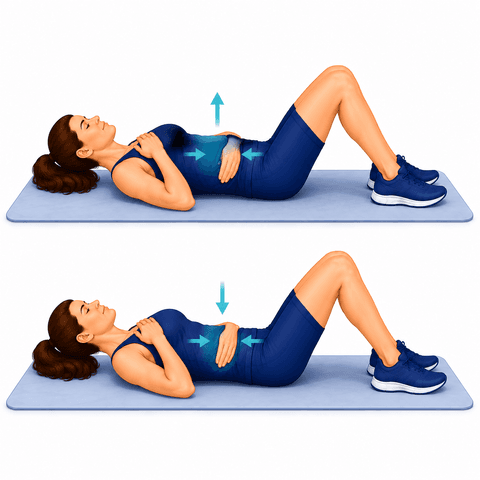
- Lie on your back, knees bent, one hand on your chest and one on your belly.
- Breathe in slowly through your nose so your belly rises while your chest stays still.
- Breathe out slowly through pursed lips, letting your belly fall.
Tips
- Keep it relaxed — never force the breath.
- Useful any time you feel tense or sore.
Commonly done as 5–10 breaths repetitions, several times a day.
Where this appears in recovery
Diaphragmatic Breathing is part of 48 recovery programs, most often at the immediate recovery (weeks 0–2), early recovery (weeks 2–6) and the first weeks (weeks 0–2) stages, among others. Each program shows how it fits alongside the other movements:
- Spinal Cord Stimulator Implant exercise guide
- Kyphoplasty exercise guide
- Cervical Laminoplasty exercise guide
- Revision ACDF exercise guide
- Sacroplasty exercise guide
- Lateral Lumbar Interbody Fusion (LLIF / XLIF / OLIF) exercise guide
- Anterior Cervical Discectomy and Fusion (ACDF) exercise guide
- Revision Lumbar Fusion exercise guide
- Lumbar Microdiscectomy exercise guide
- Revision Total Hip Arthroplasty (Both Components) exercise guide
- Posterior Spinal Fusion for Scoliosis exercise guide
- Posterior Spinal Fusion for Scoliosis exercise guide
- …and 36 more
All exercise guides · Condition guides · Recovery education
These are general exercise guides, not a personal prescription. The repetitions and frequency shown are what's commonly used — your own surgeon or therapist may advise something different, and their guidance comes first.