Abdominal Bracing
Builds gentle deep-core support that protects your spine during daily movement.
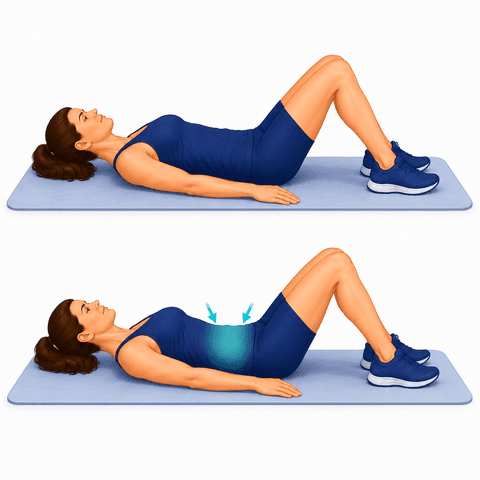
What it helps
Switches on the deep core muscles that stabilize and protect your spine through everyday movement — lifting, bending, twisting.
How to do it
- Lie on your back with knees bent.
- Gently tighten your stomach as if bracing for a light poke — do not suck in or hold your breath.
- Hold the light tension while breathing normally, then relax.
Tips
- Aim for about 20% effort, not a maximal squeeze.
- Brace before you roll, stand, or reach.
Commonly done as hold 5–10s sets of 10, a few times a day.
Where this appears in recovery
Abdominal Bracing is part of 38 recovery programs, most often at the strength & function (weeks 6–12), immediate recovery (weeks 0–2) and early recovery (weeks 2–6) stages, among others. Each program shows how it fits alongside the other movements:
- Spinal Cord Stimulator Implant exercise guide
- Kyphoplasty exercise guide
- Kyphoplasty exercise guide
- Sacroplasty exercise guide
- Sacroplasty exercise guide
- Lateral Lumbar Interbody Fusion (LLIF / XLIF / OLIF) exercise guide
- Revision Lumbar Fusion exercise guide
- Revision Lumbar Fusion exercise guide
- Revision Lumbar Fusion exercise guide
- Lumbar Microdiscectomy exercise guide
- Lumbar Microdiscectomy exercise guide
- Posterior Spinal Fusion for Scoliosis exercise guide
- …and 26 more
All exercise guides · Condition guides · Recovery education
These are general exercise guides, not a personal prescription. The repetitions and frequency shown are what's commonly used — your own surgeon or therapist may advise something different, and their guidance comes first.