Sport-Specific Training
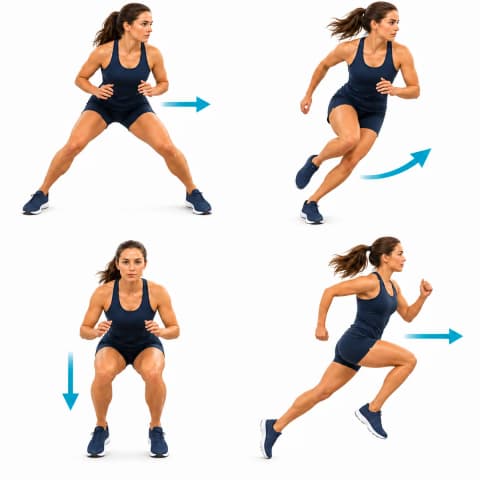
Practicing the movements of your sport as you prepare to return.
What it helps
Practicing the actual movements of your sport, so your return feels natural and prepared.
How to do it
- Rehearse the specific drills and movements your activity requires.
- Common examples: side shuffles, pivots and cuts, jump landings, and light sprints.
- Build volume and intensity gradually.
Tips
- Confidence and symmetry are good signs of readiness.
Commonly done as cleared.
Where this appears in recovery
Sport-Specific Training is part of 27 recovery programs, most often at the return to contact sport (months 9–15), return to sport (months 9–18) and long-term knee health (months 3–12) stages, among others. Each program shows how it fits alongside the other movements:
- Latarjet Procedure exercise guide
- ACL Revision Reconstruction exercise guide
- Knee Arthroscopy with Partial Meniscectomy exercise guide
- PCL Reconstruction exercise guide
- Achilles Tendon Repair exercise guide
- Distal Biceps Tendon Repair exercise guide
- Bankart Repair (Shoulder Stabilization) exercise guide
- AC Joint Reconstruction exercise guide
- SLAP Repair exercise guide
- Biceps Tenodesis (Arthroscopic) exercise guide
- ACL Reconstruction exercise guide
- Hip Arthroscopy with FAI Decompression exercise guide
- …and 15 more
All exercise guides · Condition guides · Recovery education
These are general exercise guides, not a personal prescription. The repetitions and frequency shown are what's commonly used — your own surgeon or therapist may advise something different, and their guidance comes first.