JointBooklet · jointbooklet.com
Ulnar Nerve Transposition Starter Exercise Guide
A short starting program — 8 exercises drawn from the full 34-exercise program. These are the movements most people begin with.
Before you begin. This is general guidance, not a personal prescription. If your surgeon or therapist has given you a different program or different limits, follow theirs.
1. Hand & Wrist Elevation and Swelling Control
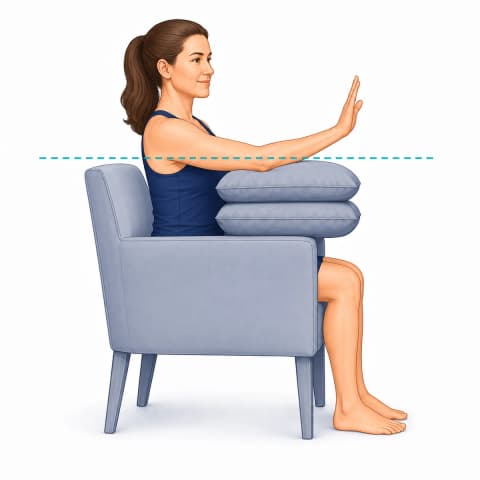
What it helps: Controls the swelling that is the main cause of stiffness after hand and wrist surgery. A swollen hand cannot make a full fist, and fingers left stiff in the first weeks are much harder to free later than the wrist itself is.
How often: every hour while awake sets of 10 slow fists, daily.
- Rest the hand higher than your heart. Sitting, prop the whole forearm on a stack of cushions so the hand sits above chest level.
- Standing, rest it on the opposite shoulder; lying down, support the whole forearm on pillows.
- With the hand up, slowly make a loose fist and open it fully, spreading the fingers.
- Repeat the slow fist-and-open several times, then let the hand rest in the raised position.
- Come back to it regularly through the day rather than doing one long session.
Tip: Above the heart is the part that matters. A hand resting on your lap or in a sling at waist height is not elevated, and this is the commonest reason swelling does not settle.
2. Finger Range of Motion
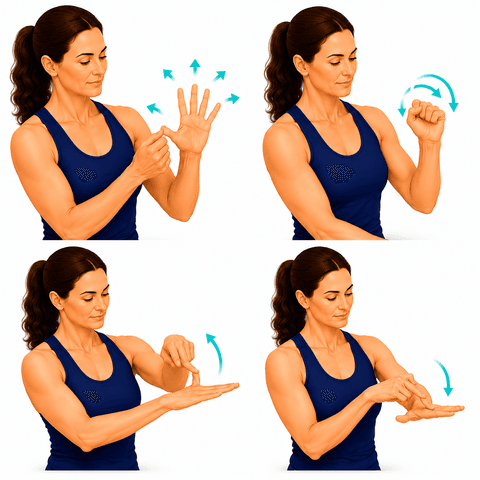
What it helps: Keeps the finger joints moving through their full range — preserving the bend and straighten you need to grip, pinch, and use your hands for everything.
How often: 2–3 sets of 10, daily (several times).
- Open the hand wide, fingers straight.
- Make a full fist, then open again.
- Bend each finger one at a time toward the palm, then straighten.
Tip: Smooth, comfortable motion through the whole range.
3. Grip Strengthening
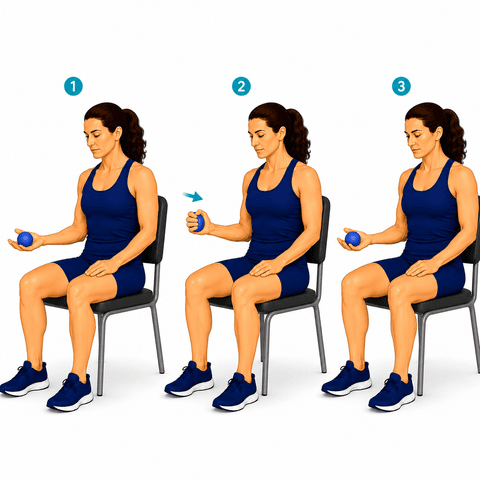
What it helps: Builds the grip and forearm strength behind almost every hand task — and supports the tendons at the elbow that grip relies on.
How often: 2–3 sets of 10–15, most days.
- Hold a soft ball or therapy putty in your hand.
- Squeeze firmly and hold a few seconds, then relax fully.
- Work through comfortable effort; stop short of sharp pain.
Tip: Full squeeze, full relax — both matter.
4. Ulnar Nerve Glides
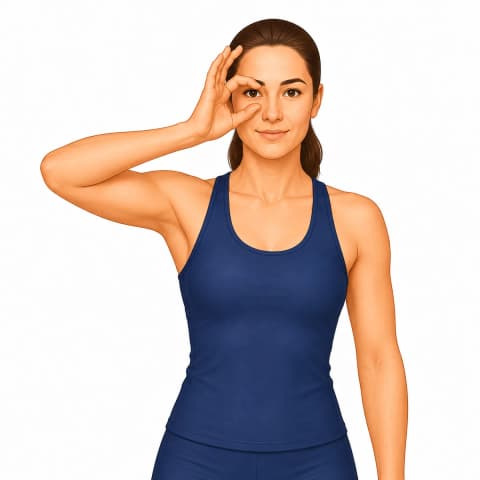
What it helps: Encourages the ulnar nerve to slide freely through the elbow rather than tethering in scar tissue after surgery. A nerve that glides is a nerve that stops being irritated by ordinary elbow movement.
How often: 2–3 sets of 5–10, several times daily.
- Start with the arm down by your side, palm facing forward.
- Bend the elbow and bring the hand up toward your face, turning the palm toward you.
- Make a circle with your thumb and index finger and bring it around your eye, like holding a monocle, keeping the elbow lifted out to the side.
- Hold briefly, then reverse the sequence smoothly back to the starting position.
Tip: This is a glide, not a stretch. Move in and out of the position smoothly rather than holding at the end and pulling.
5. Scapular Retraction
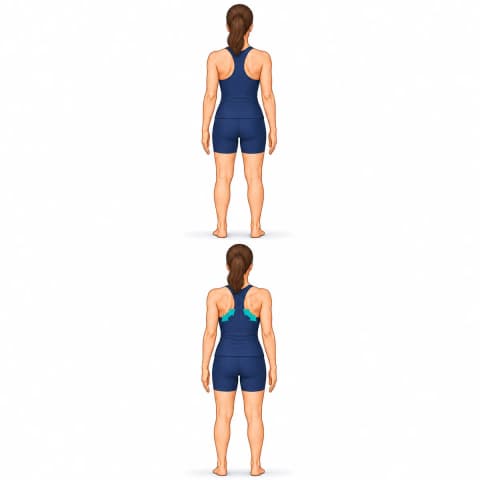
What it helps: Keeps the muscles that position the shoulder blade working while the shoulder joint itself is resting. Those muscles set the platform the whole shoulder moves on, and they weaken quickly in a sling, which makes the later recovery harder than it needs to be.
How often: 2–3 sets of hold 5s, 10 times, daily.
- Sit or stand tall with your arms resting at your sides.
- Draw both shoulder blades gently back and down, as though squeezing them toward each other.
- Keep the movement small and slow. Your arms should not move at all.
- Hold briefly, then relax completely.
Tip: Small is correct. This is a squeeze between the shoulder blades, not a shrug and not an arm movement.
6. Gentle Neck Isometrics
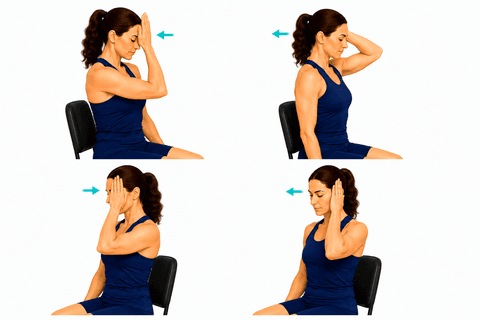
What it helps: Strengthens the deep muscles that support and steady your neck without moving it — a safe, comfortable way to build the support that eases neck pain.
How often: 5 each direction sets of Hold 5–10 seconds, daily.
- Sit tall with a gentle chin-tuck. Place your palm on your forehead.
- Press your head lightly into your hand and your hand back into your head — a steady, comfortable push with NO movement of the neck.
- Hold, relax, and repeat. Do the same with the hand on the back of the head, then each side.
Tip: Light pressure — about 20–30% effort. This is not a strength test.
7. Core Activation
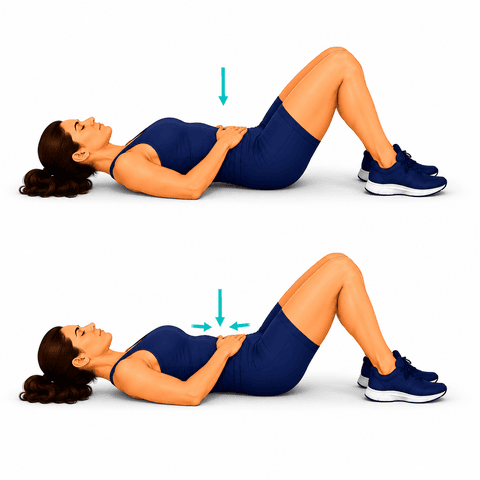
What it helps: Switches on the deep core muscles that stabilize your pelvis and spine, giving your hips a solid platform to move from.
How often: 2-3 sets of 10, daily.
- Lie or sit comfortably.
- Gently draw your belly button toward your spine.
- Hold a few seconds while breathing normally, then relax.
Tip: Avoid holding your breath.
8. Walking Program
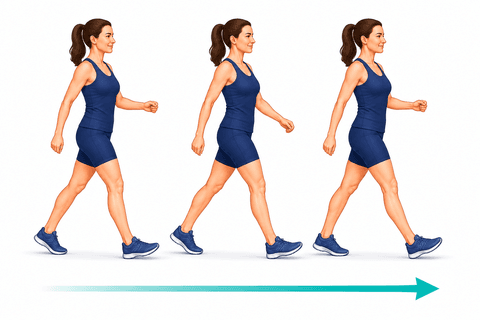
What it helps: Comfortable, frequent walking keeps the joints loose, builds your stamina, and rebuilds confidence on your feet. Little and often beats long and tiring.
How often: throughout the day.
- Take short walks at a comfortable pace.
- Increase your distance gradually as you feel able.
Tip: Use your assistive device as directed.
See the complete 34-exercise program, phase by phase.
What to expect in recovery
The full recovery guide for this procedure: Ulnar Nerve Transposition recovery.
Recovery reading
Browse all exercise guides · Condition guides · Recovery education library
Are you a clinician? See how orthopedic practices use JointBooklet.
Are you a clinician? See how orthopedic practices use JointBooklet.
These are general exercise guides, not a personal prescription. The repetitions and frequency shown are what's commonly used — your own surgeon or therapist may advise something different, and their guidance comes first.