Core Activation
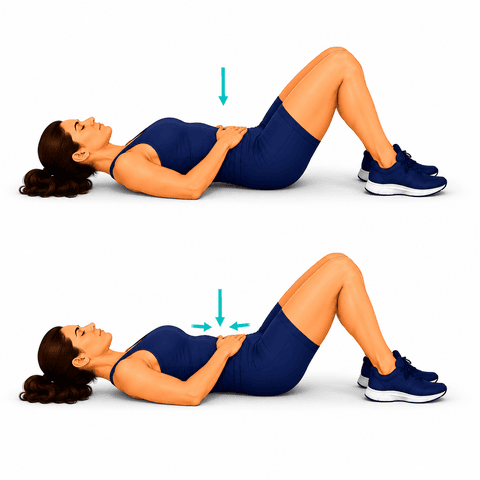
Gentle core engagement to support posture and balance while you recover.
What it helps
Switches on the deep core muscles that stabilize your pelvis and spine, giving your hips a solid platform to move from.
How to do it
- Lie or sit comfortably.
- Gently draw your belly button toward your spine.
- Hold a few seconds while breathing normally, then relax.
Tips
- Avoid holding your breath.
Commonly done as 2-3 sets of 10, daily.
Where this appears in recovery
Core Activation is part of 80 recovery programs, most often at the protected healing (weeks 0–2), immediate recovery (weeks 0–2) and wound and swelling (weeks 0–2) stages, among others. Each program shows how it fits alongside the other movements:
- Clavicle Fracture ORIF exercise guide
- Tarsal Tunnel Release exercise guide
- Distal Fibula Fracture ORIF exercise guide
- Achilles Tendon Lengthening exercise guide
- Lapidus Bunionectomy exercise guide
- Soft Tissue Mass Excision (Deep) exercise guide
- Cervical Laminoplasty exercise guide
- Achilles Tendon Repair exercise guide
- Superior Capsular Reconstruction exercise guide
- Bone Graft Harvest (Iliac Crest) exercise guide
- Subtalar Fusion exercise guide
- Distal Biceps Tendon Repair exercise guide
- …and 68 more
All exercise guides · Condition guides · Recovery education
These are general exercise guides, not a personal prescription. The repetitions and frequency shown are what's commonly used — your own surgeon or therapist may advise something different, and their guidance comes first.