Scapular Retraction
Gentle shoulder-blade squeezes — safe immediately, because the shoulder joint itself does not move.
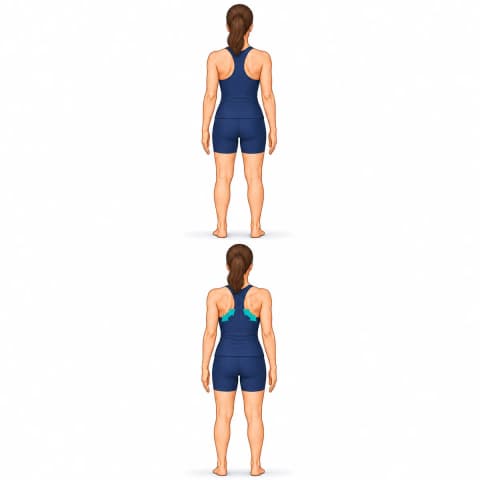
What it helps
Keeps the muscles that position the shoulder blade working while the shoulder joint itself is resting. Those muscles set the platform the whole shoulder moves on, and they weaken quickly in a sling, which makes the later recovery harder than it needs to be.
How to do it
- Sit or stand tall with your arms resting at your sides.
- Draw both shoulder blades gently back and down, as though squeezing them toward each other.
- Keep the movement small and slow. Your arms should not move at all.
- Hold briefly, then relax completely.
Tips
- Small is correct. This is a squeeze between the shoulder blades, not a shrug and not an arm movement.
- Because the shoulder joint stays still, this is usually allowed from the first days — check with your care team if unsure.
- If your arm is in a sling, leave it there. This works just the same.
- Easy to do sitting at a desk or watching television, several short sets through the day.
Commonly done as 2–3 sets of hold 5s, 10 times, daily.
Where this appears in recovery
Scapular Retraction is part of 55 recovery programs, most often at the protected healing (weeks 0–2), regaining motion (weeks 2–6) and protected healing (weeks 0–3) stages, among others. Each program shows how it fits alongside the other movements:
- Clavicle Fracture ORIF exercise guide
- Clavicle Fracture ORIF exercise guide
- Latarjet Procedure exercise guide
- Latarjet Procedure exercise guide
- Distal Clavicle Excision exercise guide
- Distal Clavicle Excision exercise guide
- Superior Capsular Reconstruction exercise guide
- Superior Capsular Reconstruction exercise guide
- Arthroscopic Rotator Cuff Repair exercise guide
- Arthroscopic Rotator Cuff Repair exercise guide
- Distal Biceps Tendon Repair exercise guide
- Distal Biceps Tendon Repair exercise guide
- …and 43 more
All exercise guides · Condition guides · Recovery education
These are general exercise guides, not a personal prescription. The repetitions and frequency shown are what's commonly used — your own surgeon or therapist may advise something different, and their guidance comes first.