Hand Pain — Complete Exercise Program
Looking for a shorter starting point? The Hand Pain starter guide covers the first 8 exercises on a printable sheet.
A phase-by-phase exercise program used in recovery for hand pain. Each movement includes what it's working on and how it's typically performed. Your own surgeon's or therapist's guidance always comes first.
Phase 1
Finger Range of Motion
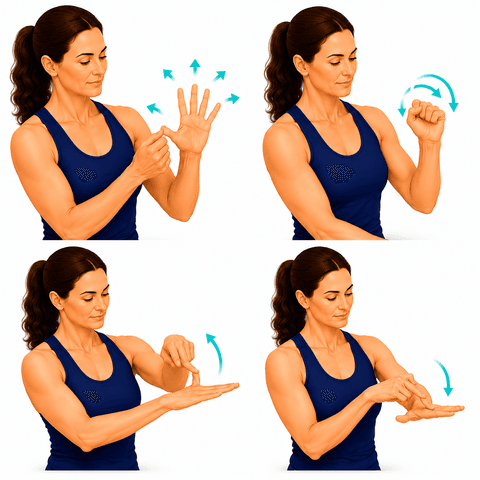
Gentle bending and straightening to keep the finger joints moving.
What it helps: Keeps the finger joints moving through their full range — preserving the bend and straighten you need to grip, pinch, and use your hands for everything.
- Open the hand wide, fingers straight.
- Make a full fist, then open again.
- Bend each finger one at a time toward the palm, then straighten.
Tips:
- Smooth, comfortable motion through the whole range.
- Do it often through the day, especially when the hand feels stiff.
Commonly done as 2–3 sets of 10, daily (several times).
Tendon Gliding (Finger Glides)
A sequence of finger positions that keeps the tendons sliding smoothly through the hand and wrist.
What it helps: Keeps the finger tendons sliding freely through their sheaths and the carpal tunnel — preventing stiffness and catching, and keeping the hand smooth and supple.
- Start with fingers straight.
- Bend just the top two knuckles into a "hook," then straighten.
- Make a full fist, then straighten.
- Bend the big knuckles only into a "tabletop," then straighten.
- Make a "straight fist" (fingers curled but knuckles flat). Move slowly through each.
Tips:
- Move smoothly through the whole sequence.
- Gentle and controlled — these keep the tendons gliding, not strengthening.
Commonly done as 2–3 sets of 5–10 of each, daily.
Finger & Hand Stretch
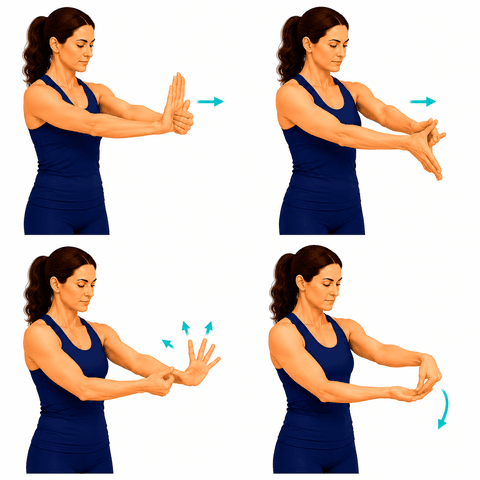
Gentle stretches for the fingers and palm to ease stiffness.
What it helps: Eases stiffness in the finger joints and palm — keeping the hand supple and the fingers moving freely for grip and pinch.
- Gently straighten the fingers back with the other hand until you feel a mild stretch in the palm and fingers.
- Spread the fingers wide and hold.
- Gently bend each finger and hold a moment.
Tips:
- Gentle, mild stretches — never force a stiff or sore joint.
- A warm soak or heat first makes stretching more comfortable.
Commonly done as 2–3 sets of Hold 10–15 sec, daily.
Posture Training
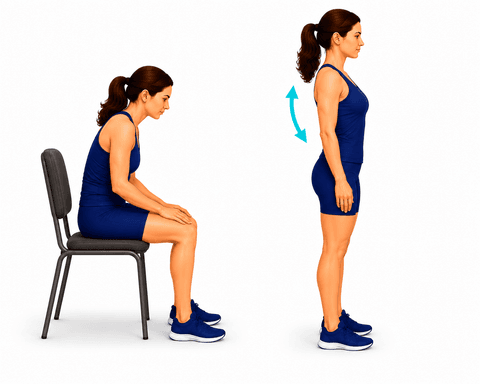
Trains a neutral spine for sitting, standing, and lifting safely.
What it helps: Trains a neutral, balanced spine for sitting, standing, and lifting — good posture takes strain off the back all day long.
- Sit or stand tall, stacking ears over shoulders over hips.
- Gently draw your shoulder blades down and back.
- Hold a tall, relaxed neutral position; reset whenever you slouch.
Tips:
- Set reminders to check your posture during the day.
- A small lumbar roll helps when sitting.
Commonly done throughout the day.
Walking Program
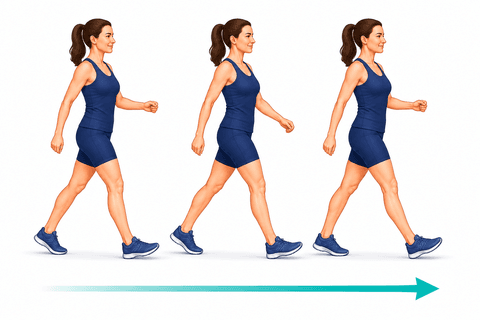
Short, frequent walks build endurance and confidence.
What it helps: Comfortable, frequent walking keeps the joints loose, builds your stamina, and rebuilds confidence on your feet. Little and often beats long and tiring.
- Take short walks at a comfortable pace.
- Increase your distance gradually as you feel able.
Tips:
- Use your assistive device as directed.
Commonly done throughout the day.
Phase 2
Tendon Gliding (Finger Glides)
A sequence of finger positions that keeps the tendons sliding smoothly through the hand and wrist.
What it helps: Keeps the finger tendons sliding freely through their sheaths and the carpal tunnel — preventing stiffness and catching, and keeping the hand smooth and supple.
- Start with fingers straight.
- Bend just the top two knuckles into a "hook," then straighten.
- Make a full fist, then straighten.
- Bend the big knuckles only into a "tabletop," then straighten.
- Make a "straight fist" (fingers curled but knuckles flat). Move slowly through each.
Tips:
- Move smoothly through the whole sequence.
- Gentle and controlled — these keep the tendons gliding, not strengthening.
Commonly done as 2–3 sets of 5–10 of each, daily.
Finger Range of Motion
Gentle bending and straightening to keep the finger joints moving.
What it helps: Keeps the finger joints moving through their full range — preserving the bend and straighten you need to grip, pinch, and use your hands for everything.
- Open the hand wide, fingers straight.
- Make a full fist, then open again.
- Bend each finger one at a time toward the palm, then straighten.
Tips:
- Smooth, comfortable motion through the whole range.
- Do it often through the day, especially when the hand feels stiff.
Commonly done as 2–3 sets of 10, daily (several times).
Hand Putty Exercises

All-around hand strengthening with therapy putty — grip, pinch, and spread.
What it helps: Builds all-around hand and finger strength — grip, pinch, and the muscles that spread the fingers — the foundation of strong, capable hands for daily tasks.
- Squeeze the putty in a full fist, then release.
- Pinch the putty between the thumb and each fingertip in turn.
- Press the putty flat and dig individual fingers in; spread the fingers against a loop of putty.
Tips:
- Comfortable effort; full squeeze and full release.
- Putty comes in firmnesses — start soft and progress as you get stronger.
Commonly done as 2 sets of 10 each, most days.
Grip Strengthening

Builds hand and forearm grip strength with a ball or putty.
What it helps: Builds the grip and forearm strength behind almost every hand task — and supports the tendons at the elbow that grip relies on.
- Hold a soft ball or therapy putty in your hand.
- Squeeze firmly and hold a few seconds, then relax fully.
- Work through comfortable effort; stop short of sharp pain.
Tips:
- Full squeeze, full relax — both matter.
- Grip work loads the elbow tendons, so build it gradually if you have tennis or golfer's elbow.
Commonly done as 2–3 sets of 10–15, most days.
Walking Program
Short, frequent walks build endurance and confidence.
What it helps: Comfortable, frequent walking keeps the joints loose, builds your stamina, and rebuilds confidence on your feet. Little and often beats long and tiring.
- Take short walks at a comfortable pace.
- Increase your distance gradually as you feel able.
Tips:
- Use your assistive device as directed.
Commonly done throughout the day.
Phase 3
Hand Putty Exercises
All-around hand strengthening with therapy putty — grip, pinch, and spread.
What it helps: Builds all-around hand and finger strength — grip, pinch, and the muscles that spread the fingers — the foundation of strong, capable hands for daily tasks.
- Squeeze the putty in a full fist, then release.
- Pinch the putty between the thumb and each fingertip in turn.
- Press the putty flat and dig individual fingers in; spread the fingers against a loop of putty.
Tips:
- Comfortable effort; full squeeze and full release.
- Putty comes in firmnesses — start soft and progress as you get stronger.
Commonly done as 2 sets of 10 each, most days.
Grip Strengthening
Builds hand and forearm grip strength with a ball or putty.
What it helps: Builds the grip and forearm strength behind almost every hand task — and supports the tendons at the elbow that grip relies on.
- Hold a soft ball or therapy putty in your hand.
- Squeeze firmly and hold a few seconds, then relax fully.
- Work through comfortable effort; stop short of sharp pain.
Tips:
- Full squeeze, full relax — both matter.
- Grip work loads the elbow tendons, so build it gradually if you have tennis or golfer's elbow.
Commonly done as 2–3 sets of 10–15, most days.
Finger Extension (Rubber Band)
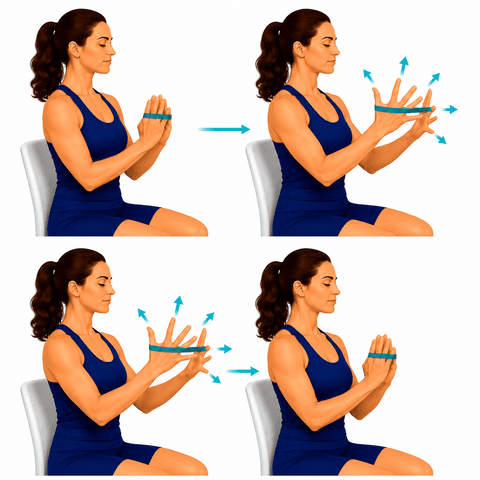
Strengthens the muscles that open the hand and straighten the fingers.
What it helps: Builds the often-overlooked muscles that open the hand — balancing the strong gripping muscles and supporting smooth, comfortable finger movement.
- Place a rubber band around the outside of your fingers and thumb.
- Open the fingers and thumb apart against the band's resistance.
- Slowly close back with control.
Tips:
- Use a band light enough to do smoothly.
- Controlled open and close — both directions matter.
Commonly done as 2 sets of 10–15, most days.
Thumb Strengthening
Builds pinch and thumb strength with putty or a soft ball.
What it helps: Builds the pinch and thumb strength behind opening jars, turning keys, and gripping — and supports the base of the thumb so it carries pinch loads more comfortably.
- Pinch therapy putty or a soft ball between the thumb and the side of the index finger; hold, then release.
- Pinch between the thumb tip and each fingertip in turn.
- Press the thumb into the putty and push, then relax.
Tips:
- Comfortable effort — stop short of sharp pain at the base of the thumb.
- Full pinch, full release.
Commonly done as 2 sets of 10, most days.
Walking Program
Short, frequent walks build endurance and confidence.
What it helps: Comfortable, frequent walking keeps the joints loose, builds your stamina, and rebuilds confidence on your feet. Little and often beats long and tiring.
- Take short walks at a comfortable pace.
- Increase your distance gradually as you feel able.
Tips:
- Use your assistive device as directed.
Commonly done throughout the day.
Phase 4
Hand Putty Exercises
All-around hand strengthening with therapy putty — grip, pinch, and spread.
What it helps: Builds all-around hand and finger strength — grip, pinch, and the muscles that spread the fingers — the foundation of strong, capable hands for daily tasks.
- Squeeze the putty in a full fist, then release.
- Pinch the putty between the thumb and each fingertip in turn.
- Press the putty flat and dig individual fingers in; spread the fingers against a loop of putty.
Tips:
- Comfortable effort; full squeeze and full release.
- Putty comes in firmnesses — start soft and progress as you get stronger.
Commonly done as 2 sets of 10 each, most days.
Grip Strengthening
Builds hand and forearm grip strength with a ball or putty.
What it helps: Builds the grip and forearm strength behind almost every hand task — and supports the tendons at the elbow that grip relies on.
- Hold a soft ball or therapy putty in your hand.
- Squeeze firmly and hold a few seconds, then relax fully.
- Work through comfortable effort; stop short of sharp pain.
Tips:
- Full squeeze, full relax — both matter.
- Grip work loads the elbow tendons, so build it gradually if you have tennis or golfer's elbow.
Commonly done as 2–3 sets of 10–15, most days.
Finger Extension (Rubber Band)
Strengthens the muscles that open the hand and straighten the fingers.
What it helps: Builds the often-overlooked muscles that open the hand — balancing the strong gripping muscles and supporting smooth, comfortable finger movement.
- Place a rubber band around the outside of your fingers and thumb.
- Open the fingers and thumb apart against the band's resistance.
- Slowly close back with control.
Tips:
- Use a band light enough to do smoothly.
- Controlled open and close — both directions matter.
Commonly done as 2 sets of 10–15, most days.
Low-Impact Recreational Activities
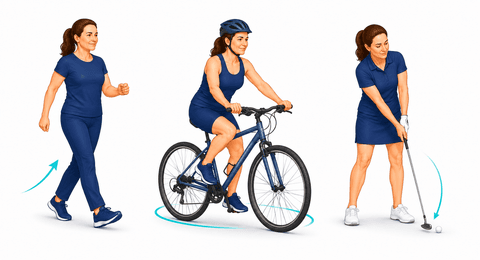
Enjoyable activities that protect your joint.
What it helps: Getting back to the activities you enjoy in ways that are kind to your joints — the whole point of building this strength.
Commonly done as you like.
Walking Program
Short, frequent walks build endurance and confidence.
What it helps: Comfortable, frequent walking keeps the joints loose, builds your stamina, and rebuilds confidence on your feet. Little and often beats long and tiring.
- Take short walks at a comfortable pace.
- Increase your distance gradually as you feel able.
Tips:
- Use your assistive device as directed.
Commonly done throughout the day.
Phase 5
Hand Putty Exercises
All-around hand strengthening with therapy putty — grip, pinch, and spread.
What it helps: Builds all-around hand and finger strength — grip, pinch, and the muscles that spread the fingers — the foundation of strong, capable hands for daily tasks.
- Squeeze the putty in a full fist, then release.
- Pinch the putty between the thumb and each fingertip in turn.
- Press the putty flat and dig individual fingers in; spread the fingers against a loop of putty.
Tips:
- Comfortable effort; full squeeze and full release.
- Putty comes in firmnesses — start soft and progress as you get stronger.
Commonly done as 2 sets of 10 each, most days.
Grip Strengthening
Builds hand and forearm grip strength with a ball or putty.
What it helps: Builds the grip and forearm strength behind almost every hand task — and supports the tendons at the elbow that grip relies on.
- Hold a soft ball or therapy putty in your hand.
- Squeeze firmly and hold a few seconds, then relax fully.
- Work through comfortable effort; stop short of sharp pain.
Tips:
- Full squeeze, full relax — both matter.
- Grip work loads the elbow tendons, so build it gradually if you have tennis or golfer's elbow.
Commonly done as 2–3 sets of 10–15, most days.
Finger Range of Motion
Gentle bending and straightening to keep the finger joints moving.
What it helps: Keeps the finger joints moving through their full range — preserving the bend and straighten you need to grip, pinch, and use your hands for everything.
- Open the hand wide, fingers straight.
- Make a full fist, then open again.
- Bend each finger one at a time toward the palm, then straighten.
Tips:
- Smooth, comfortable motion through the whole range.
- Do it often through the day, especially when the hand feels stiff.
Commonly done as 2–3 sets of 10, daily (several times).
Walking Program
Short, frequent walks build endurance and confidence.
What it helps: Comfortable, frequent walking keeps the joints loose, builds your stamina, and rebuilds confidence on your feet. Little and often beats long and tiring.
- Take short walks at a comfortable pace.
- Increase your distance gradually as you feel able.
Tips:
- Use your assistive device as directed.
Commonly done throughout the day.
Low-Impact Recreational Activities
Enjoyable activities that protect your joint.
What it helps: Getting back to the activities you enjoy in ways that are kind to your joints — the whole point of building this strength.
Commonly done as you like.
About Hand Pain
What the condition is, how it's usually managed, and what to expect — read the Hand Pain guide.
Recovery reading
Browse all exercise guides · Condition guides · Recovery education library
These are general exercise guides, not a personal prescription. The repetitions and frequency shown are what's commonly used — your own surgeon or therapist may advise something different, and their guidance comes first.