Posture Training
Trains a neutral spine for sitting, standing, and lifting safely.
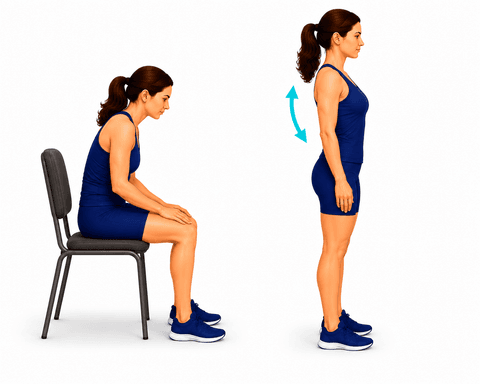
What it helps
Trains a neutral, balanced spine for sitting, standing, and lifting — good posture takes strain off the back all day long.
How to do it
- Sit or stand tall, stacking ears over shoulders over hips.
- Gently draw your shoulder blades down and back.
- Hold a tall, relaxed neutral position; reset whenever you slouch.
Tips
- Set reminders to check your posture during the day.
- A small lumbar roll helps when sitting.
Commonly done throughout the day.
Where this appears in recovery
Posture Training is part of 115 recovery programs, most often at the immediate recovery (weeks 0–2), early recovery (weeks 2–6) and strength & function (weeks 6–12) stages, among others. Each program shows how it fits alongside the other movements:
- Spinal Cord Stimulator Implant exercise guide
- Spinal Cord Stimulator Implant exercise guide
- Kyphoplasty exercise guide
- Kyphoplasty exercise guide
- Cervical Laminoplasty exercise guide
- Cervical Laminoplasty exercise guide
- Revision ACDF exercise guide
- Revision ACDF exercise guide
- Sacroplasty exercise guide
- Sacroplasty exercise guide
- Sacroplasty exercise guide
- Lateral Lumbar Interbody Fusion (LLIF / XLIF / OLIF) exercise guide
- …and 103 more
All exercise guides · Condition guides · Recovery education
These are general exercise guides, not a personal prescription. The repetitions and frequency shown are what's commonly used — your own surgeon or therapist may advise something different, and their guidance comes first.