JointBooklet · jointbooklet.com
De Quervain's Tenosynovitis Starter Exercise Guide
A short starting program — 8 exercises drawn from the full 25-exercise program. These are the movements most people begin with.
Before you begin. This is general guidance, not a personal prescription. If your surgeon or therapist has given you a different program or different limits, follow theirs.
1. Thumb & Wrist Stretch

What it helps: Eases tension in the thumb-side wrist tendons — gently loosening the tight, irritated tendons that limit thumb and wrist use.
How often: 3 sets of Hold 15–20 sec, daily.
- Hold the arm out, thumb up. Gently bend the wrist downward and toward the little-finger side until you feel a mild stretch along the thumb side of the wrist.
- Hold gently; keep it comfortable.
- You can tuck the thumb lightly into the palm first for a touch more — but never force it.
Tip: A gentle, mild stretch only — thumb-side tendons are easily over-stretched.
2. Wrist Isometrics
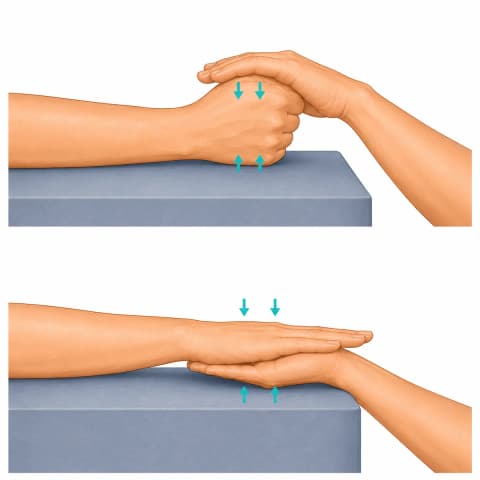
What it helps: Loads the forearm tendons gently without movement — a comfortable way to keep them strong and often to ease tendon pain before they're ready for moving resistance.
How often: 1 sets of Hold 20–45 sec ×3–5, daily.
- Rest the forearm on a table, hand off the edge. For extensors: make a light fist, push the back of the hand up against your other hand — no movement — and hold.
- For flexors: push the palm down against your other hand and hold.
- Use comfortable pressure; the wrist stays still.
Tip: No movement happens — you're holding against resistance.
3. Wrist Range of Motion
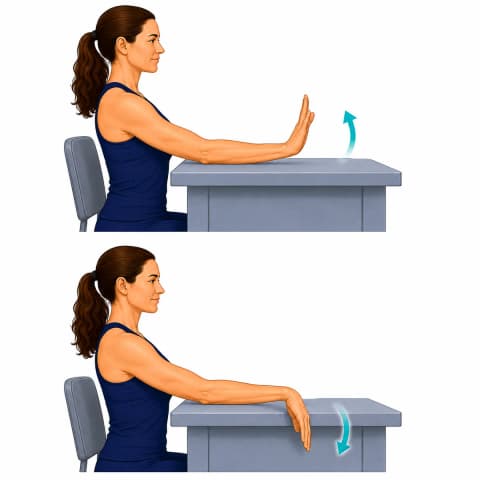
What it helps: Keeps the wrist moving through its full range — preserving the bend, straighten, and side-to-side motion you use for everyday hand tasks.
How often: 2–3 sets of 10 each, daily.
- Rest your forearm on a table with your hand just past the edge, hand open and relaxed.
- Bend the wrist up so the back of the hand rises, then down so the fingers drop, through a comfortable range.
- Then move the hand side to side — toward the thumb, then toward the little finger.
- Finally make slow circles.
Tip: Smooth, comfortable motion — don't force the ends.
4. Posture Training
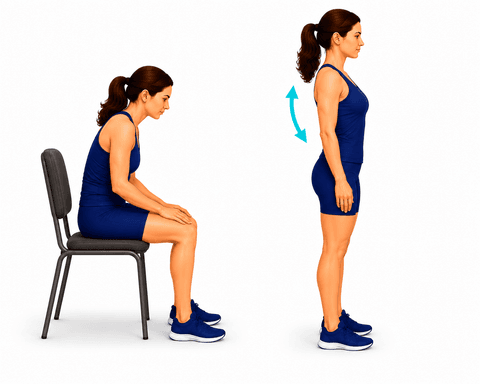
What it helps: Trains a neutral, balanced spine for sitting, standing, and lifting — good posture takes strain off the back all day long.
How often: throughout the day.
- Sit or stand tall, stacking ears over shoulders over hips.
- Gently draw your shoulder blades down and back.
- Hold a tall, relaxed neutral position; reset whenever you slouch.
Tip: Set reminders to check your posture during the day.
5. Walking Program
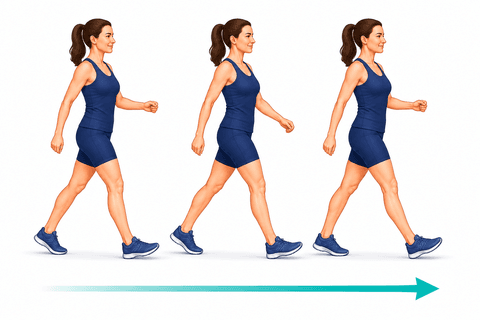
What it helps: Comfortable, frequent walking keeps the joints loose, builds your stamina, and rebuilds confidence on your feet. Little and often beats long and tiring.
How often: throughout the day.
- Take short walks at a comfortable pace.
- Increase your distance gradually as you feel able.
Tip: Use your assistive device as directed.
6. Wrist Deviation (Side-to-Side)
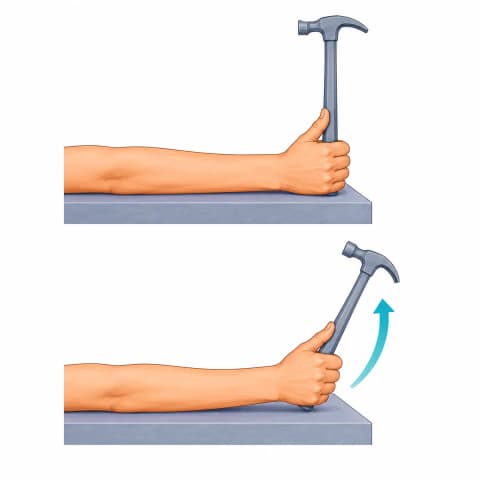
What it helps: Strengthens the side-to-side wrist muscles — important support for the thumb-side tendons and for steady, controlled wrist use.
How often: 2 sets of 10–12, most days.
- Rest the forearm on a table with the hand off the edge, thumb up, holding a light weight or hammer.
- Slowly raise the hand toward the thumb side, then lower with control.
- Keep the forearm still; the motion is at the wrist.
Tip: Light resistance, controlled motion.
7. Forearm Stretch (Flexors & Extensors)
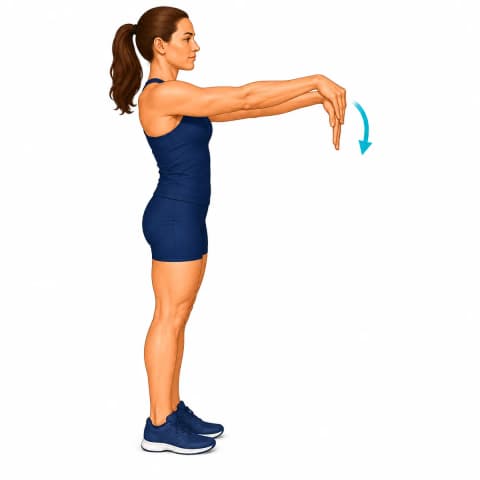
What it helps: Loosens the forearm muscles that attach at the elbow — easing the tension that pulls on irritated tendons and limits comfortable wrist and grip use.
How often: 3 sets of Hold 20–30 sec each, daily.
- Straighten the arm in front of you, palm down. With the other hand, gently bend the wrist down until you feel a stretch along the top of the forearm (extensors).
- Then turn the palm up and gently bend the wrist down to stretch the underside (flexors).
- Hold each gently; keep the elbow straight.
Tip: A gentle, steady pull — never sharp.
8. Grip Strengthening
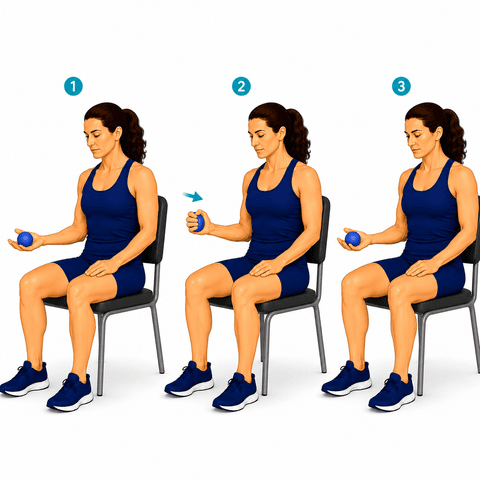
What it helps: Builds the grip and forearm strength behind almost every hand task — and supports the tendons at the elbow that grip relies on.
How often: 2–3 sets of 10–15, most days.
- Hold a soft ball or therapy putty in your hand.
- Squeeze firmly and hold a few seconds, then relax fully.
- Work through comfortable effort; stop short of sharp pain.
Tip: Full squeeze, full relax — both matter.
See the complete 25-exercise program, phase by phase.
About De Quervain's Tenosynovitis
What the condition is, how it's usually managed, and what to expect — read the De Quervain's Tenosynovitis guide.
Recovery reading
Browse all exercise guides · Condition guides · Recovery education library
Are you a clinician? See how orthopedic practices use JointBooklet.
Are you a clinician? See how orthopedic practices use JointBooklet.
These are general exercise guides, not a personal prescription. The repetitions and frequency shown are what's commonly used — your own surgeon or therapist may advise something different, and their guidance comes first.