Single-Leg Balance
Improves balance and stability.
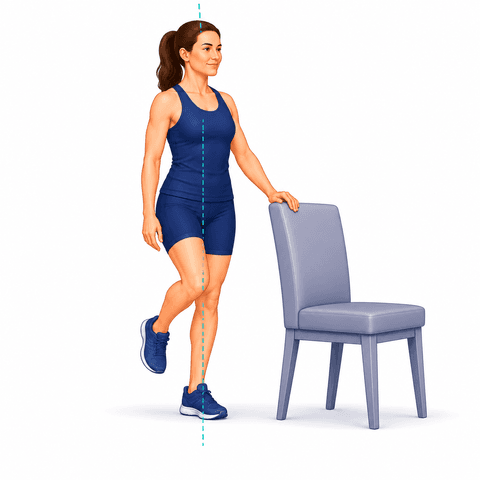
What it helps
Trains your hip and leg to stay steady when all your weight is on one side — which is most of walking. Better balance means a surer, more confident step.
How to do it
- Stand near a counter for safety.
- Lift one foot and balance on the other leg.
- Hold as able.
Tips
- Holding the counter with one or both hands still counts. Letting go comes later, if it comes at all.
Commonly done daily.
Where this appears in recovery
Single-Leg Balance is part of 133 recovery programs, most often at the strength building (months 2–5), return to sport (months 9–18) and advanced recovery (months 3–6) stages, among others. Each program shows how it fits alongside the other movements:
- ACL Revision Reconstruction exercise guide
- ACL Revision Reconstruction exercise guide
- Tarsal Tunnel Release exercise guide
- Distal Fibula Fracture ORIF exercise guide
- Spinal Cord Stimulator Implant exercise guide
- Knee Arthroscopy (Diagnostic / Debridement) exercise guide
- Kyphoplasty exercise guide
- Knee Arthroscopy with Partial Meniscectomy exercise guide
- Achilles Tendon Lengthening exercise guide
- Lapidus Bunionectomy exercise guide
- PCL Reconstruction exercise guide
- PCL Reconstruction exercise guide
- …and 121 more
All exercise guides · Condition guides · Recovery education
These are general exercise guides, not a personal prescription. The repetitions and frequency shown are what's commonly used — your own surgeon or therapist may advise something different, and their guidance comes first.