Isometric Hip Abduction
A steady, held push outward that loads the side-hip muscles without any movement — often the gentlest way to start.
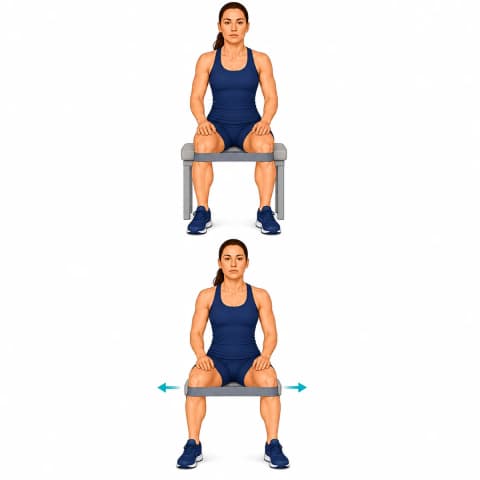
What it helps
Holding a steady contraction loads the side-hip tendons gently — it often eases pain while it begins rebuilding their strength. A calm, controlled first step before adding moving loads.
How to do it
- Sit tall (or lie on your back) with a looped band around the outside of your knees — or simply use your hands on the outside of your knees for resistance.
- Press your knees gently outward against the band or your hands.
- Hold a firm but comfortable push — steady, no movement — then slowly relax.
- Rest a moment and repeat.
Tips
- You should feel the muscles on the side of the hip working — not your hip pain. Ease the effort if it provokes the sore spot.
- Keep breathing normally through the hold; don't hold your breath.
- Hold, don't bounce — the whole point is a steady contraction.
Commonly done as 4–5 holds sets of Hold 30–45 seconds, daily.
Where this appears in recovery
Isometric Hip Abduction is part of 18 recovery programs, most often at the immediate recovery (weeks 0–2), protected healing (weeks 0–2) and early recovery (weeks 0–2) stages, among others. Each program shows how it fits alongside the other movements:
- ACL Revision Reconstruction exercise guide
- PCL Reconstruction exercise guide
- Bone Graft Harvest (Iliac Crest) exercise guide
- Microfracture (Knee Cartilage) exercise guide
- Revision Total Hip Arthroplasty (Both Components) exercise guide
- Revision Total Hip Arthroplasty (Both Components) exercise guide
- Hip Arthroscopy with FAI Decompression exercise guide
- MACI Cartilage Implantation exercise guide
- Revision Total Hip Arthroplasty (Femoral Component) exercise guide
- Hip Arthroscopy with Labral Repair exercise guide
- Patellar Tendon Repair exercise guide
- Meniscal Repair exercise guide
- …and 6 more
All exercise guides · Condition guides · Recovery education
These are general exercise guides, not a personal prescription. The repetitions and frequency shown are what's commonly used — your own surgeon or therapist may advise something different, and their guidance comes first.