Elliptical Trainer
Low-impact cardio that is easy on the joints.
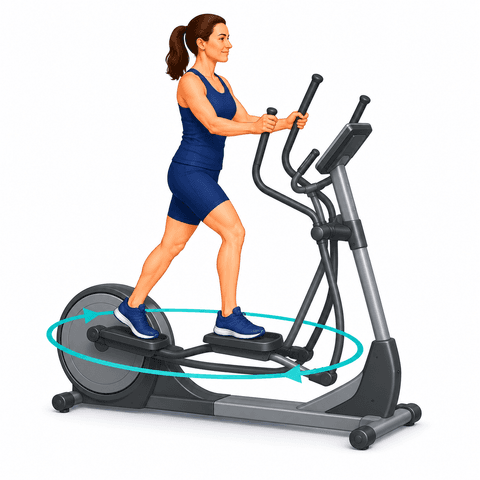
What it helps
Low-impact cardio that builds endurance and keeps the legs moving while staying easy on the joints.
How to do it
- Step on with your feet flat on the pedals and take hold of the moving handles.
- Start with low resistance and let your legs trace smooth ovals, keeping your heels down.
- Stay upright rather than leaning your weight onto the handles.
- Build the time first and the resistance later.
Tips
- Your feet never leave the pedals, which is what makes this gentler on the joints than a treadmill.
- The moving handles bring the arms in. The fixed centre bars are there instead if you would rather steady yourself.
- Ten easy minutes is a reasonable place to start.
Commonly done as able.
Where this appears in recovery
Elliptical Trainer is part of 83 recovery programs, most often at the return to running (months 5–9), advanced recovery (months 3–6) and strength building (months 1–3) stages, among others. Each program shows how it fits alongside the other movements:
- ACL Revision Reconstruction exercise guide
- Tarsal Tunnel Release exercise guide
- Distal Fibula Fracture ORIF exercise guide
- Spinal Cord Stimulator Implant exercise guide
- Knee Arthroscopy (Diagnostic / Debridement) exercise guide
- Knee Arthroscopy with Partial Meniscectomy exercise guide
- Achilles Tendon Lengthening exercise guide
- Lapidus Bunionectomy exercise guide
- PCL Reconstruction exercise guide
- Cervical Laminoplasty exercise guide
- Achilles Tendon Repair exercise guide
- Subtalar Fusion exercise guide
- …and 71 more
All exercise guides · Condition guides · Recovery education
These are general exercise guides, not a personal prescription. The repetitions and frequency shown are what's commonly used — your own surgeon or therapist may advise something different, and their guidance comes first.