Balance Board Training
Challenges the ankle's steadiness on a gently unstable surface.
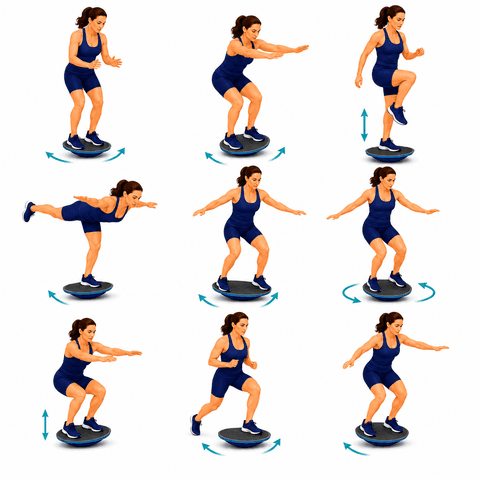
What it helps
Challenges the ankle to react and steady itself on an unstable surface — the control that helps prevent rolls and falls.
How to do it
- Stand near a counter for support and place both feet on a balance or wobble board.
- Slowly tilt the board forward, back, and side to side under control.
- Progress toward more movement as your steadiness improves.
Tips
- Keep a hand or fingertip on support until you feel secure.
Commonly done as 2-3 sets, several times a week.
Where this appears in recovery
Balance Board Training is part of 17 recovery programs, most often at the strength building (weeks 10–26), advanced recovery (months 3–6) and long-term recovery (months 6–12) stages, among others. Each program shows how it fits alongside the other movements:
- Fasciotomy (Compartment Syndrome) exercise guide
- Ankle ORIF (Trimalleolar) exercise guide
- Triple Arthrodesis exercise guide
- Ankle Arthroscopy (Cartilage Repair) exercise guide
- Posterior Tibial Tendon Reconstruction exercise guide
- Lisfranc Injury ORIF exercise guide
- Ankle Arthroscopy (Debridement) exercise guide
- Total Ankle Arthroplasty exercise guide
- Tibial Shaft Fracture ORIF exercise guide
- Brostrom Procedure (Lateral Ankle Ligament Reconstruction) exercise guide
- Peroneal Tendinopathy exercise guide
- Chronic Ankle Instability exercise guide
- …and 5 more
All exercise guides · Condition guides · Recovery education
These are general exercise guides, not a personal prescription. The repetitions and frequency shown are what's commonly used — your own surgeon or therapist may advise something different, and their guidance comes first.