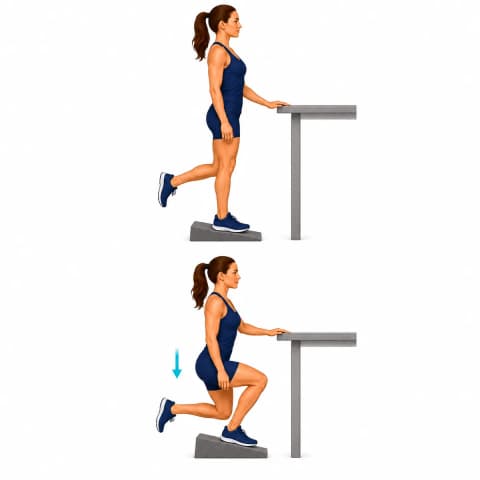
Single-Leg Decline Squat
A slow, controlled squat on one leg on a slight decline — the targeted loading exercise for the kneecap tendon.
What it helps
Slow, controlled loading on a decline is the targeted way to rebuild the kneecap tendon's strength and capacity — the specific loading a tendon needs to recover and tolerate activity again.
How to do it
- Stand on the affected leg on a small decline — a foam wedge, or the front of your foot on a thick book (about a 20–25° slope), heel lower than toes.
- Keep your trunk upright. Slowly bend the knee to lower yourself, taking 3–4 seconds down.
- Pause briefly, then take 3–4 seconds to rise back up. Slow and controlled is the whole point.
- Hold a rail or counter for balance as needed.
Tips
- Some tendon discomfort during the loading is acceptable and usually settles afterward; sharp or steadily worsening pain means ease the depth or load.
- Start with both legs (or a smaller range) and progress to single-leg and deeper as it allows.
- The decline is what focuses the work on the tendon — a flat squat doesn't do the same job.
Commonly done as 3 sets of 15 sets of 3–4 sec down, 3–4 up, every other day.
Where this appears in recovery
Single-Leg Decline Squat is part of 7 recovery programs, most often at the return to running (months 5–9), return to running (months 3–6) and advanced strengthening (months 6–9) stages, among others. Each program shows how it fits alongside the other movements:
All exercise guides · Condition guides · Recovery education
These are general exercise guides, not a personal prescription. The repetitions and frequency shown are what's commonly used — your own surgeon or therapist may advise something different, and their guidance comes first.