Return-to-Sport Conditioning
Overall fitness and resilience work to support a confident return.
What it helps
Overall fitness and resilience work that prepares your whole body for a confident return to sport.
How to do it
- Combine strength, endurance, balance and controlled sport drills.
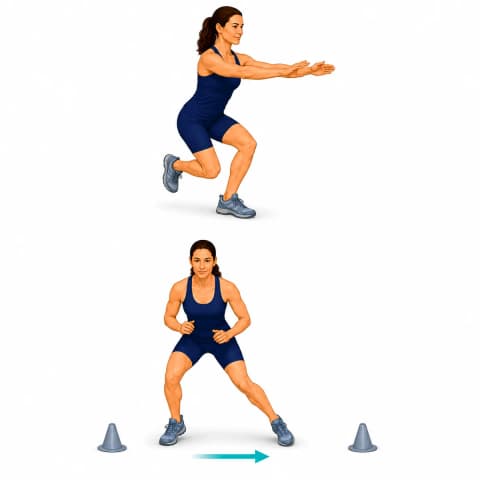
- Single-leg work — a slow, shallow squat on one leg — builds the control that sport asks for.
- Add agility drills such as side-to-side shuffles between two markers, staying controlled rather than fast.
- Keep up calf-strength work alongside.
Tips
- A gradual, well-rounded build helps protect against re-injury.
- Quality of movement comes before speed.
Commonly done ongoing.
Where this appears in recovery
Return-to-Sport Conditioning is part of 31 recovery programs, most often at the long-term recovery (months 6–12), return to contact sport (months 9–15) and return to sport (months 9–18) stages, among others. Each program shows how it fits alongside the other movements:
- Clavicle Fracture ORIF exercise guide
- Latarjet Procedure exercise guide
- ACL Revision Reconstruction exercise guide
- PCL Reconstruction exercise guide
- Distal Clavicle Excision exercise guide
- Achilles Tendon Repair exercise guide
- Superior Capsular Reconstruction exercise guide
- Arthroscopic Rotator Cuff Repair exercise guide
- Distal Biceps Tendon Repair exercise guide
- Bankart Repair (Shoulder Stabilization) exercise guide
- AC Joint Reconstruction exercise guide
- Total Shoulder Arthroplasty (Anatomic) exercise guide
- …and 19 more
All exercise guides · Condition guides · Recovery education
These are general exercise guides, not a personal prescription. The repetitions and frequency shown are what's commonly used — your own surgeon or therapist may advise something different, and their guidance comes first.