Passive Hip Range of Motion (Circumduction)
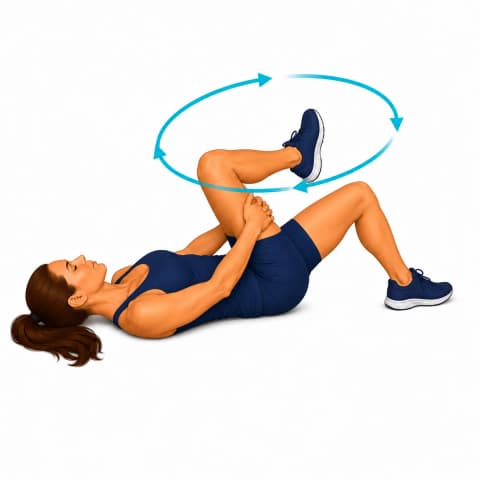
Someone else, or your own hands, circles the hip gently — the joint moves without the muscles working.
What it helps
Keeps the joint surfaces and the capsule gliding against each other after surgery, which is what prevents the internal scarring that stiffens a hip and is difficult to undo. Doing it passively means the healing tissues are moved without being loaded.
How to do it
- Lie on your back with the operated leg straight and relaxed.
- Bend the hip and knee up, using your hands behind the thigh or with a helper supporting the leg.
- Move the leg slowly in a circle — up, out to the side, around and back down — keeping the leg completely relaxed throughout.
- Circle in one direction, then reverse. Stay within the range your surgeon has allowed.
Tips
- The leg is being carried, not lifted. If your hip muscles are working, the exercise is not doing its job.
- Small and frequent beats large and occasional — several short sessions through the day is the usual advice.
- Your surgeon may have set limits on how far to bend or rotate the hip; those limits come before the circle.
Commonly done as 2–3 sets of 10 circles each way, several times daily.
Where this appears in recovery
Passive Hip Range of Motion (Circumduction) is part of 4 recovery programs, most often at the protected healing (weeks 0–2), restoring motion (weeks 2–6) and protected healing (weeks 0–3) stages, among others. Each program shows how it fits alongside the other movements:
All exercise guides · Condition guides · Recovery education
These are general exercise guides, not a personal prescription. The repetitions and frequency shown are what's commonly used — your own surgeon or therapist may advise something different, and their guidance comes first.