Hip Abduction
Strengthens the outer hip while you stay off the foot.
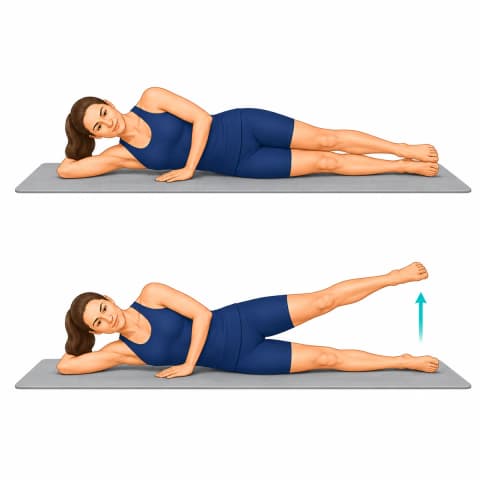
What it helps
Strengthens the outer-hip muscles that keep your hip level and steady — strength you can build without putting any weight through your healing foot.
How to do it
- Lie on your side with the surgical leg on top and both legs straight.
- Rest your head on your lower arm and your upper hand on the floor in front of you.
- Lift the top leg a comfortable distance, keeping it in line with your body.
- Lower slowly.
Tips
- Keep your toes pointing forward, not up toward the ceiling — that is what keeps the work in the outer hip.
- Don't let the leg drift forward as it rises.
- A moderate lift done well beats a high one done badly.
Commonly done as 2-3 sets of 10, daily.
Where this appears in recovery
Hip Abduction is part of 22 recovery programs, most often at the immediate recovery (weeks 0–2), non-weight-bearing (weeks 2–6) and locked in extension (weeks 0–4) stages, among others. Each program shows how it fits alongside the other movements:
- Distal Fibula Fracture ORIF exercise guide
- Lapidus Bunionectomy exercise guide
- Subtalar Fusion exercise guide
- First MTP Fusion (Hallux Rigidus) exercise guide
- Ankle Fusion (Tibiotalar Arthrodesis) exercise guide
- Ankle ORIF (Trimalleolar) exercise guide
- Achilles Tendon Reconstruction exercise guide
- Triple Arthrodesis exercise guide
- Triple Arthrodesis exercise guide
- Quadriceps Tendon Repair exercise guide
- Flexor Tendon Repair (Leg) exercise guide
- Ankle Arthroscopy (Cartilage Repair) exercise guide
- …and 10 more
All exercise guides · Condition guides · Recovery education
These are general exercise guides, not a personal prescription. The repetitions and frequency shown are what's commonly used — your own surgeon or therapist may advise something different, and their guidance comes first.