Dynamic Balance Training
Challenges balance with movement to prepare for activity and sport.
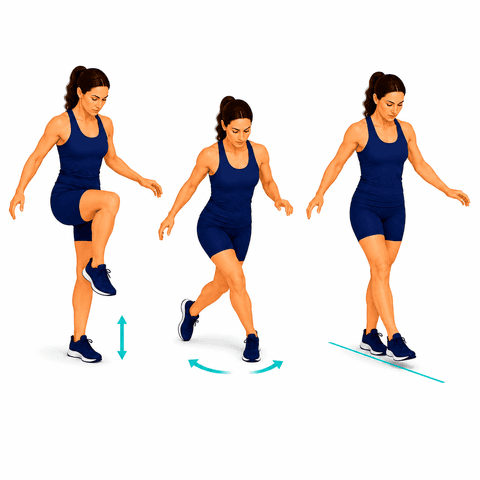
What it helps
Challenges your balance with movement, preparing you for the unpredictable demands of daily life and activity.
How to do it
- Practice controlled single-leg balance, then add reaching or gentle movement.
- Progress to uneven surfaces as able.
Tips
- Keep support nearby as you progress.
Commonly done as 2-3 sets, several times a week.
Where this appears in recovery
Dynamic Balance Training is part of 10 recovery programs, typically at the advanced recovery (months 3–6), long-term recovery (months 6–12) and return to impact (months 6–12) stages. Each program shows how it fits alongside the other movements:
- Achilles Tendon Repair exercise guide
- Cheilectomy (Big Toe) exercise guide
- Ankle ORIF (Trimalleolar) exercise guide
- Ankle Arthroscopy (Cartilage Repair) exercise guide
- Hammertoe Correction exercise guide
- Medial Displacement Calcaneal Osteotomy exercise guide
- Morton's Neuroma Excision exercise guide
- Ankle ORIF (Bimalleolar) exercise guide
- Lisfranc Injury ORIF exercise guide
- Ankle Arthroscopy (Debridement) exercise guide
All exercise guides · Condition guides · Recovery education
These are general exercise guides, not a personal prescription. The repetitions and frequency shown are what's commonly used — your own surgeon or therapist may advise something different, and their guidance comes first.