Upper Trap & Levator Stretch
Eases tension in the muscles that run from the neck to the shoulder.
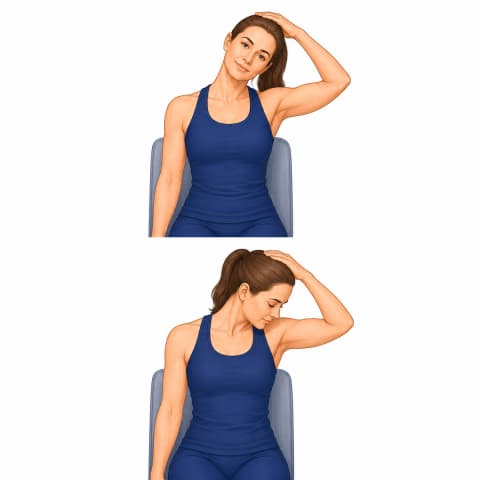
What it helps
Loosens the tight neck-to-shoulder muscles that often build up tension and pull on the neck, easing stiffness and discomfort.
How to do it
- Sit or stand tall. Gently tip one ear toward that shoulder until you feel a comfortable stretch down the opposite side of your neck.
- Rest the hand on that side lightly on your head — resting only, no pulling.
- For the back corner of the neck, turn your nose down toward your armpit and ease gently forward.
- Hold each comfortably, then switch sides.
Tips
- Gentle and comfortable — never force the neck.
- Keep the opposite shoulder relaxed down, not hiked up.
Commonly done as 2–3 each side sets of Hold 20–30 seconds, daily.
Where this appears in recovery
Upper Trap & Levator Stretch is part of 28 recovery programs, most often at the protected healing (weeks 0–2), protected healing (weeks 0–3) and full motion (weeks 2–6) stages, among others. Each program shows how it fits alongside the other movements:
- Clavicle Fracture ORIF exercise guide
- Latarjet Procedure exercise guide
- Distal Clavicle Excision exercise guide
- Superior Capsular Reconstruction exercise guide
- Superior Capsular Reconstruction exercise guide
- Arthroscopic Rotator Cuff Repair exercise guide
- Proximal Humerus Fracture ORIF exercise guide
- Bankart Repair (Shoulder Stabilization) exercise guide
- AC Joint Reconstruction exercise guide
- Total Shoulder Arthroplasty (Anatomic) exercise guide
- SLAP Repair exercise guide
- Open Rotator Cuff Repair exercise guide
- …and 16 more
All exercise guides · Condition guides · Recovery education
These are general exercise guides, not a personal prescription. The repetitions and frequency shown are what's commonly used — your own surgeon or therapist may advise something different, and their guidance comes first.