Arm Nerve Glides
Gentle movements that help a neck nerve slide freely down the arm.
What it helps
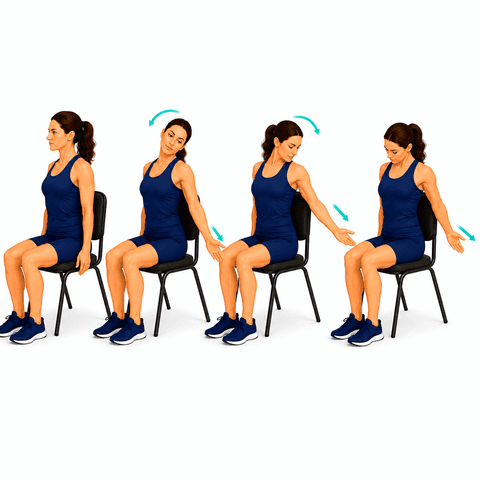
Helps an irritated neck nerve glide freely down the arm, which can ease arm pain, tingling, or numbness. Gentle, repeated motion — never forced.
How to do it
- Sit or stand tall. Start with the affected arm out to the side, elbow bent, palm up.
- Slowly straighten the elbow and ease the arm out while gently tilting your head AWAY — then return as you tilt the head back toward that side.
- Move smoothly in and out of the range, like flossing — never holding at the end or pushing into symptoms.
Tips
- Gentle is the rule — ease back the moment it provokes sharp or shooting arm symptoms.
- Small, smooth, repeated movements — not a hard stretch.
- Stop and check with your care team if symptoms steadily worsen.
Commonly done as 2–3 times sets of 10–15 slow glides, daily.
Where this appears in recovery
Arm Nerve Glides is part of 41 recovery programs, most often at the protected healing (weeks 0–3), bone healing (weeks 3–12) and immediate recovery (weeks 0–2) stages, among others. Each program shows how it fits alongside the other movements:
- Latarjet Procedure exercise guide
- Latarjet Procedure exercise guide
- Cervical Laminoplasty exercise guide
- Distal Biceps Tendon Repair exercise guide
- Revision ACDF exercise guide
- Revision ACDF exercise guide
- Proximal Humerus Fracture ORIF exercise guide
- Total Shoulder Arthroplasty (Anatomic) exercise guide
- Open Rotator Cuff Repair exercise guide
- Open Rotator Cuff Repair exercise guide
- Distal Humerus ORIF exercise guide
- Distal Humerus ORIF exercise guide
- …and 29 more
All exercise guides · Condition guides · Recovery education
These are general exercise guides, not a personal prescription. The repetitions and frequency shown are what's commonly used — your own surgeon or therapist may advise something different, and their guidance comes first.