Upper Body Conditioning
Keeps your arms and shoulders strong — helpful for crutches and staying active.
What it helps
Keeps your arms and shoulders strong — especially helpful for using crutches and staying active during recovery.
How to do it
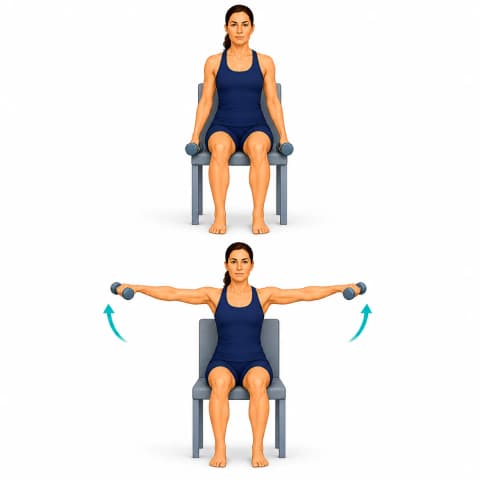
- Sit tall in a chair without arms, both feet flat on the floor and your back supported.
- Hold a light weight in each hand, arms relaxed at your sides, palms turned in toward your thighs.
- Raise both arms out to the sides until they are level with your shoulders.
- Lower them slowly back to your sides.
Tips
- Stay seated and supported while you're non-weight-bearing.
- Light weights are plenty — a resistance band, or no weight at all, works just as well.
- The lift stops at shoulder height.
Commonly done a few times a week.
Where this appears in recovery
Upper Body Conditioning is part of 84 recovery programs, most often at the return to activity (months 3–6), advanced strengthening (months 6–9) and return to contact sport (months 9–15) stages, among others. Each program shows how it fits alongside the other movements:
- Clavicle Fracture ORIF exercise guide
- Latarjet Procedure exercise guide
- Latarjet Procedure exercise guide
- Soft Tissue Mass Excision (Deep) exercise guide
- Distal Radius Fracture ORIF exercise guide
- Distal Radius Fracture ORIF exercise guide
- Distal Clavicle Excision exercise guide
- Distal Clavicle Excision exercise guide
- Achilles Tendon Repair exercise guide
- Superior Capsular Reconstruction exercise guide
- Superior Capsular Reconstruction exercise guide
- Arthroscopic Rotator Cuff Repair exercise guide
- …and 72 more
All exercise guides · Condition guides · Recovery education
These are general exercise guides, not a personal prescription. The repetitions and frequency shown are what's commonly used — your own surgeon or therapist may advise something different, and their guidance comes first.