Thoracic Extension Mobility
Restores movement in the upper back so the neck does not have to compensate.
What it helps
The upper back and the neck share the work of holding the head upright. When the upper back is stiff — common after any period of guarded posture — the neck takes on more of that load. Restoring upper-back extension gives the cervical spine less to compensate for.
How to do it
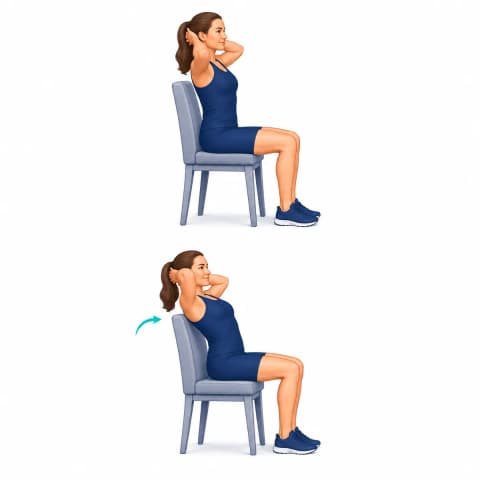
- Sit in a firm chair with your feet flat and your hands resting behind your head, elbows forward.
- Keeping your low back still, gently arch backward over the top of the chair, opening through the chest.
- Return to upright without forcing the movement.
Tips
- The motion comes from the upper back, not the neck — the head stays in line with the body.
- A gentle stretch across the chest is expected; sharp pain is not.
Commonly done as 1-2 sets of 8-10, once or twice a day.
Where this appears in recovery
Thoracic Extension Mobility is part of 13 recovery programs, most often at the strength & function (weeks 6–12), gentle motion (weeks 6–12) and early recovery (weeks 2–6) stages, among others. Each program shows how it fits alongside the other movements:
- Cervical Laminoplasty exercise guide
- Revision ACDF exercise guide
- Anterior Cervical Corpectomy and Fusion exercise guide
- Cervical Hardware Removal exercise guide
- Cervical Laminectomy exercise guide
- Cervical Microdiscectomy (Posterior) exercise guide
- Cervical Microdiscectomy (Posterior) exercise guide
- Posterior Cervical Fusion exercise guide
- Posterior Cervical Fusion exercise guide
- Cervical Disc Replacement exercise guide
- Cervical Disc Replacement exercise guide
- Thoracic Laminectomy exercise guide
- …and 1 more
All exercise guides · Condition guides · Recovery education
These are general exercise guides, not a personal prescription. The repetitions and frequency shown are what's commonly used — your own surgeon or therapist may advise something different, and their guidance comes first.