Sleeper Stretch
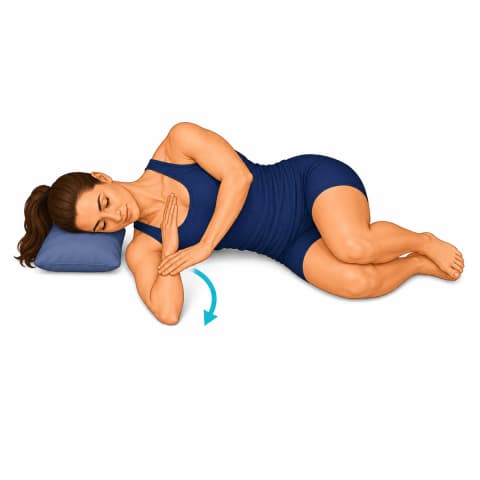
Stretches the back of the shoulder capsule, which is often tight and limits motion.
What it helps
Loosens the back of the shoulder capsule, which commonly tightens and restricts reaching — restoring smooth motion and easing the pinch at the front of the shoulder.
How to do it
- Lie on your side on the affected shoulder, arm out in front, elbow bent 90° so the forearm points up.
- With your other hand, gently press the forearm down toward the bed, feeling a stretch in the back of the shoulder.
- Hold the gentle stretch; don't force it.
Tips
- Roll slightly back off the shoulder so you're not crushing it.
- A gentle, steady stretch — never sharp.
Commonly done as 3 sets of Hold 20–30 sec, daily.
Where this appears in recovery
Sleeper Stretch is part of 22 recovery programs, most often at the bone healing (weeks 3–12), full motion (weeks 2–6) and active motion (months 3–5) stages, among others. Each program shows how it fits alongside the other movements:
- Latarjet Procedure exercise guide
- Distal Clavicle Excision exercise guide
- Superior Capsular Reconstruction exercise guide
- Arthroscopic Rotator Cuff Repair exercise guide
- Arthroscopic Rotator Cuff Repair exercise guide
- Proximal Humerus Fracture ORIF exercise guide
- Bankart Repair (Shoulder Stabilization) exercise guide
- AC Joint Reconstruction exercise guide
- Total Shoulder Arthroplasty (Anatomic) exercise guide
- SLAP Repair exercise guide
- Open Rotator Cuff Repair exercise guide
- Biceps Tenodesis (Arthroscopic) exercise guide
- …and 10 more
All exercise guides · Condition guides · Recovery education
These are general exercise guides, not a personal prescription. The repetitions and frequency shown are what's commonly used — your own surgeon or therapist may advise something different, and their guidance comes first.