Scapular Y-T-W
Strengthens the muscles between and around the shoulder blades.
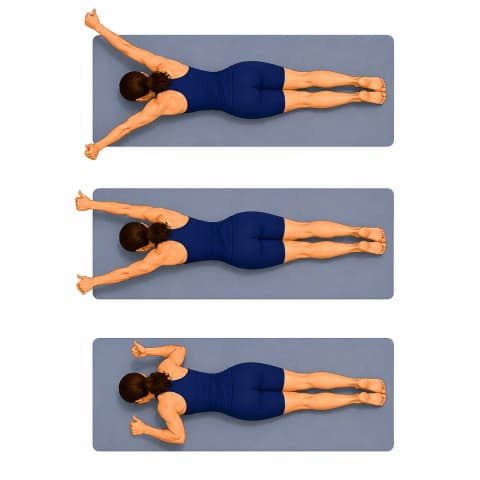
What it helps
Builds the mid-back and shoulder-blade muscles that anchor and position the shoulder — the foundation that lets it move and lift without pinching.
How to do it
- Lie face-down with your arms hanging and your thumbs pointing up.
- Y: raise both arms overhead into a wide Y, squeezing the shoulder blades together. Lower.
- T: raise both arms straight out to the sides into a T. Lower.
- W: bend your elbows and pull them down and back into a W, squeezing the blades. Lower.
Tips
- Lead with squeezing the shoulder blades, not shrugging.
- Light or no weight; quality over quantity.
- Thumbs stay pointing up throughout.
- If lying face-down is not comfortable, the same three shapes work bent forward at a table.
Commonly done as 2 sets of 8–10 each, a few times a week.
Where this appears in recovery
Scapular Y-T-W is part of 62 recovery programs, most often at the strength building (weeks 6–12), strength building (months 3–6) and advanced strengthening (months 6–9) stages, among others. Each program shows how it fits alongside the other movements:
- Clavicle Fracture ORIF exercise guide
- Latarjet Procedure exercise guide
- Latarjet Procedure exercise guide
- Distal Clavicle Excision exercise guide
- Distal Clavicle Excision exercise guide
- Superior Capsular Reconstruction exercise guide
- Superior Capsular Reconstruction exercise guide
- Arthroscopic Rotator Cuff Repair exercise guide
- Arthroscopic Rotator Cuff Repair exercise guide
- Distal Biceps Tendon Repair exercise guide
- Distal Biceps Tendon Repair exercise guide
- Proximal Humerus Fracture ORIF exercise guide
- …and 50 more
All exercise guides · Condition guides · Recovery education
These are general exercise guides, not a personal prescription. The repetitions and frequency shown are what's commonly used — your own surgeon or therapist may advise something different, and their guidance comes first.