Rhythmic Stabilization
Quick, gentle holds against light pushes that train the shoulder to stay stable and controlled.
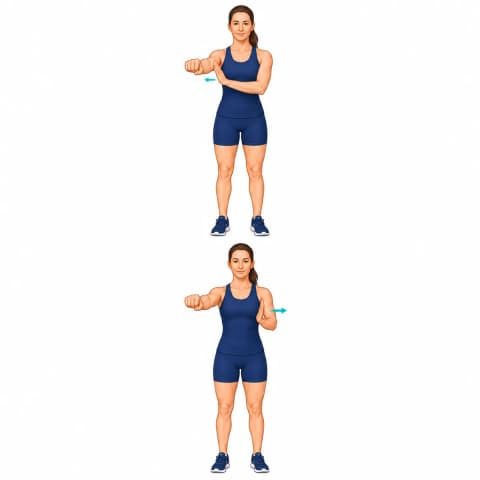
What it helps
Trains the shoulder's stabilizing muscles to react and hold the joint steady — building the dynamic control that keeps the shoulder secure during everyday movement.
How to do it
- Hold the arm in a comfortable position (e.g., in front, elbow slightly bent). Have a partner or your other hand apply light, quick pushes from different directions.
- Resist just enough to keep the arm steady — small holds, not big movements.
- Progress to a hand on a wall or ball, gently shifting weight through the arm.
Tips
- The arm barely moves — you're reacting to keep it still.
- Light and controlled; this is about control, not strength.
Commonly done as 2–3 sets of 30–60 sec, most days.
Where this appears in recovery
Rhythmic Stabilization is part of 44 recovery programs, most often at the strength building (weeks 6–12), strength building (months 3–6) and advanced strengthening (months 6–9) stages, among others. Each program shows how it fits alongside the other movements:
- Clavicle Fracture ORIF exercise guide
- Latarjet Procedure exercise guide
- Latarjet Procedure exercise guide
- Distal Clavicle Excision exercise guide
- Distal Clavicle Excision exercise guide
- Superior Capsular Reconstruction exercise guide
- Superior Capsular Reconstruction exercise guide
- Arthroscopic Rotator Cuff Repair exercise guide
- Arthroscopic Rotator Cuff Repair exercise guide
- Proximal Humerus Fracture ORIF exercise guide
- Proximal Humerus Fracture ORIF exercise guide
- Bankart Repair (Shoulder Stabilization) exercise guide
- …and 32 more
All exercise guides · Condition guides · Recovery education
These are general exercise guides, not a personal prescription. The repetitions and frequency shown are what's commonly used — your own surgeon or therapist may advise something different, and their guidance comes first.