Progressive Planks
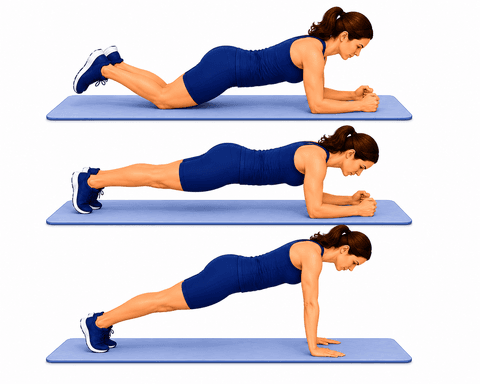
Builds whole-core endurance, progressing from easier to harder holds.
What it helps
Builds whole-core endurance from easier to harder holds — a strong core supports your spine and everything you lift and carry.
How to do it
- Start with a plank on knees and forearms, body in a straight line, core braced.
- Hold for a comfortable time, keeping your back from sagging.
- Progress to a full plank and longer holds as you get stronger.
Tips
- Never let your low back sag — drop to your knees first.
- Build time gradually.
Commonly done as hold 15–45s sets of 2–3 reps, most days.
Where this appears in recovery
Progressive Planks is part of 24 recovery programs, most often at the long-term recovery (months 6–12), advanced recovery (months 3–6) and strengthen (weeks 8–12) stages, among others. Each program shows how it fits alongside the other movements:
- Lateral Lumbar Interbody Fusion (LLIF / XLIF / OLIF) exercise guide
- Revision Lumbar Fusion exercise guide
- Lumbar Microdiscectomy exercise guide
- Posterior Spinal Fusion for Scoliosis exercise guide
- Sacroiliac Joint Fusion exercise guide
- Anterior Lumbar Interbody Fusion (ALIF) exercise guide
- Anterior Scoliosis Correction exercise guide
- Lumbar Laminectomy exercise guide
- Thoracic Fusion exercise guide
- Lumbar Pedicle Subtraction Osteotomy exercise guide
- Lumbar Disc Replacement exercise guide
- Lumbar Posterolateral Fusion exercise guide
- …and 12 more
All exercise guides · Condition guides · Recovery education
These are general exercise guides, not a personal prescription. The repetitions and frequency shown are what's commonly used — your own surgeon or therapist may advise something different, and their guidance comes first.