Pendulum Swings
Gentle, relaxed swinging that eases the shoulder into motion without the muscles having to work.
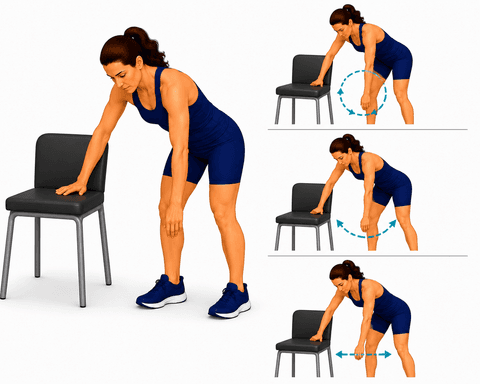
What it helps
Coaxes the shoulder through gentle motion with the muscles relaxed — keeping the joint moving and easing stiffness when active movement is still uncomfortable.
How to do it
- Lean forward and support your good arm on a table or chair, letting the sore arm hang down relaxed.
- Let the arm swing gently — small circles, then forward-and-back and side-to-side — using a gentle sway of your body, not the shoulder muscles.
- Keep it loose and pain-free, like a relaxed pendulum.
Tips
- The movement comes from rocking your body, not from working the shoulder.
- Keep the swings small and comfortable.
Commonly done as 2–3 sets of 1–2 min, a few times a day.
Where this appears in recovery
Pendulum Swings is part of 35 recovery programs, most often at the protected healing (weeks 0–2), protected healing (weeks 0–3) and swelling & finger motion (weeks 0–2) stages, among others. Each program shows how it fits alongside the other movements:
- Clavicle Fracture ORIF exercise guide
- Latarjet Procedure exercise guide
- Distal Radius Fracture ORIF exercise guide
- Distal Clavicle Excision exercise guide
- Superior Capsular Reconstruction exercise guide
- Superior Capsular Reconstruction exercise guide
- Arthroscopic Rotator Cuff Repair exercise guide
- Proximal Humerus Fracture ORIF exercise guide
- Bankart Repair (Shoulder Stabilization) exercise guide
- AC Joint Reconstruction exercise guide
- Total Shoulder Arthroplasty (Anatomic) exercise guide
- SLAP Repair exercise guide
- …and 23 more
All exercise guides · Condition guides · Recovery education
These are general exercise guides, not a personal prescription. The repetitions and frequency shown are what's commonly used — your own surgeon or therapist may advise something different, and their guidance comes first.